
If you’ve been in crypto long enough, you already know this feeling.
Everything looks strong. Headlines are bullish. Prices are flying. People start saying, “This time is different.” Then suddenly… Bitcoin drops 10% in a day. Then 20%. Then fear takes over.
And everyone starts asking the same question:
“Is this the end… or just another cycle?”
To understand what’s happening in 2026, we first need to look at what happened before.
Because Bitcoin doesn’t move randomly. It follows patterns of human behavior, money flow, and leverage.
The First Big Lesson: 2018 — When Hype Died
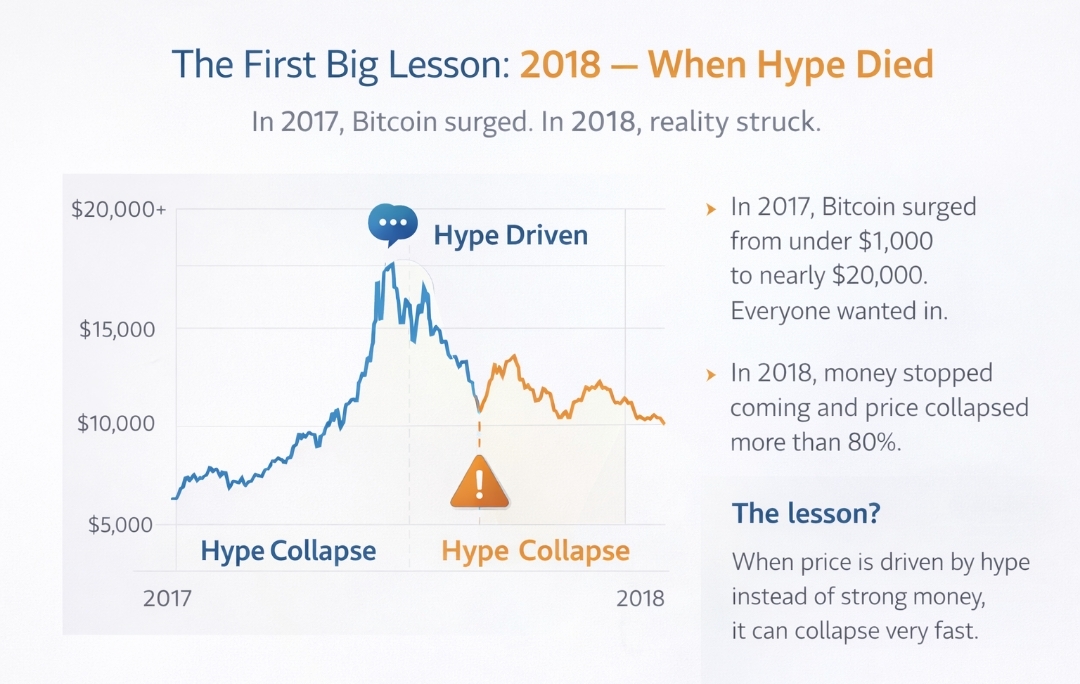 In 2017, Bitcoin went crazy.
It went from under $1,000 to almost $20,000. Everyone was talking about crypto. Taxi drivers, shopkeepers, friends who never invested before — everyone wanted in.
Then in 2018, reality hit.
No big scandal. No major collapse.
Just one thing: buyers disappeared.
When new money stopped coming, price started falling. Slowly at first. Then faster. Panic spread. People sold. Bitcoin dropped more than 80%.
The lesson?
When price is driven by hype instead of strong money, it can collapse very fast.
The Second Big Lesson: 2022 — When the System Broke
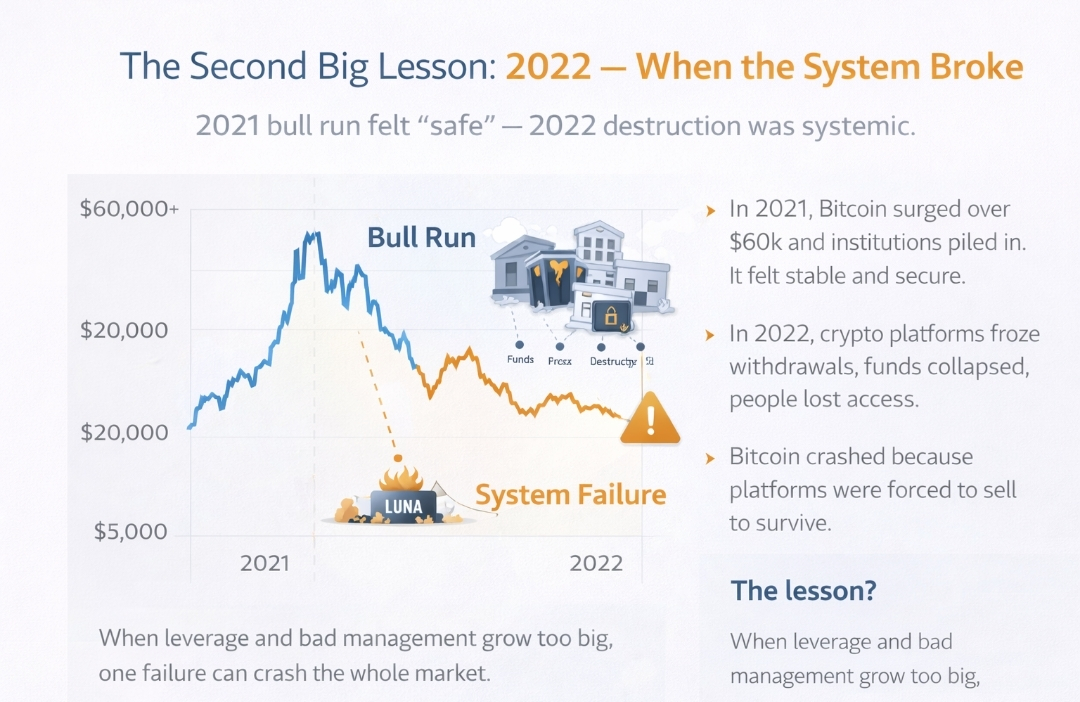 2021 was another massive bull run. Bitcoin crossed $60k. Institutions joined. Big companies invested. It felt “safe” now.
Then 2022 happened.
This time, it wasn’t just hype dying.
It was the system breaking.
Big crypto companies failed. Platforms froze withdrawals. Funds went bankrupt. Trust was destroyed.
People couldn’t even access their own money.
So selling wasn’t optional. It was forced.
Bitcoin crashed again — not just because of fear, but because companies had to sell to survive.
The lesson?
When leverage and bad management grow too big, one failure can crash the whole market.
The 2026 Crash: A Different Kind of Pain
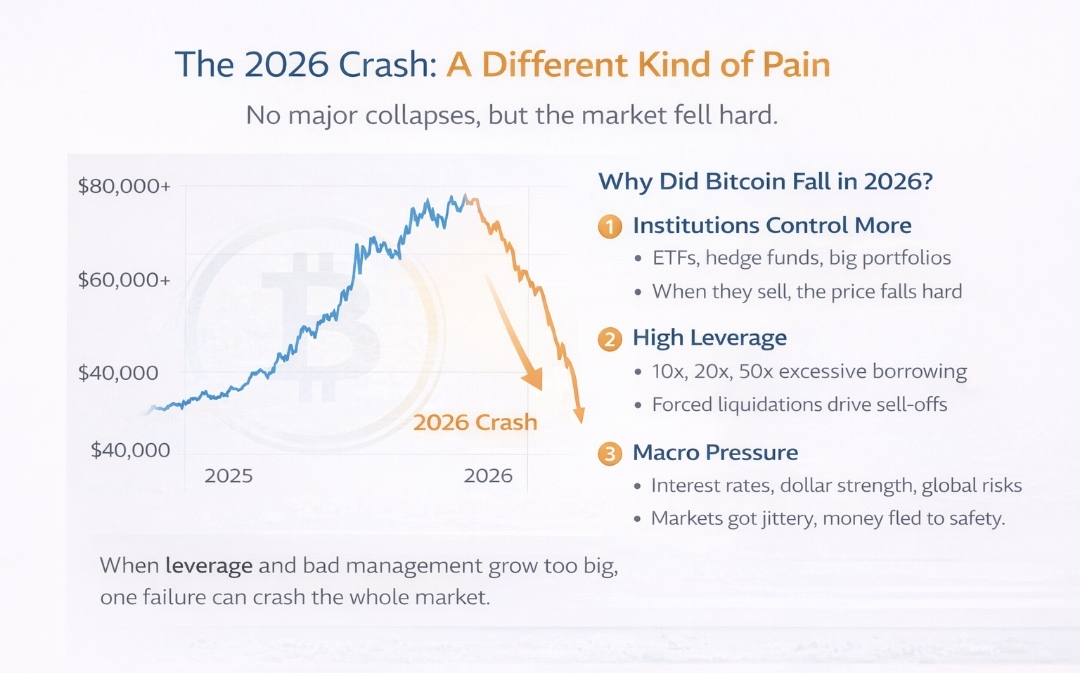 Now let’s talk about 2026.
This crash feels different.
No major exchange has collapsed (so far). No massive fraud exposed (yet). No big platform shut down overnight.
So why did Bitcoin fall so hard?
Three main reasons.
1. Institutions Control More Than Ever
Before, crypto was mostly retail traders.
Now?
ETFs. Funds. Hedge managers. Big portfolios.
When these players buy, price flies. When they sell, price falls hard.
In 2025, institutions pushed Bitcoin to new highs. In 2026, many of them started taking profit.
When big money leaves, small investors can’t stop the fall.
2. Leverage Was Too High Again
Every bull market creates the same problem: greed.
People start using leverage. 10x. 20x. 50x.
They think price will only go up.
Then one bad week comes.
Liquidations start. Positions get closed automatically. Selling creates more selling.
It becomes a chain reaction.
That’s exactly what we saw in early 2026.
Not just people selling. Systems selling for them.
3. Macro Pressure Is Back
Bitcoin doesn’t live in isolation anymore.
It’s connected to:
Interest rates
Tech stocks
Dollar strength
Global politics
When traditional markets become risky, big investors reduce exposure everywhere — including crypto.
In 2026, risk appetite dropped. Money moved to “safer” assets. Crypto suffered.
Why 2026 Is Not Like 2022 (Yet)
 This part is important.
Many people think: “Another 80% crash is coming.”
Maybe. But not automatically.
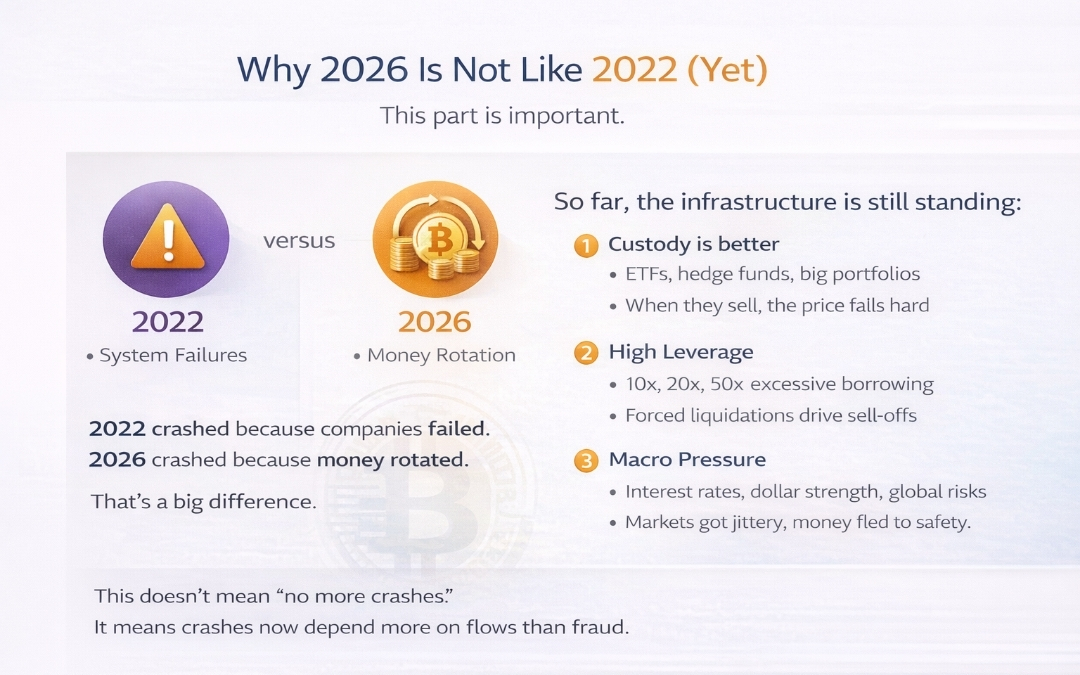
2022 crashed because companies failed. 2026 crashed because money rotated.
That’s a big difference.
So far, the infrastructure is still standing. Custody is better. Regulation is clearer. Audits exist.
This doesn’t mean “no more crashes.”
It means crashes now depend more on flows than fraud.
What Smart Investors Are Watching Now
Instead of emotions, smart investors watch data.
Here are the main signals.
1. ETF Flows
Are institutions buying again? Or still selling?
Positive flows = support. Negative flows = pressure.
2. Exchange Balances
When people move BTC to exchanges, they plan to sell. When they withdraw, they plan to hold.
This shows real intention.
3. Miner Behavior
If miners are selling heavily, it means stress. If they stop selling, pressure reduces.
Miners are like early warning signs.
4. Leverage Levels
High leverage = danger. Low leverage = healthier market.
After crashes, leverage resets. That’s good.
What History Suggests About “What’s Next”
 Let’s be honest.
Nobody knows exact prices.
But history gives ranges.
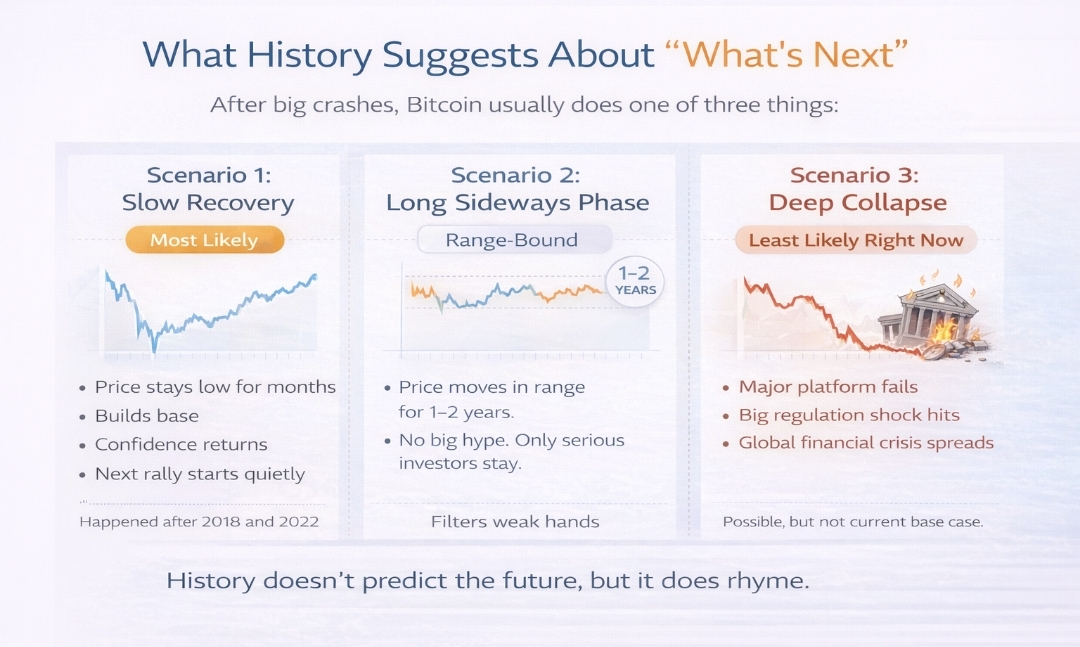
After big crashes, Bitcoin usually does one of three things:
Scenario 1: Slow Recovery (Most Likely)
Price stays low for months. Builds base. Confidence returns. Next rally starts quietly.
This happened after 2018 and 2022.
Scenario 2: Long Sideways Phase
Price moves in range for 1–2 years. No big hype. Only serious investors stay.
This filters weak hands.
Scenario 3: Deep Collapse (Least Likely Right Now)
Only happens if:
Major platform fails
Big regulation shock hits
Global financial crisis spreads
Possible, but not current base case.
What This Means for Regular Investors
Let’s talk practically.
Not theory.
Not hype.
Real life.
If You’re Long-Term
Ask yourself:
Can I hold if price drops another 30%?
If no → you’re overexposed.
Better to reduce stress than chase dreams.
Use DCA. Don’t chase green candles. Don’t panic sell red ones.
If You’re Trading
Respect volatility.
Small position. Clear stop. No revenge trades.
Most people lose in crashes not because of bad analysis — but because of emotions.
If You’re New
This is actually your advantage.
You’re learning in hard times. Not in hype.
That builds discipline.
The Biggest Truth About Bitcoin Cycles
 Here’s something nobody likes to say:
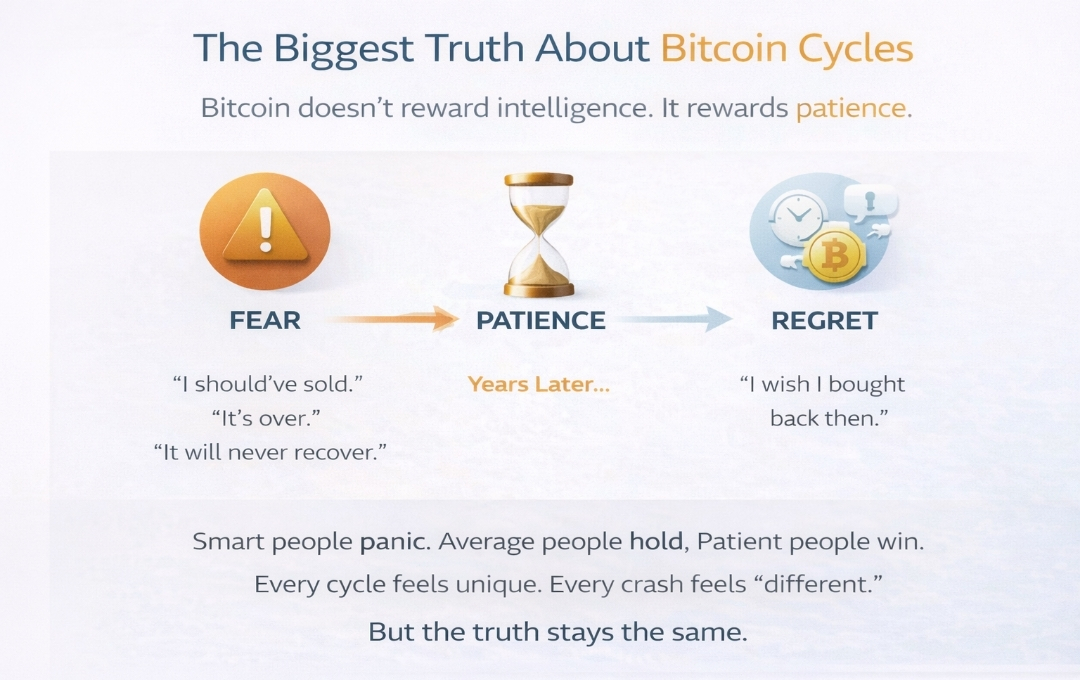
Bitcoin doesn’t reward intelligence. It rewards patience.
Smart people panic. Average people hold. Patient people win.
Every cycle feels unique. Every crash feels “different.”
But fear always sounds the same.
“I should’ve sold.” “It’s over.” “It will never recover.”
Then years later…
People say: “I wish I bought back then.”
Final Thoughts
The 2026 crash is painful. No doubt.
But it’s not meaningless.
It’s a reset.
Excess leverage is gone.
Weak hands exited.
Valuations normalized.
Reality returned.
This is how strong markets are built.
Not in hype. Not in tweets. Not in pumps.
But in silence.
If Bitcoin survives this phase — and history suggests it usually does — the next cycle will start when nobody is paying attention.
And by the time everyone notices…
It will already be too late.
