

Every crypto cycle has its visible stars—DEXs, L2s, memecoins, AI tokens.
And then there is the invisible layer.
The storage engines.
The data availability rails.
The systems that keep decentralized apps alive when millions of users pile in
Walrus Protocol lives in that invisible layer.
Rather than chasing speculative narratives, Walrus is building something far more fundamental: a high-performance decentralized data storage network designed for the next generation of Web3 applications—DePIN, AI agents, gaming worlds, social networks, and real-world data pipelines.
If blockchains are settlement layers…
👉 Walrus wants to be the data layer beneath them.
⚙️ What Walrus Is Really Solving
Modern Web3 is running into a hard wall
Blockchains are expensive for raw data.
Centralized cloud providers undermine decentralization.
AI and gaming apps need massive throughput
DePIN networks require constant data streaming.
Storage systems must be fast and censorship-resistant.
Walrus positions itself as a scalable, decentralized blob-storage network optimized for:
High-volume datasets
Application state
Media files
AI model inputs
DePIN telemetry
Game world data
Instead of forcing every byte onto a main chain, Walrus offloads data into a specialized network—while keeping cryptographic guarantees that the data exists, hasn’t been tampered with, and remains retrievable.
This makes Walrus less of a flashy consumer protocol and more like:
AWS-style infrastructure for decentralized systems.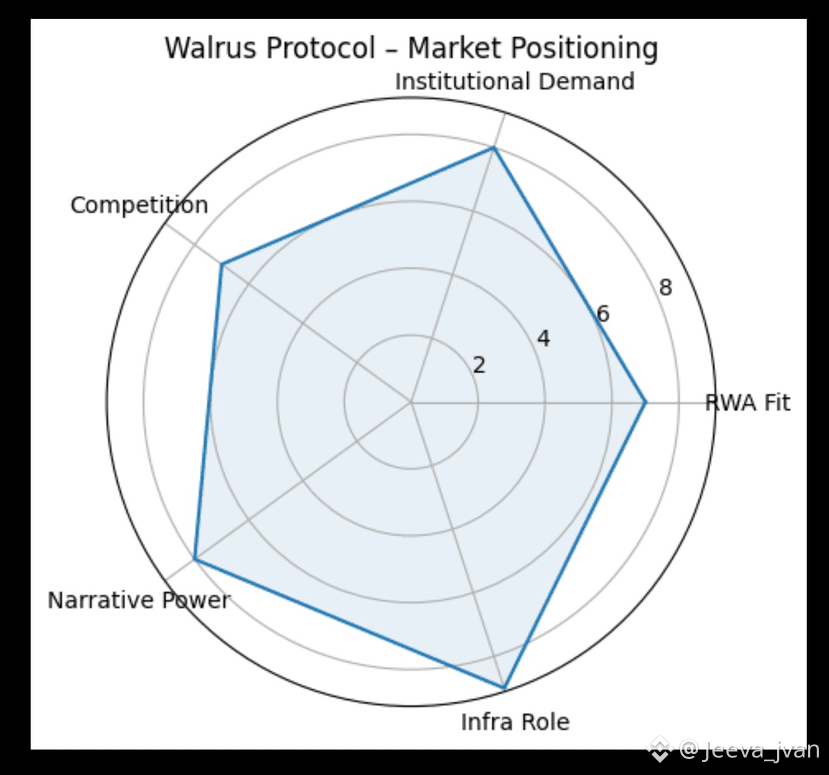
🧠 Architecture Focus: Throughput Over Hype
Walrus leans into engineering-heavy design:
Parallelized storage nodes
Data sharding
Erasure coding
Cryptographic proofs of availability
Incentivized validators / operators
The goal?
✔️ Massive scalability
✔️ Cheap storage per GB
✔️ Fast retrieval
✔️ Network-level redundancy
✔️ Fault tolerance
This puts Walrus squarely in the same conversation as other data-availability or decentralized-storage projects—but with a sharp emphasis on application-first performance rather than pure archival storage.
🌐 Why Walrus Matters in 2026’s Market Narrative
Three megatrends are colliding
1️⃣ AI agents running on-chai
2️⃣ DePIN networks generating real-world dat
3️⃣ Fully on-chain games & metaverses
All three are brutally data-hungry.
Settlement chains alone can’t carry that weight.
That’s why infrastructure protocols like Walrus suddenly become critical.
Not speculative.
Structural.
If crypto becomes a real compute layer for the internet, data availability networks may be among the most valuable primitives in the stack.
Walrus is betting on that future.
🔍 Token Role & Network Economic
While designs evolve, Walrus-style networks typically rely on their native token to
Pay for storage and retrieval
Reward node operato
Secure the network
Govern upgrades
Allocate bandwidth
If Walrus succeeds in onboarding real workloads—AI pipelines, games, enterprise pilots—the token shifts from narrative-driven demand to usage-driven demand.
That transition is often where infrastructure plays separate from purely speculative cycles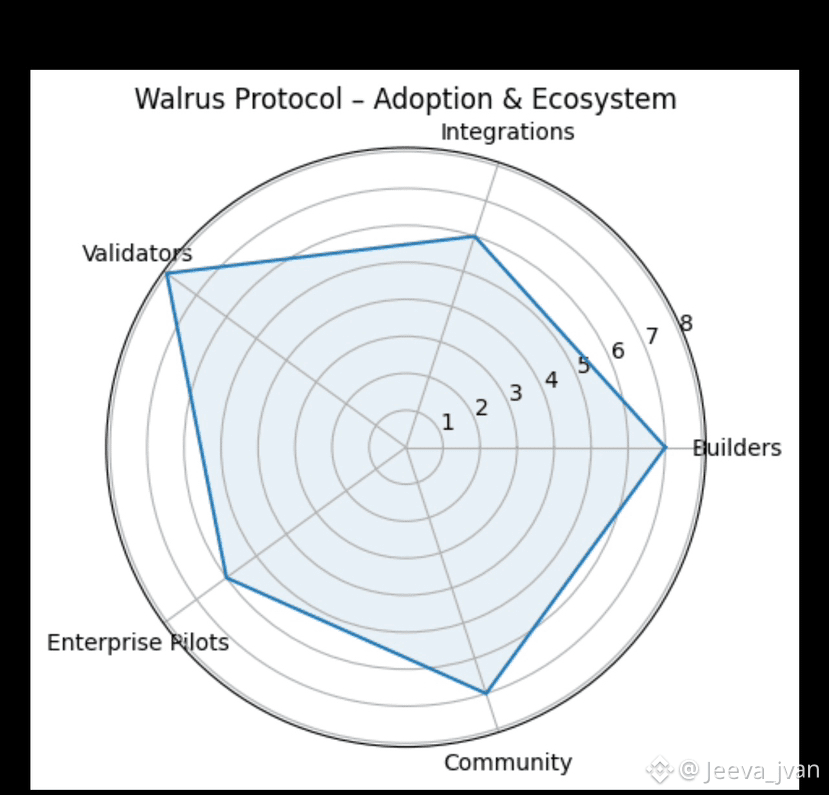
🧭 Strategic Positioning: Where Walrus Competes
Walrus enters a competitive field:
Decentralized storage networks
Dta-availability layers
Rollup backends
DePIN-focused infrastructure
Cloud-hybrid crypto systems
Its differentiation comes from:
🔹 Performance-oriented architecture
🔹 App-specific optimization
🔹 Modular design for chain
🔹 Focus on live data rather than cold archive
🔹 Integration-first mindset
If Dusk is aiming for capital markets…
👉 Walrus is aiming for the application explosion.
📊 Radar Chart Analysis — Walrus Protocol
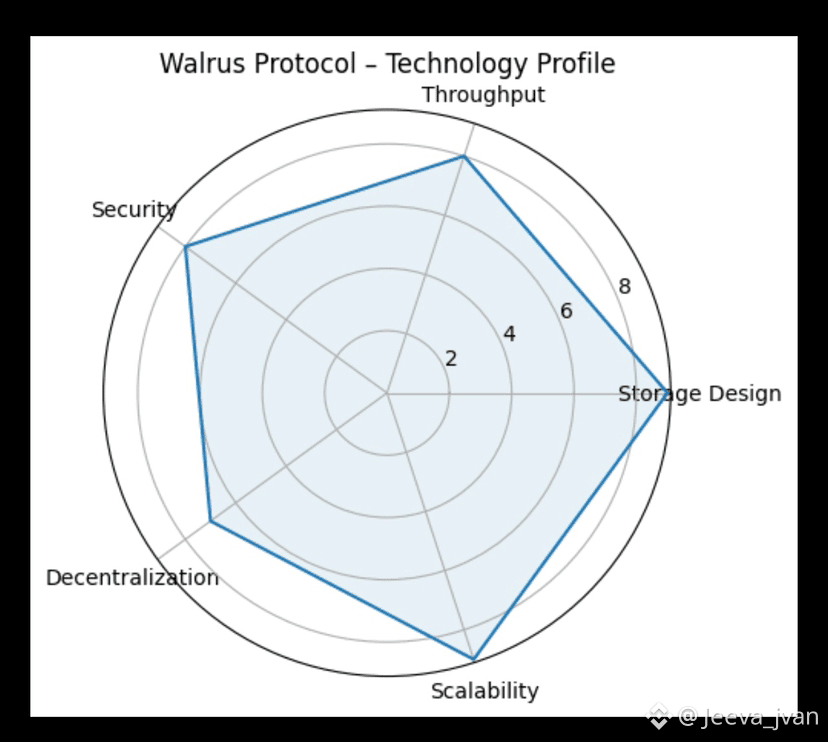
Above you can see three radar-style visuals instead of line charts. These are perfect for research posts, X threads, or carousel slides.
🛠️ 1) Technology Profile
Axes:
Storage Design
Throughput
Security
Decentralization
Scalability
👉 Reading:
Walrus scores strongest on Storage Design + Scalability, signaling a network built for heavy workloads. Decentralization trails slightly—typical for infra in expansion mode.
🌍 2) Market Positionin
Axes:
RWA Fit
Institutional Demand
Competition
Narrative Power
Infrastructure Role
👉 Reading:
Highest on Infrastructure Role and Narrative Power—Walrus fits the “picks-and-shovels” thesis of Web3. Competition is meaningful, which makes partnerships and integrations critical.
🚀 3) Adoption & Ecosystem
Axes
Builders
Integrations
Validators
Enterprise Pilots
Community
👉 Reading:
Validator strength is solid. Growth zones sit in enterprise pilots + developer integrations—exactly what usually drives the next leg of infrastructure adoption. @Walrus 🦭/acc #walrus $WAL

