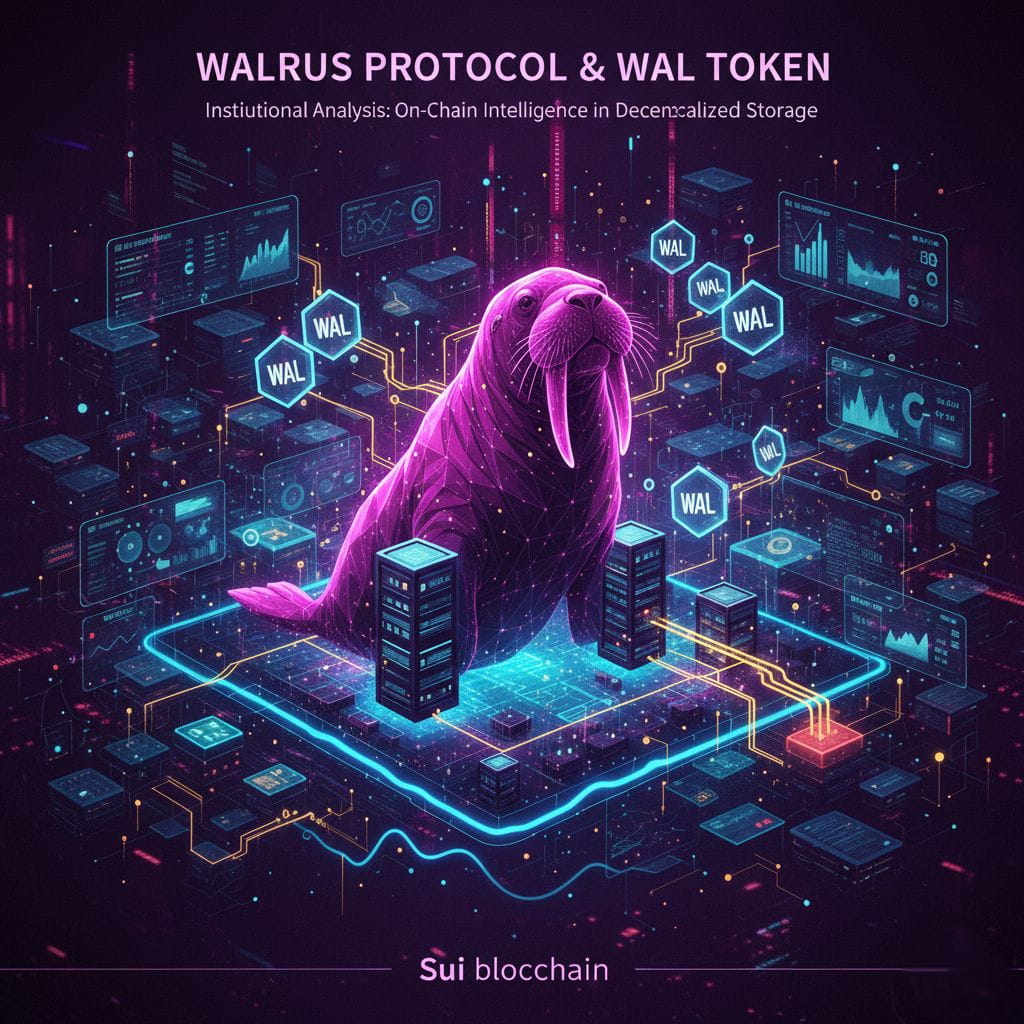
The represents a structural shift in how decentralized infrastructure treats data, accountability, and oversight. Rather than positioning analytics, transparency, and risk monitoring as external services layered on top of a protocol, Walrus embeds these functions directly into its core design. This architectural decision is particularly relevant for institutional stakeholders who require verifiable data integrity, predictable system behavior, and continuous insight into network conditions in order to meet regulatory, fiduciary, and operational standards.
At the foundation of Walrus is its native integration with the blockchain, which enables deterministic execution, parallel transaction processing, and object based state management. These properties are not merely performance optimizations. They allow Walrus to expose granular, real time visibility into storage objects, access patterns, validator behavior, and economic flows. Every stored data object exists as an on chain reference with cryptographic provenance, allowing institutions to trace how data is created, distributed, accessed, and maintained across the network without reliance on trusted intermediaries or opaque reporting layers.
Walrus treats storage not as passive capacity but as an actively monitored economic system. Storage nodes are continuously evaluated through on chain proofs of availability, performance attestations, and economic bonding. These signals are recorded natively and can be analyzed in real time by any observer. This creates a shared and objective data environment where risk indicators such as node concentration, regional dependency, uptime variance, or stake imbalance are immediately visible. For institutions accustomed to model risk management and operational resilience frameworks, this level of transparency aligns closely with existing internal control expectations while removing the need for third party audits to establish baseline trust.
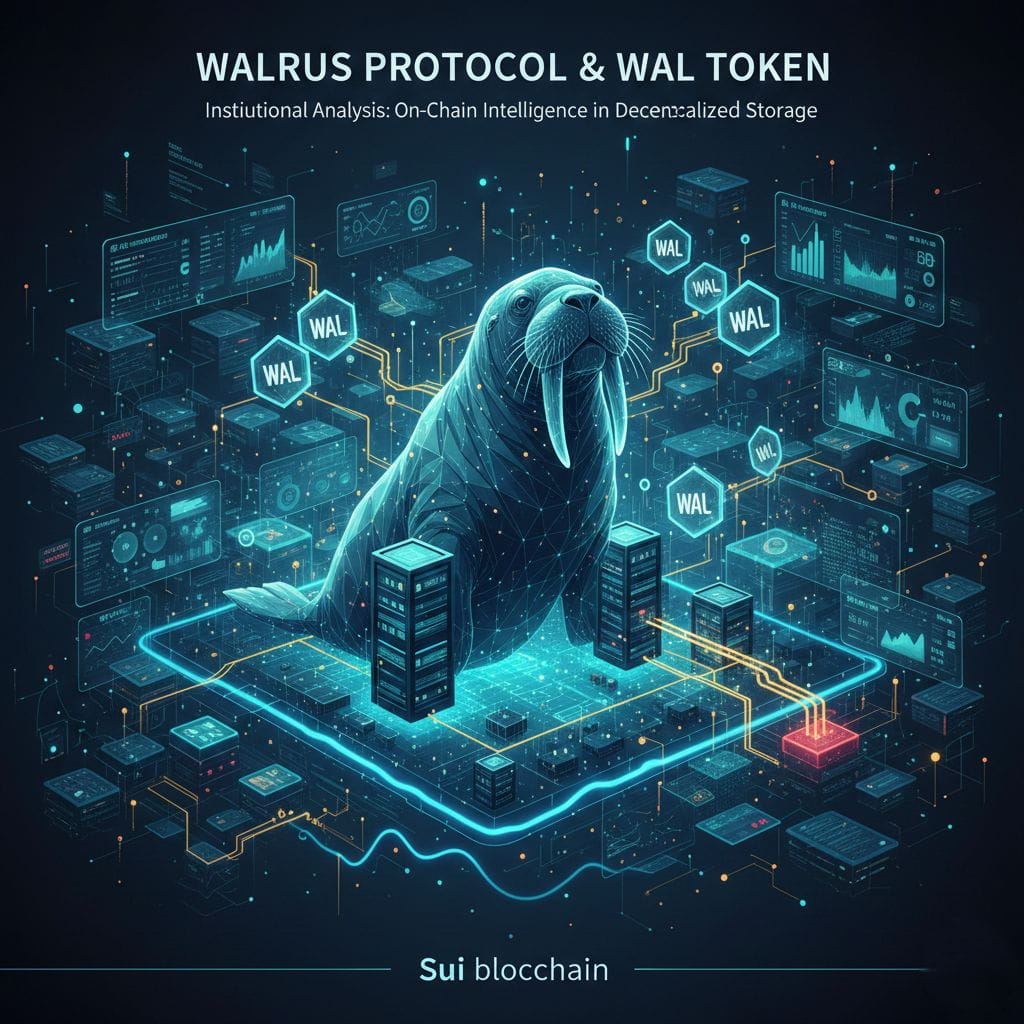
The use of erasure coding and distributed blob storage further strengthens the protocol’s analytical clarity. Because data is fragmented and distributed across independent nodes, Walrus can measure fault tolerance, redundancy margins, and recovery thresholds directly on chain. This allows real time assessment of systemic stress without waiting for failure events to occur. Institutions can model worst case scenarios using live network data rather than historical assumptions, improving the accuracy of risk forecasting and stress testing. The protocol’s architecture effectively transforms storage reliability from a qualitative promise into a continuously quantifiable metric.
Governance within Walrus is similarly data driven. The WAL token is not only a unit of payment but a governance instrument whose use is observable and auditable at all times. Voting power, proposal outcomes, parameter changes, and treasury flows are all recorded on chain with no discretionary abstraction. This creates a governance environment where oversight is inherent rather than procedural. Institutional participants can independently verify whether governance outcomes reflect stakeholder intent, whether economic incentives remain aligned, and whether protocol changes introduce unintended risk. This level of governance transparency addresses long standing concerns regulators have raised around accountability in decentralized systems.
From a compliance perspective, Walrus does not attempt to circumvent regulatory expectations through obscurity. Instead, it offers a framework where compliance alignment becomes technically feasible without centralization. Data availability proofs, immutable audit trails, and deterministic economic logic enable institutions to demonstrate controls, trace asset flows, and document operational behavior using primary source data. While Walrus itself does not impose jurisdiction specific compliance rules, its architecture supports compliance by design, allowing regulated entities to build policy enforcement, reporting, and monitoring layers on top of verifiable protocol data.
Real time data intelligence is also central to how Walrus manages economic sustainability. Storage pricing, reward distribution, and staking incentives are derived from observable network conditions rather than discretionary adjustment. This reduces information asymmetry between protocol operators and users, a critical concern for institutional risk committees. Participants can assess whether pricing reflects actual supply and demand, whether rewards adequately compensate operational risk, and whether inflation dynamics are sustainable over time. Such transparency supports informed capital allocation decisions and reduces the likelihood of sudden structural imbalances.
Crucially, Walrus positions analytics as shared infrastructure rather than privileged insight. All participants, regardless of size, access the same underlying data. This design choice reduces the concentration of informational advantage and aligns with regulatory principles around fair access and market integrity. For banks, asset managers, and custodians exploring decentralized infrastructure, this reduces dependency risk and enhances confidence that critical operational signals are not selectively disclosed or withheld.
In broader context, Walrus reflects a maturation of decentralized infrastructure toward institutional norms without replicating centralized control models. By embedding analytics, transparency, and governance oversight directly into the protocol layer, it demonstrates that decentralized systems can meet the informational rigor demanded by regulated entities while preserving openness and resilience. The protocol does not rely on assurances, marketing narratives, or discretionary reporting. Instead, it offers continuous, cryptographically verifiable insight into its own operation.
As institutions increasingly evaluate blockchain based infrastructure not as speculative assets but as operational substrates, architectures like Walrus become strategically relevant. Its emphasis on native data intelligence, measurable risk, and accountable governance suggests a path forward where decentralized systems can integrate into regulated financial and data environments without compromising either decentralization or oversight. In this sense, Walrus is less a storage protocol in the conventional understanding and more a data governance framework expressed through decentralized technology.