After spending enough time in crypto markets, you stop getting impressed by flashy roadmaps and start paying attention to execution. Most projects never make it past speculation. A few survive long enough to find product–market fit. Very few cross into the territory where institutions actually care. Dusk, heading into 2026, is starting to sit in that last category.
What caught my attention isn’t price action or social sentiment — it’s how the protocol is being positioned around settlement, compliance, and real-world issuance. These are boring words for retail, but they’re the exact keywords institutions filter for.
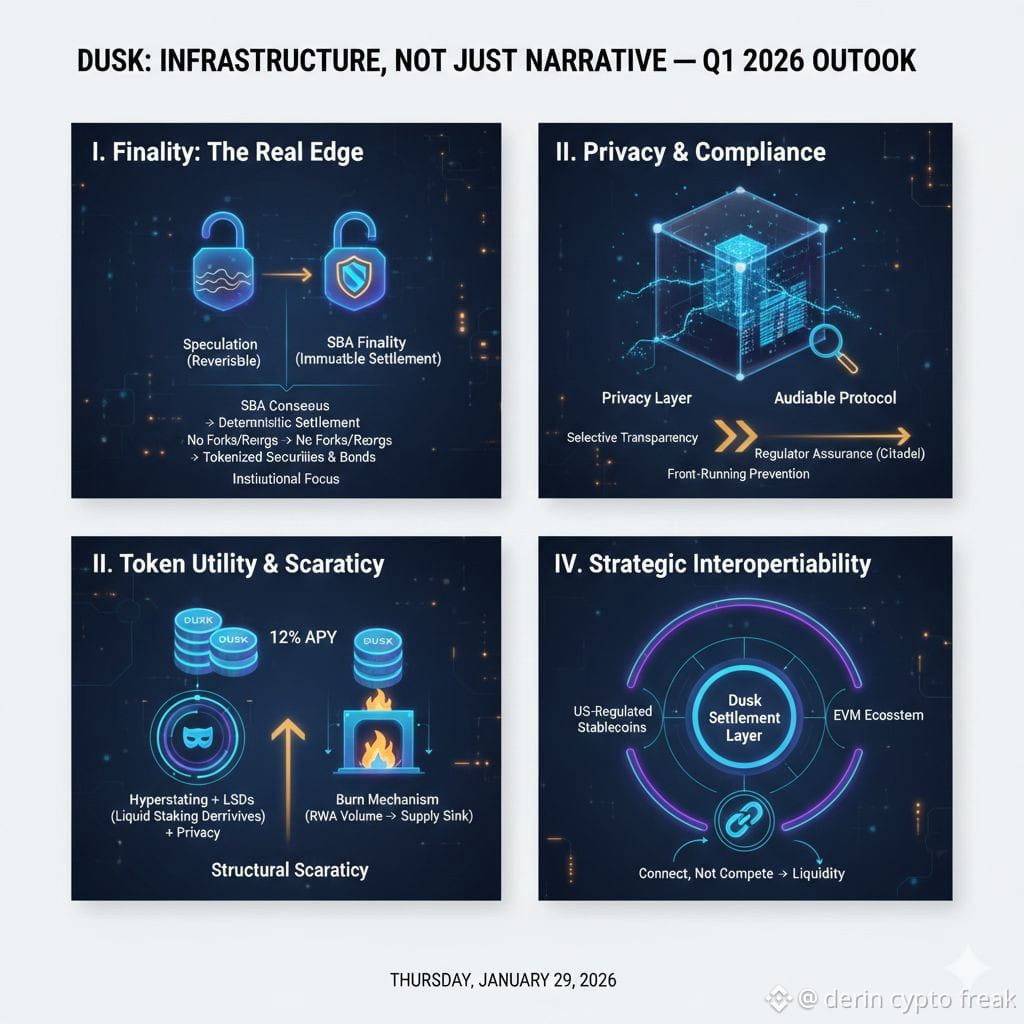
### Finality Is the Real Edge
In traditional markets, settlement risk is a serious problem. Trades don’t truly “exist” until they settle, and delays create counterparty exposure. That’s why finality matters more than throughput. You can process a million transactions per second, but if those transactions can be reversed, they’re useless in regulated finance.
Dusk’s approach to consensus solves that problem directly. The Segregated Byzantine Agreement framework prioritizes deterministic finality — once a transaction is confirmed, it’s legally and technically settled. No forks, no reorg risk. From an institutional perspective, that’s non-negotiable.
This is also why Dusk is even being discussed in the context of tokenized securities and bond issuance. These markets don’t tolerate ambiguity. If a system can’t guarantee final settlement, it doesn’t make the shortlist.
### Privacy Without Breaking Compliance
Most privacy chains make the same mistake: they optimize for anonymity at the expense of auditability. That works until regulators show up. Then the entire model collapses.
Dusk’s design is more nuanced. Privacy exists where it needs to — trade details, counterparties, execution logic — but the system remains auditable at the protocol level. This “selective transparency” is critical. Regulators don’t need to see every trader’s strategy; they need assurance that rules are being followed.
From a trading standpoint, this matters because it prevents front-running and information leakage while still allowing institutions to operate within legal boundaries. That’s a rare balance, and it’s not easy to pull off.
### Token Utility That’s Tied to Activity
Another thing traders learn over time is to ignore static token models. If value doesn’t scale with usage, inflation eventually kills the trade.
DUSK’s economics are tied directly to network activity. With mainnet live and staking fully operational, the token now plays multiple roles: securing the network, paying execution fees, and capturing value through burns.
Staking yields around the low double digits aren’t revolutionary on their own. What’s interesting is the underlying staking architecture. The ability to build liquid staking products without sacrificing privacy opens doors for structured products, funds, and institutional wrappers.
On the supply side, transaction fee burns introduce a deflationary pressure that increases as real-world asset volume grows. If issuance and settlement ramp up, scarcity becomes structural rather than speculative.
### Interoperability Changes the Risk Profile
One of the biggest risks with specialized chains is isolation. Liquidity fragmentation kills adoption.
Dusk’s integration with cross-chain infrastructure, particularly through Chainlink’s interoperability framework, reduces that risk significantly. Stablecoins and assets don’t need to be native to Dusk to settle there. That’s a big deal.
Instead of competing with the EVM ecosystem, Dusk plugs into it as a settlement layer. Traders understand how valuable that is — it’s much easier to attract volume when users don’t have to abandon existing tooling or liquidity.
### How I’m Looking at This as a Trader
This isn’t a momentum play or a short-term narrative trade. It’s infrastructure exposure. The kind that doesn’t move fast, but moves with size when it does.
Markets tend to misprice boring tech until it becomes unavoidable. Settlement layers, compliance-friendly privacy, and real-world asset rails aren’t exciting — until institutions start deploying capital at scale. By the time that’s obvious on-chain, the asymmetry is gone.
From a risk–reward perspective, Dusk sits in that uncomfortable middle zone where retail isn’t fully interested yet, but institutions are clearly circling. That’s usually where the best long-term trades are built.
This isn’t about believing in a story. It’s about recognizing when a protocol stops selling potential and starts delivering infrastructure. And in this market, that distinction is everything.