$1 billion on paper, but tens of millions in the market: how venture funds overvalued crypto projects.
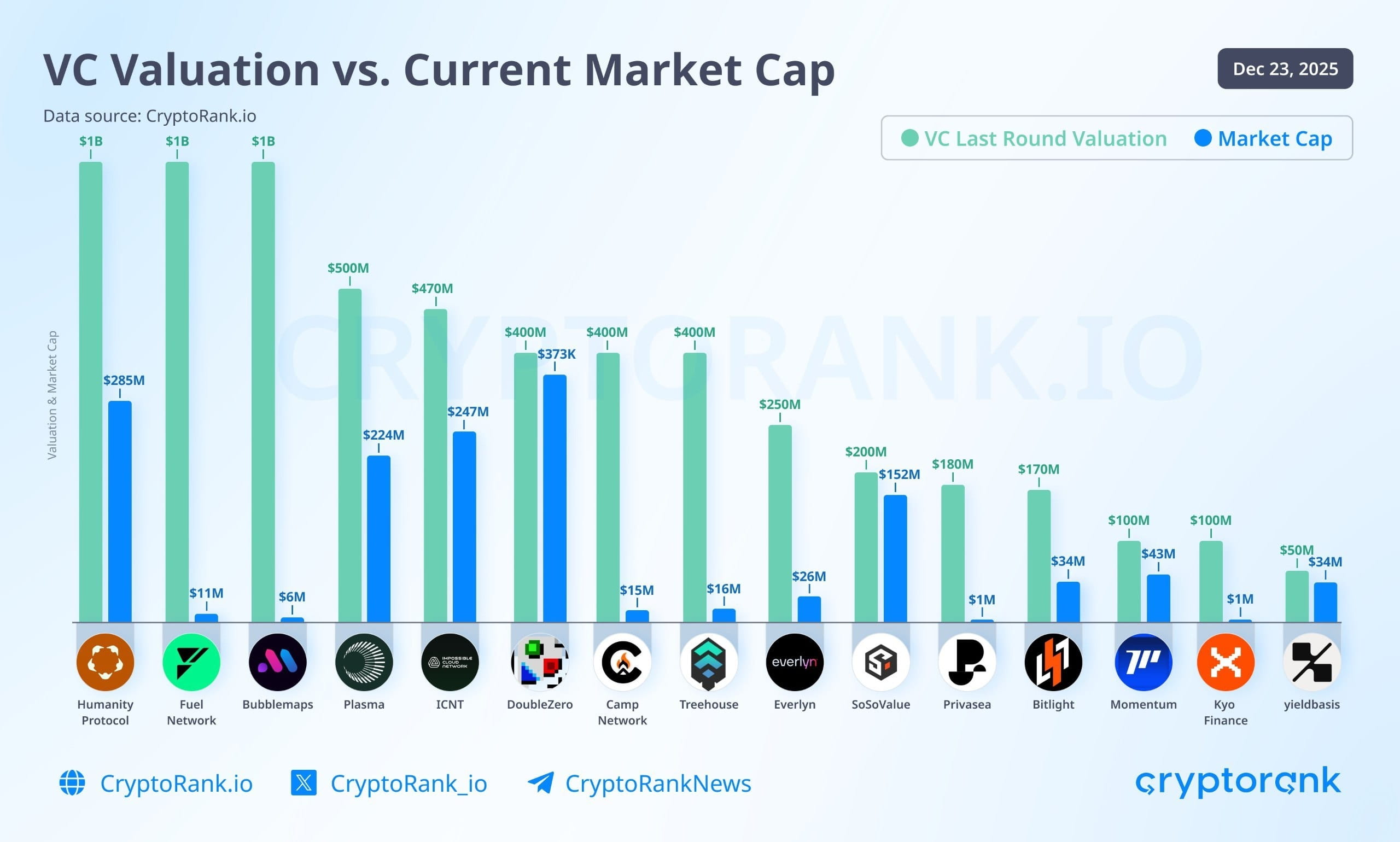
Infographic from #CryptoRank clearly shows the gap between how projects were valued by venture funds in the last rounds and how the market values them now.
In many cases, the difference is multiplicative. Projects that received VC valuations of $500 million - $1 billion are now trading with a capitalization in the tens or hundreds of millions, and sometimes significantly lower:
- Humanity Protocol - the last VC round valued the project at $1 billion, while the current market capitalization is about $285 million.
- Fuel Network - valuation from funds at the level of $1 billion, market - only $11 million.
- Bubblemaps - valuation from funds at the level of $1 billion, market - only $6 million.
Moreover, this dynamic applies to both infrastructure and application solutions - from network protocols to DeFi and data projects. Just EVERYTHING.
The mechanics here, in fact, are typical. In phases of hype and strong narratives, venture funds embed aggressive expectations in valuations: rapid user growth, market capture, dominance in the segment. These valuations reflect not the current state of the project, but an optimistic scenario for the future.
BUT when the market cycle changes, liquidity contracts, and the narrative loses strength, revaluation occurs. The market stops paying for expectations and starts assessing:
- real demand,
- revenue and tokenomics,
- sustainability of the model,
- the ability to withstand prolonged phases of weak interest.
As a result, most "paper" VC valuations are not confirmed by the market and are adjusted downwards - sometimes sharply, sometimes gradually. Unfortunately, this gap is not an anomaly, but a process of clearing expectations.
An important conclusion to be made for the future is that VC valuation by itself is not a guide for the token price or investment potential at the moment. And another important point is that venture investors account for this risk, that’s what they are for. However, many from retail do not, because they considered a number of purchases as potential "LifeChange," rather than a risky investment. And therefore they "cooked," accordingly.