
For years, crypto has marketed privacy like a magic trick: “you can’t see anything, so you can’t touch anything.” That idea sounds powerful… until you try to plug it into real finance.
Because real financial systems don’t run on invisibility. They run on verifiable trust.
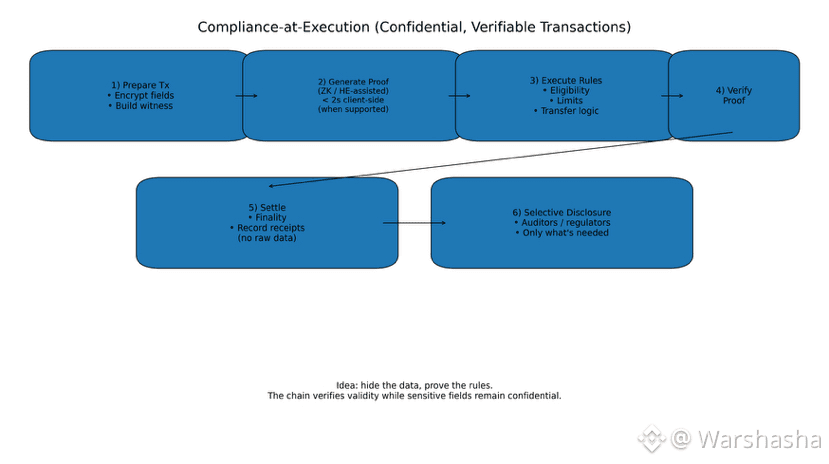
And that’s the shift I’ve been watching with #Dusk . The project isn’t trying to win the privacy narrative by promising total disappearance. It’s doing something way harder (and honestly more valuable): building an environment where data can stay confidential while rules can still be proven and enforced at execution time.
That difference — privacy + proof instead of privacy + opacity — is what turns Dusk from “a privacy chain” into something that actually fits the direction regulated on-chain finance is moving.
The Big Idea: Hide the Data, Prove the Rules
The most misunderstood part of compliance is that it isn’t just paperwork. In institutional markets, compliance is behavioral — it’s embedded in the process:
who is allowed to hold an asset
how transfers are restricted
what limits apply
what disclosures are required and when
how audit evidence is produced
A lot of crypto apps still treat compliance like a second step: execute first, explain later.
But the regulated world doesn’t work like that. Institutions want rules enforced during execution, not reviewed after the fact.
Dusk’s framing is simple and mature:
Don’t publish private financial data.
Publish proof that the transaction followed the rules.
That one inversion changes everything. Because now privacy doesn’t fight regulation — it becomes the mechanism that makes regulated markets usable on-chain.
What’s Actually New: Dusk’s “Multilayer” Evolution Changes the Game
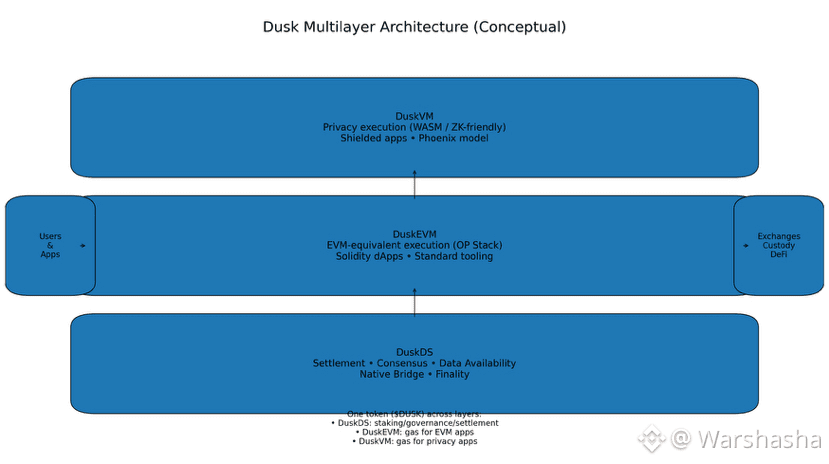
One of the most important developments in the @Dusk ecosystem is that it’s no longer treating the L1 as a single monolith. It’s evolving into a multi-layer modular stack — and this matters because institutions (and serious builders) don’t want bespoke tooling and long integration timelines.
The concept looks like this:
DuskDS is the settlement + consensus base layer
DuskEVM brings familiar EVM execution so apps can ship with standard tooling
DuskVM is the privacy execution layer for deeper, full-privacy applications
This structure is basically @Dusk saying: “We’ll keep settlement and regulatory guarantees strong at the base, and let execution environments specialize above it.”
That’s how you scale a regulated system without weakening the trust layer.
Hedger: The Moment Dusk’s Compliance-Privacy Story Became “EVM-Native”
This is where things get really interesting lately.
Dusk introduced Hedger, which is built specifically for the EVM execution layer. The goal isn’t theoretical privacy — it’s confidential, auditable transactions that institutions can actually use.
Hedger’s design matters because it isn’t just “ZK for privacy.” It combines multiple cryptographic techniques (including homomorphic encryption + zero-knowledge proofs) in a way that’s clearly designed for regulated market structure — not just retail anonymity.
The features that stood out to me:
support for confidential asset ownership and transfers
groundwork for obfuscated order books (huge for institutional execution quality)
regulated auditability by design
emphasis on user experience (fast proving flows)
That last part is underrated. If privacy systems are so heavy that only specialists can use them, institutions will always choose “private permissioned databases” instead. If privacy becomes usable, the conversation changes.
The Real Moat: Licenses and Market Structure Aren’t an Afterthought Here
A lot of chains try to “partner into compliance.” Dusk is doing something different: it’s aligning with regulated venues and frameworks in a way that lets the network behave like market infrastructure, not just a smart-contract playground.
The partnership dynamics around NPEX are a good example. Instead of compliance being isolated per-application, the framing is moving toward protocol-level coverage — meaning the environment itself is built to support regulated issuance, trading, settlement, and custody flows under structured oversight.
That’s exactly what institutions want: fewer bespoke setups, fewer legal unknowns, fewer integration surprises.
EURQ on $DUSK : Why a Digital Euro Matters More Than People Think
This is one of those developments that looks “boring” until you understand how regulated markets operate.
Dusk’s ecosystem has aligned with EURQ, a digital euro positioned for regulated use (not just “a stablecoin narrative”). In real tokenized markets, the settlement rail is everything. If the settlement asset is questionable, the whole system gets stuck in compliance review.
A regulated euro-denominated instrument changes what can realistically be built:
euro settlement for tokenized securities
compliant payment flows
reducing reliance on synthetic stablecoin structures for regulated venues
When institutions move, they move with rails that compliance teams already understand. A credible euro-based settlement instrument is one of those rails.
Chainlink Standards + Cross-Chain Compliance: This is the “Expansion Layer” Moment
Another major recent signal: $DUSK and its regulated partners adopting Chainlink standards (including CCIP and data standards).
If Dusk’s base thesis is “regulated issuance + compliant privacy,” then interoperability is the next question institutions ask:
“Great — but can the asset move safely across systems without losing controls?”
This is where CCIP-style architecture becomes a real institutional unlock, because it supports a framework where assets can travel while still preserving issuer controls and regulated constraints.
To me, this is the “grown-up phase” of tokenization:
not just issuing assets on one chain
but enabling assets to be used across ecosystems without breaking compliance logic
The Quiet Infrastructure Move Most People Miss: Continuous Auditability
The other trend I’m seeing across regulated on-chain design is that audit processes are shifting.
Traditional audits are slow and manual. Institutions want more continuous assurance:
real-time verification
execution-level evidence
fewer off-chain reconstructions
Dusk’s architecture naturally fits this because the proof is produced by execution itself, not by a reporting layer that tries to explain what happened afterward.
That’s not just “nice.” That’s operational risk reduction.
And institutions are obsessed with operational risk.

Where Dusk Fits in the 2026 Reality: “Proof-First Finance”
If I had to summarize what Dusk is building in one phrase, it would be:
Proof-first finance.
Not:
“trust us” finance
“hide everything” finance
“we’ll comply later” finance
But:
rules enforced at execution
confidentiality preserved by design
legitimacy provable without exposure
That’s exactly the shape regulated on-chain systems are evolving into.
No, nothing is guaranteed. Execution still matters. Adoption still has friction. Competition is real. But what’s becoming clearer is that Dusk’s original design choices are lining up with how regulated on-chain finance is actually being implemented.
And that alignment is rare.