

The first time I tried to explain “onchain finance” to a friend who works in compliance, I made the classic mistake. I talked about faster settlement and global access. They didn’t care. They cared that on most public chains, every transfer is a permanent press release. Who paid who, when, and how much. In real markets, that is not transparency, it is a data leak. Dusk’s bet is that the next wave of financial crypto adoption will not be won by the loudest apps, but by the chain that can handle confidentiality and regulation without turning the whole thing back into a closed database.
As of February 4, 2026, the market is pricing DUSK like a mid cap infrastructure token, not a blue chip narrative. CoinMarketCap shows DUSK around $0.105 with about $23.5M in 24 hour trading volume, roughly $52.3M market cap, and about 497M circulating supply against a 1B max. If you think in Bangladeshi taka, CoinGecko lists DUSK around ৳13.57 with 24 hour traded volume roughly ৳2.23B. That price data matters, but it is not the main story. The main story is that Dusk is explicitly building for regulated finance, and it is trying to do it with primitives that institutions recognize: permissioning, auditability, and controlled disclosure, while still keeping a public blockchain settlement layer.
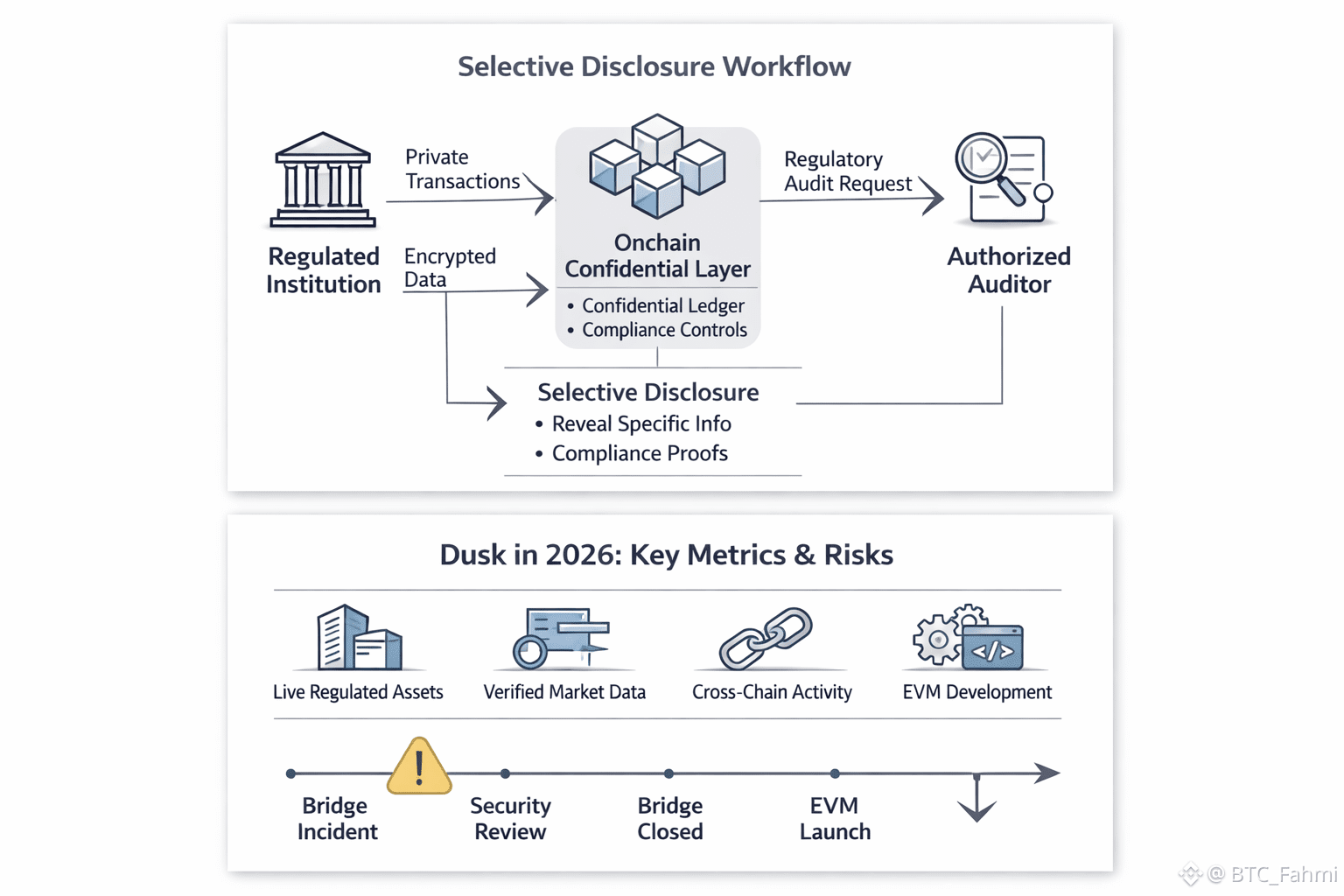
The clearest way to understand Dusk is to stop thinking about “privacy coin” and start thinking about “market plumbing.” Dusk’s own documentation frames it as a privacy blockchain for regulated finance, designed so institutions can meet real regulatory requirements onchain while users can keep balances and transfers confidential, with the option to reveal information to authorized parties when required. That “reveal when required” part is the key nuance. Pure privacy is easy to market and hard to deploy in finance. What finance wants is selective disclosure: you do not broadcast everything to the world, but you can prove compliance, ownership, eligibility, and settlement correctness to the people who have a legitimate need to know.
Under the hood, Dusk has been moving toward a modular stack rather than one monolithic chain. In June 2025, the team described an evolution to a multilayer architecture, with a settlement and data layer (DuskDS) underneath an EVM execution layer (DuskEVM), plus a privacy focused application layer planned as DuskVM. The practical reason is boring and that is exactly why it matters. Financial apps do not want bespoke tooling. They want familiar developer workflows, predictable integration paths for wallets and exchanges, and an execution environment that does not require custom everything. DuskEVM is meant to meet developers where they already are, while DuskDS remains the base that anchors staking, final settlement, and the privacy and compliance model.
The “real infrastructure” signal in 2026 is not a new slogan, it is counterparties. Dusk has been working with NPEX, described by Dusk as a fully regulated Dutch stock exchange for SMEs supervised by Netherlands Authority for the Financial Markets. Dusk says NPEX has facilitated over €200M in financing for 100+ SMEs and connects 17,500+ active investors. That is the difference between “we could tokenize securities” and “we have a distribution partner that already lives inside the rules.” In the same announcement, Dusk and NPEX said they are adopting Chainlink standards including CCIP, DataLink, and Data Streams, aiming to combine compliant issuance, cross chain settlement, and verified market data onchain. For traders, that is a concrete path to non crypto flows: regulated assets plus official data plus interoperability that does not require trusting random bridges.
Now for the part that keeps this from being a fairy tale: operational risk is still real, and Dusk has been transparent about that. In mid January 2026, Dusk published a Bridge Services Incident Notice saying monitoring detected unusual activity involving a team managed wallet used in bridge operations, that bridge services were paused, related addresses were recycled, and they coordinated with Binance after part of the flow touched its platform. They stated that no user funds were impacted based on available information, and that DuskDS mainnet was not affected at the protocol level. They also said the bridge would remain closed until security review is concluded, and tied reopening to resuming the DuskEVM launch timeline. If you trade infrastructure tokens, this is the kind of incident that matters more than any marketing partnership, because it tests whether the team treats security as a process, not an event.
So what is the 2026 trader and investor lens here. Dusk is not trying to be everything for everyone. It is trying to be the chain where regulated assets can exist without forcing institutions to choose between compliance and confidentiality. The upside case is simple in mechanism: if regulated venues actually issue, trade, and settle on Dusk using selective disclosure, then usage becomes sticky, because regulated workflows do not churn easily once they integrate. The downside case is also simple: if integrations slip, if regulatory complexity slows deployments, or if bridge and operational hardening takes longer than expected, then you get a chain with good theory and thin activity.
If you want to treat Dusk seriously in 2026, do it the unsexy way. Watch for evidence that regulated assets are live, that market data pipelines are real, that cross chain movement is restored safely, and that developers can actually ship on the EVM layer without heroic effort. Price will follow whatever truth those metrics reveal.
