
Smart contracts changed what software can do by making code enforceable on a shared ledger. But most smart contracts still inherit the same old friction points: payments are inconsistent across apps, users must hold the gas token to interact, and contracts can’t truly “wake up” on their own when something happens elsewhere on-chain.
Dusk’s economic protocol is designed to remove those limits by adding economic primitives at the protocol layer, not as app-specific hacks. In practical terms, it upgrades what smart contracts can be: not only logic that executes, but products and services with standardized monetization, smoother user onboarding, and event-driven automation.
Below is a clear breakdown of what the protocol enables, why it matters, and what it unlocks for developers, enterprises, and everyday users.
Protocol-Level Payments: Smart Contracts Become Standardized Revenue Tools
In many blockchains, payments inside apps are improvised. One app charges a transaction tax, another relies on tips, another uses custom fee logic. It works, but it’s fragmented and hard to compose. The moment you try to connect multiple protocols, those differences become an integration tax.
Dusk introduces a protocol component often described as a transfer contract that can arbitrate smart contract payments. The key idea is that “how a contract gets paid” is no longer a one-off design choice per dApp. Instead, payments become standardized across the ecosystem.
Why that matters
Monetization becomes native: A smart contract can cleanly operate as a revenue generating service without forcing every developer to reinvent billing logic.
Composability improves: When payments follow consistent rules, multiple apps can plug into each other financially, not just functionally. This is the difference between “apps can call each other” and “apps can pay each other reliably.”
Future multi-denomination payments: A major long term benefit is the possibility of paying contract fees in other tokens (like stablecoins), while gas remains denominated in DUSK. That separation is powerful: users get predictable pricing for services, and the chain preserves a coherent gas model.
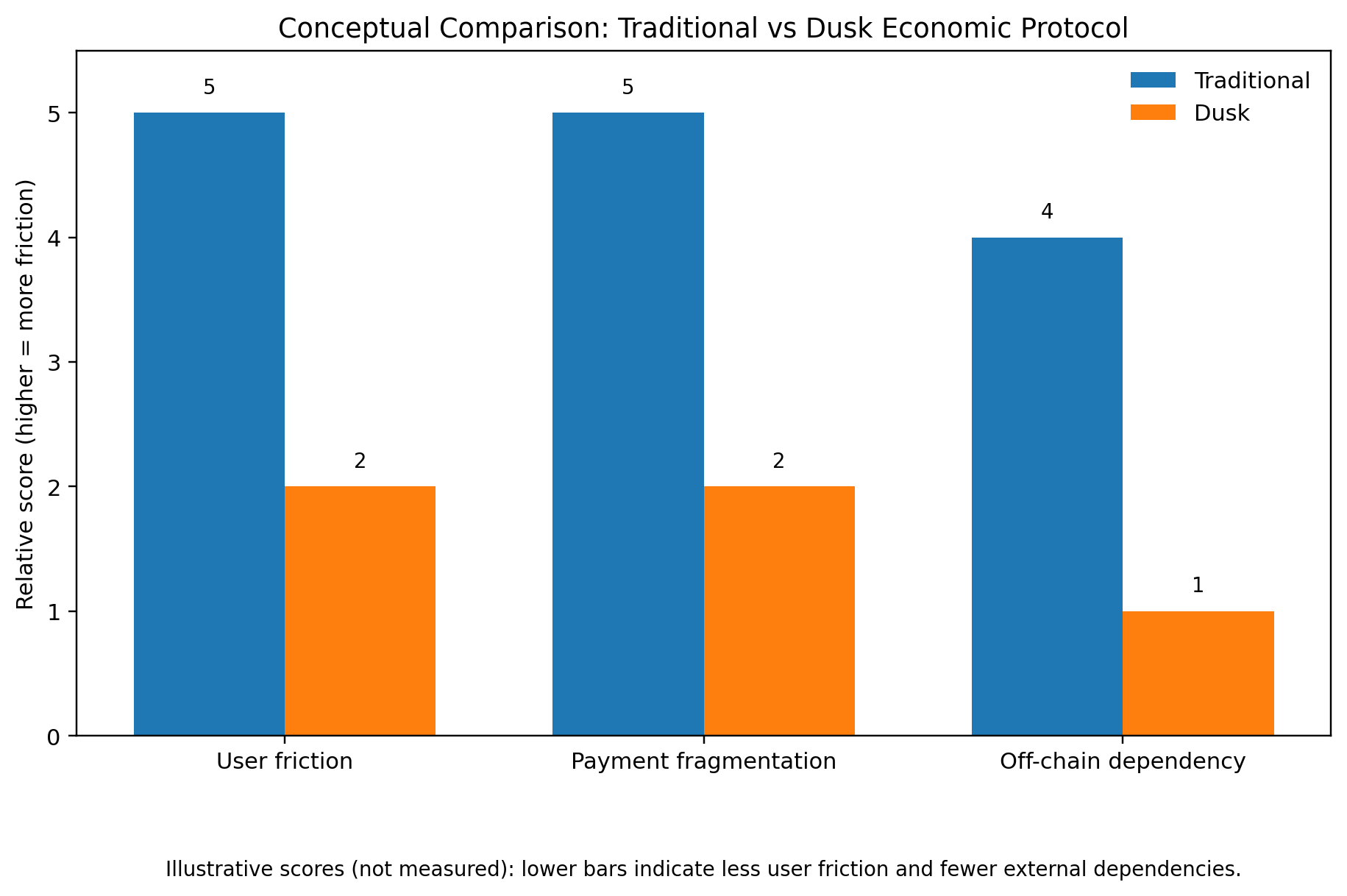
Traditional vs Dusk economic protocol comparison
Think of it like this: instead of every website building its own checkout system, the network offers a standardized payments rail that smart contracts can use by default.
Dusk’s economic protocol is basically trying to fix two of the biggest “real world” problems in smart contracts: who pays gas, and how automation actually happens.
Gas sponsorship: apps can pay gas so users don’t have to
For most people, gas is the first headache in crypto. Even if the product is simple, the user still has to buy the gas token, keep a balance, deal with fee changes, and sometimes watch a transaction fail. Dusk flips that experience by letting smart contracts sponsor gas when they choose.
That single capability changes the vibe from “crypto tool” to “normal product.” Users can just sign and use the app, without becoming crypto native first. For businesses, it’s like Web2: customers don’t pay for server calls, the platform covers infrastructure and chooses how to monetize. And that opens cleaner pricing models like subscriptions, pay-per-use, freemium tiers, or even off-chain invoicing with on-chain execution.
In short: gas sponsorship is not only “cheaper fees.” It’s a UX and business model lever.
Auto contracts: event driven automation without relying on bots
Most chains are reactive: a contract runs only when someone calls it. If you want automation, you usually need off-chain keepers or bots watching events and pushing transactions. Dusk expands this with autocontracts: contracts that can execute automatically in response to on-chain events emitted by other contracts.
That’s a big deal because it makes workflows faster and less fragile. You can build systems that behave like: “If event X happens, execute Y” directly as part of the on-chain logic. This can support advanced patterns like automated trading strategies, conditional transfers and escrow releases, collateral rebalancing, and enterprise flows like settlement or invoice triggers coordinated through event streams.
What changes overall
Put these together and you get a shift in how smart contracts feel:
For developers, it’s more freedom to design sustainable business models beyond basic transaction taxes, with better economic composability across dApps.
For users, it’s a smoother on-ramp because the “first buy gas, then use the app” barrier can disappear.
For enterprises, it’s predictable cost control plus automation that doesn’t depend on a patchwork of external glue services.
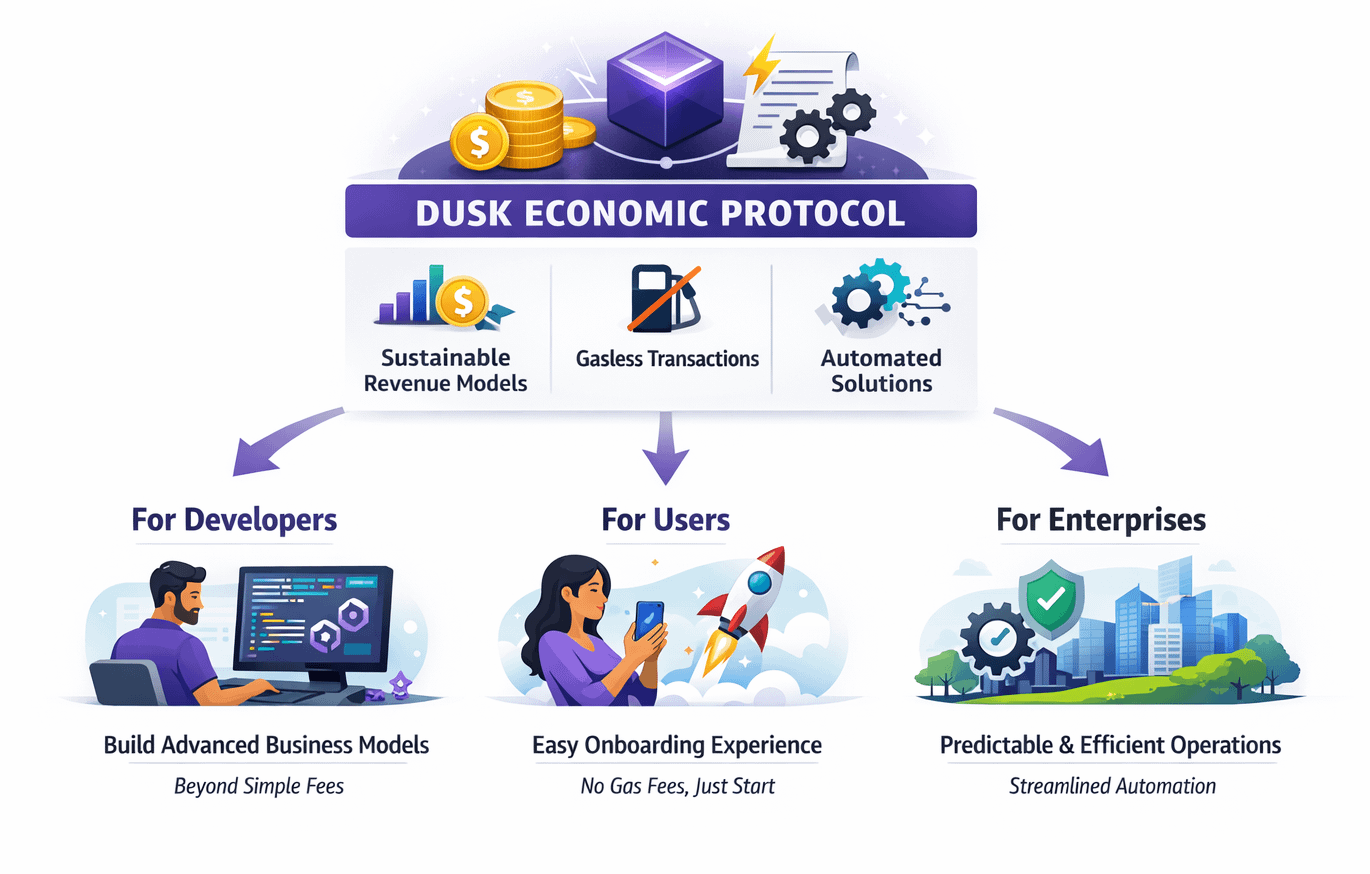
Dusk economic protocol process
Why it matters for adoption
Mass adoption isn’t just TPS. It’s whether blockchain apps can deliver reliable UX and real business logic at scale. Dusk’s approach targets that directly: contracts can sponsor gas, and contracts can automate based on events. That’s how on-chain apps start behaving like services people already understand simple to use, easy to price, and capable of running sophisticated workflows without constant manual nudging.
One more important angle:
This architecture also strengthens retention and liquidity for the ecosystem. When users don’t need to constantly manage gas, they interact more often and with less friction, which increases real on-chain activity instead of “one-time trials.” And when automation can be triggered by events through auto contracts, apps can run continuous strategies and operational workflows without relying on external bots that can fail, lag, or be manipulated. Net result: Dusk moves smart contracts closer to dependable economic infrastructure where incentives, UX, and execution reliability all reinforce each other.
Conslusion:
Dusk isn’t just upgrading smart contracts, it’s upgrading the business layer of blockchain. When contracts can sponsor gas and react to events on their own, Web3 starts feeling like a real product experience: smoother onboarding, stronger automation, and smarter monetization. This is the kind of infrastructure shift that turns “cool tech” into mass adoption.
Dusk is turning smart contracts into unstoppable on-chain products. Gas sponsorship deletes the biggest UX pain point, autocontracts bring real automation, and suddenly blockchain feels fast, seamless, and mainstream-ready. If this clicks at scale, it won’t just improve Web3, it will redefine what people expect from it.
