
Plasma is built on a simple observation: stablecoins are the highest-velocity asset class in crypto, but most blockchains still treat them like “just another token.” Plasma flips that priority. It’s a high-performance Layer-1 engineered around stablecoin payments, aiming for near-instant settlement, minimal friction, and compliance-ready rails that can scale beyond crypto-native users.
Mission: Make stablecoin payments feel like the internet
Plasma’s mission is less about winning an L1 narrative and more about shipping a dependable monetary transport layer. In Plasma’s own framing, the goal is to move money at “internet speed,” with zero fees and full transparency, and to pull trillions of dollars onchain by making stablecoins usable as everyday payment infrastructure.
Vision: stablecoin infrastructure for a new global financial system
The vision is explicitly global: Plasma’s founder/CEO describes it as building “stablecoin infrastructure for a new global financial system,” with an emphasis on secure, compliant, reliable payment rails that regulated actors can actually onboard to.
That last word matters. Plasma is positioning itself as a chain where institutions, exchanges, and payment providers can participate without the usual compliance ambiguity, reinforced by partnerships that prioritize monitoring and risk tooling.
What makes Plasma “stablecoin-native” in practice
Plasma’s architecture and go-to-market revolve around stablecoins (not a volatile gas token) as the center of gravity:
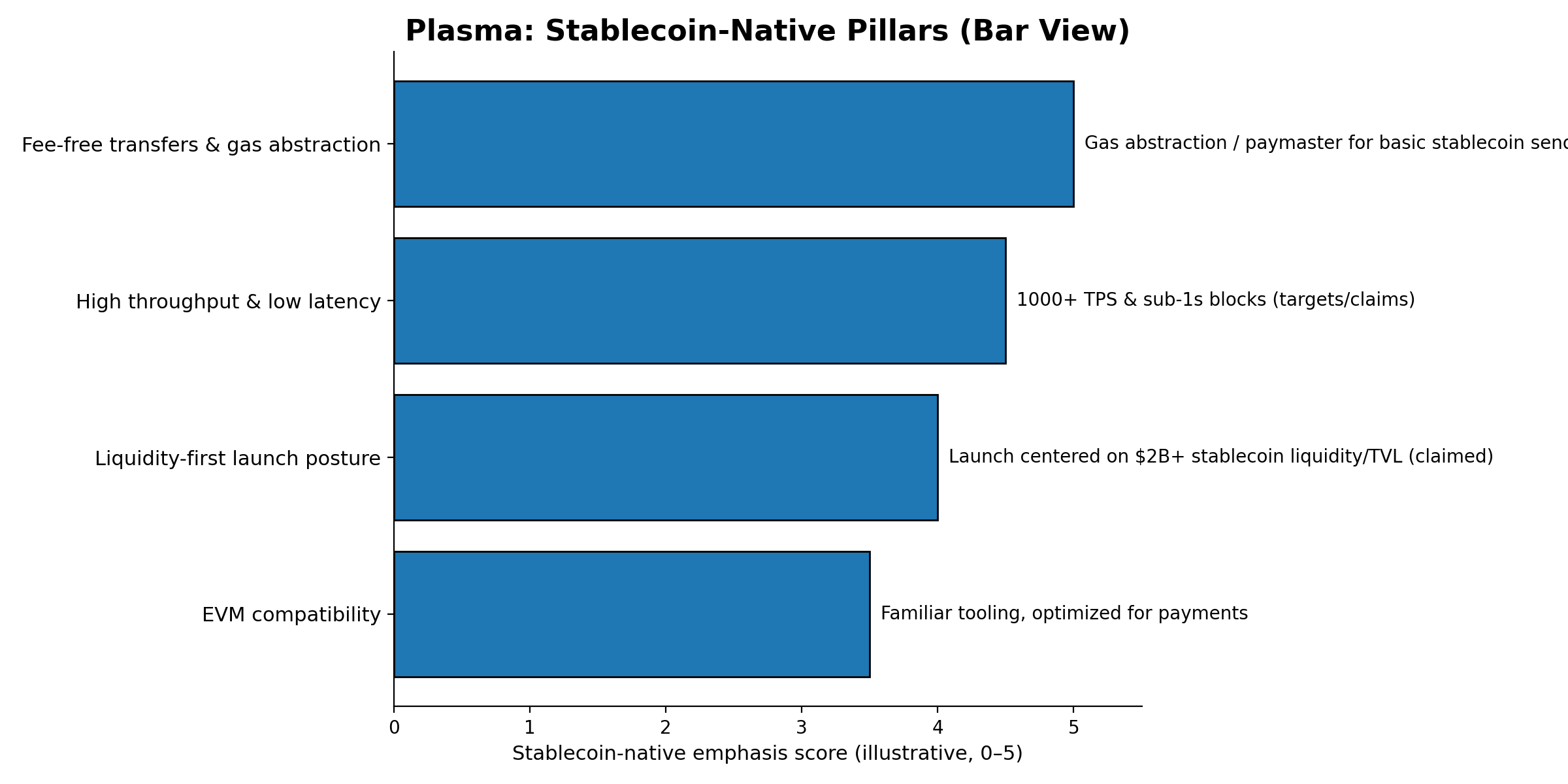
Fee-free, user-friendly transfers: Plasma highlights a “fee-free” payment experience, and public writeups describe protocol-level paymaster mechanics that can abstract gas for basic stablecoin sends, so users interact in stablecoin terms rather than juggling gas tokens.
High throughput and low latency: Plasma markets itself as high-performance, citing 1000+ TPS and sub-1 second block times as part of its stablecoin-first design targets.
EVM compatibility: The chain is positioned as EVM compatible, aiming to attract builders who want familiar tooling while optimizing the execution environment for stablecoin payment apps.
Launch posture: Plasma’s mainnet beta was reported as launching September 25, 2025, with claims of $2B+ stablecoin liquidity/TVL connected at launch, signaling that liquidity and payments are first-class launch requirements.
Tokenomics: Why XPL exists in a stablecoin-dominant system
Plasma’s native token is XPL. The design thesis is familiar to researchers in PoS economics: if stablecoins are the unit of account for users, the network still needs a security and incentive asset that aligns validators, builders, and long-term network growth. Plasma explicitly frames XPL as the asset that “secures” the system and aligns incentives as adoption scales.
Core roles of XPL:
Network security (PoS): Validators stake XPL to participate in consensus and earn protocol rewards.
Incentive engine: XPL is used for ecosystem growth campaigns and strategic partnerships aimed at expanding adoption into both crypto and traditional finance corridors.
Long-run sustainability: Token mechanics aim to fund security while limiting dilution through a burn-and-emissions balance.
Supply and distribution (initial framework)
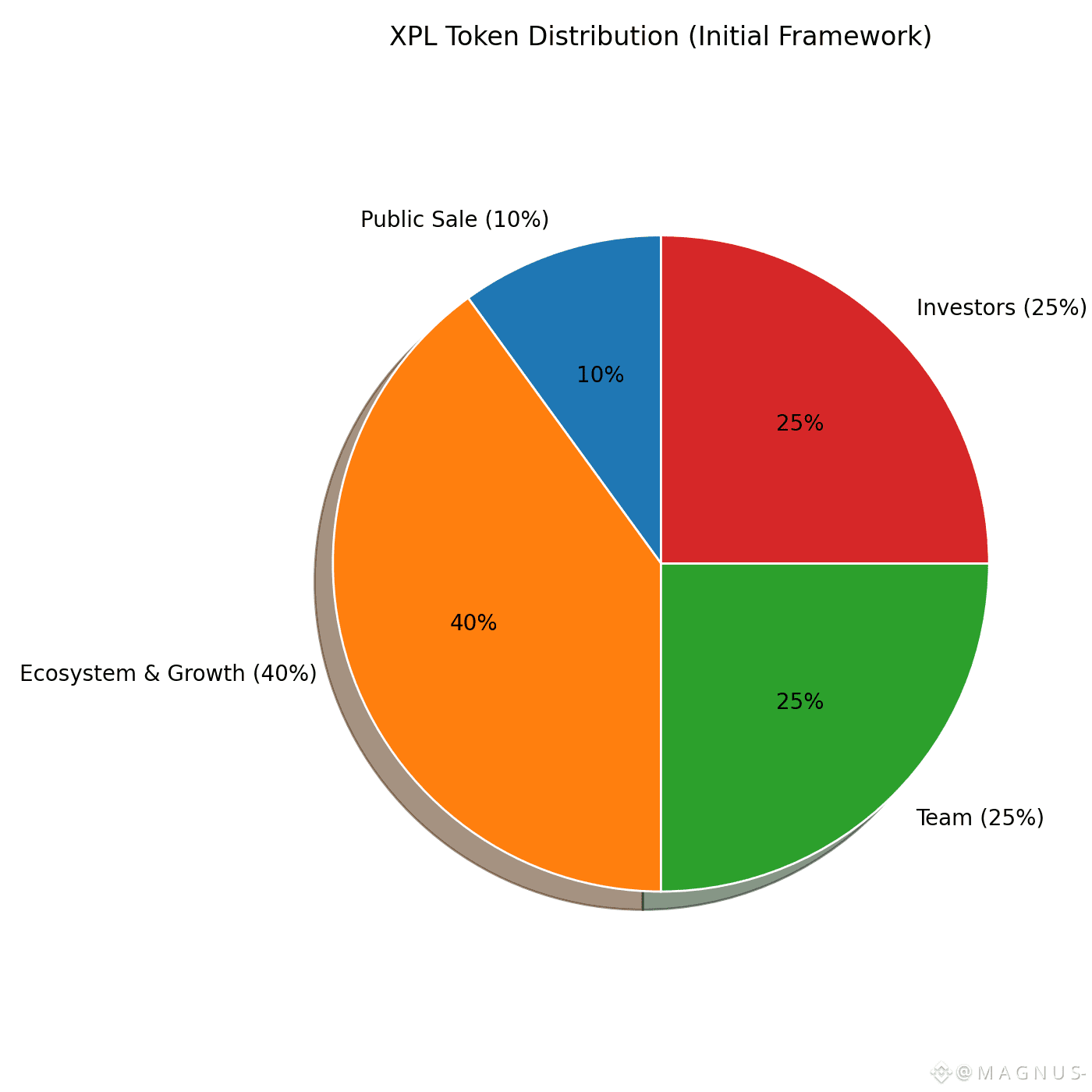
Plasma documents state an initial supply of 10,000,000,000 XPL at mainnet beta launch (with additional programmatic increases tied to validator network mechanics).
Distribution (headline allocations):
Public Sale: 10% (1.0B XPL)
Non-US purchasers: fully unlocked at mainnet beta launch
US purchasers: 12-month lockup, fully unlocked July 28, 2026
Ecosystem and Growth: 40% (4.0B XPL)
8% (0.8B) unlocked at launch for early DeFi incentives, liquidity, exchange integrations, and growth campaigns
Remaining 32% (3.2B) unlocks monthly over ~3 years
Team: 25% (2.5B XPL)
One-third: 1-year cliff from mainnet beta launch
Remaining two-thirds: monthly over the next 2 years (fully unlocked by ~3 years post-launch)
Investors: 25% (2.5B XPL)
Documented as aligned to the team unlock schedule
PLASMA XPL Tokenomics
Emissions, burn, and the “security budget”
Plasma’s docs describe a validator reward model that starts at 5% annual inflation, stepping down by 0.5% per year until a 3% long-term baseline, and only activates when external validators and delegation go live.
To counterbalance dilution, Plasma states it follows an EIP-1559-style approach where base fees are burned, positioning usage as a mechanism that can offset emissions as the network scales.
Bottom line
Plasma’s differentiation is strategic: it’s not trying to be everything for everyone. It’s trying to be the stablecoin settlement layer where payments feel normal, liquidity is deep, and network incentives are engineered for adoption at institutional scale. If Plasma succeeds, XPL is meant to function like the security and alignment layer underneath a stablecoin dominant economy, while the user experience stays anchored in “digital dollars”.
#Plasma @Plasma $XPL

