
In the broader discourse surrounding digital assets, Binance Futures is often characterized as a high-risk environment suited only for those with a high tolerance for volatility. However, this perspective frequently confuses the nature of the financial instrument with the behavior of the individual participant. To an experienced trader, the risk does not reside within the contract itself, but rather in the architecture of the position.
The counterintuitive reality is that a futures contract can be a more conservative tool than a spot holding if managed with precision. The danger is not inherent to leverage; it is inherent to the mismanagement of capital efficiency and the absence of a defined exit strategy.
The Architecture of a Futures Position
In practice, a futures contract is a derivative designed for two primary purposes: capital efficiency and risk mitigation. For the professional trader, Binance Futures is a venue to manage exposure without committing the entirety of one's liquidity.
When a trader utilizes 5x leverage, they are not necessarily seeking to quintuple their gains. Instead, they may be seeking to control a specific dollar-weighted exposure while keeping 80% of their capital in a more secure environment, such as cold storage or a low-risk yield-bearing product. In this context, the futures market acts as a surgical tool. It allows for directional exposure while maintaining a lean balance sheet on the exchange.
The risk profile of a position is determined by the distance between the entry price and the invalidation point, multiplied by the position size. If a trader risks 1% of their total account equity on a trade, the level of leverage used to achieve that 1% risk is irrelevant to the final outcome. Whether one uses 2x or 20x leverage, if the stop-loss is calculated correctly, the monetary loss remains the same.
Common Divergences in Positioning
The primary cause of liquidation and significant capital loss among the general user base is not market manipulation or "wicking," but rather a fundamental misunderstanding of position sizing. There are three recurring errors that define poor positioning:
• Fixed Leverage vs. Dynamic Sizing: Many participants choose a leverage multiple (e.g., 20x) and apply it to their entire balance without calculating the underlying asset's volatility. A 20x position on a stable, high-cap asset carries a completely different risk profile than 20x on a mid-cap altcoin.
• The Psychological Liquidation Price: Inexperienced traders often view their liquidation price as their "stop-loss." This is a catastrophic error in judgment. A professional trade is invalidated long before the exchange forces a liquidation. If the market reaches the liquidation price, it means the trader failed to manage the trade's life cycle.
• Averaging into Losing Positions: This is a behavioral trap. When a position moves against a user, the instinct to "lower the entry price" by adding more capital often leads to an oversized position that the account cannot support. This transforms a manageable loss into an account-ending event.
The Professional Framework: Risk First, Profit Second
Experienced traders view the market through the lens of survival. The objective is not to maximize the profit of a single trade, but to ensure that no single trade can significantly impair the trading capital. This requires a shift in mindset from "how much can I make?" to "how much am I willing to pay to see if this thesis is correct?"
To calculate a professional position, one must use a standard risk formula:
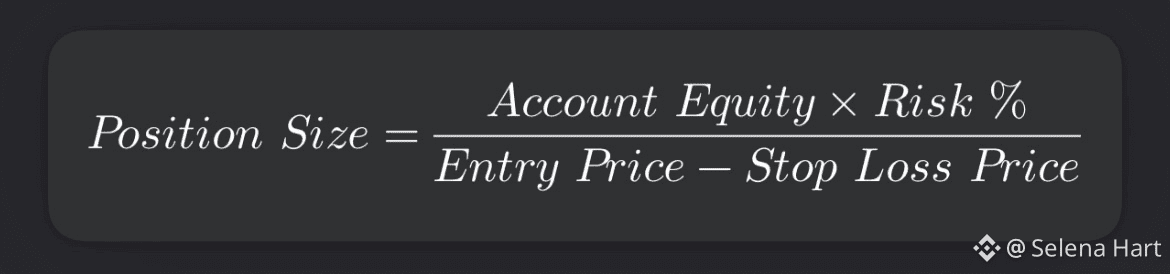
By using this approach, the leverage offered by Binance becomes a secondary utility—a way to facilitate the trade—rather than the driver of the risk itself. When the position size is determined by the distance to the stop-loss, the "risk" of futures becomes a controlled variable.
Furthermore, professional participants use futures to hedge. If a trader holds a significant amount of an asset in their spot wallet and anticipates a short-term correction, they can open a short position on Binance Futures. This "delta-neutral" approach uses the futures market to reduce risk, demonstrating that the instrument is as much a shield as it is a sword.
Perspectives on Market Alternatives
While spot trading is often championed as the "safer" alternative, it lacks the flexibility required to navigate a two-sided market. In a prolonged downtrend, a spot-only participant is forced to either sit in cash or realize losses. The futures market provides the ability to profit from declining prices or to protect existing holdings through hedging.
The difference is not in the safety of the asset, but in the activity of the participant. Spot trading is largely passive and directional. Futures trading is active and multidimensional. The "risk" associated with futures is simply the price of this increased flexibility. If a user lacks the discipline to manage that flexibility, the fault lies with the strategy, not the platform.
Reflective Takeaway on Market Behavior
The market is an aggregate of human emotion and mathematical necessity. It moves to find liquidity—the points at which the maximum number of poorly managed positions are forced to close. When we see a "liquidation cascade," we are witnessing the collective result of poor positioning.
Participants who blame the market for their losses are often looking at the wrong variable. The market is indifferent to an individual's entry price. It only responds to the supply and demand created by the positions held within it. If a trader finds themselves consistently stopped out or liquidated, the issue is likely a misalignment between their trade thesis and their risk parameters.
Ultimately, Binance Futures is a neutral infrastructure. It provides the liquidity, the speed, and the tools. The risk is a choice made by the user at the moment they input their position size and leverage.
Understanding this distinction is the missing piece for most users. Success in the derivatives market is not about predicting where the price will go; it is about ensuring that your position is structured to survive the volatility that occurs while the market decides where it wants to go. The instrument is a multiplier of the trader's existing skill—or lack thereof.
#BinanceFutures #RiskManagement #CryptoTrading #ProfessionalTrading #TradingStrategy #CapitalEfficiency
