
There is a quiet shift happening in blockchain development. It isn’t driven by headlines or hype cycles. It’s driven by fatigue. Developers are tired of bending complex ideas into fragile environments. Institutions are tired of trusting critical logic to systems that behave unpredictably under pressure. And regulators are tired of infrastructure that was never designed to carry responsibility.
Dusk sits at the intersection of that shift.
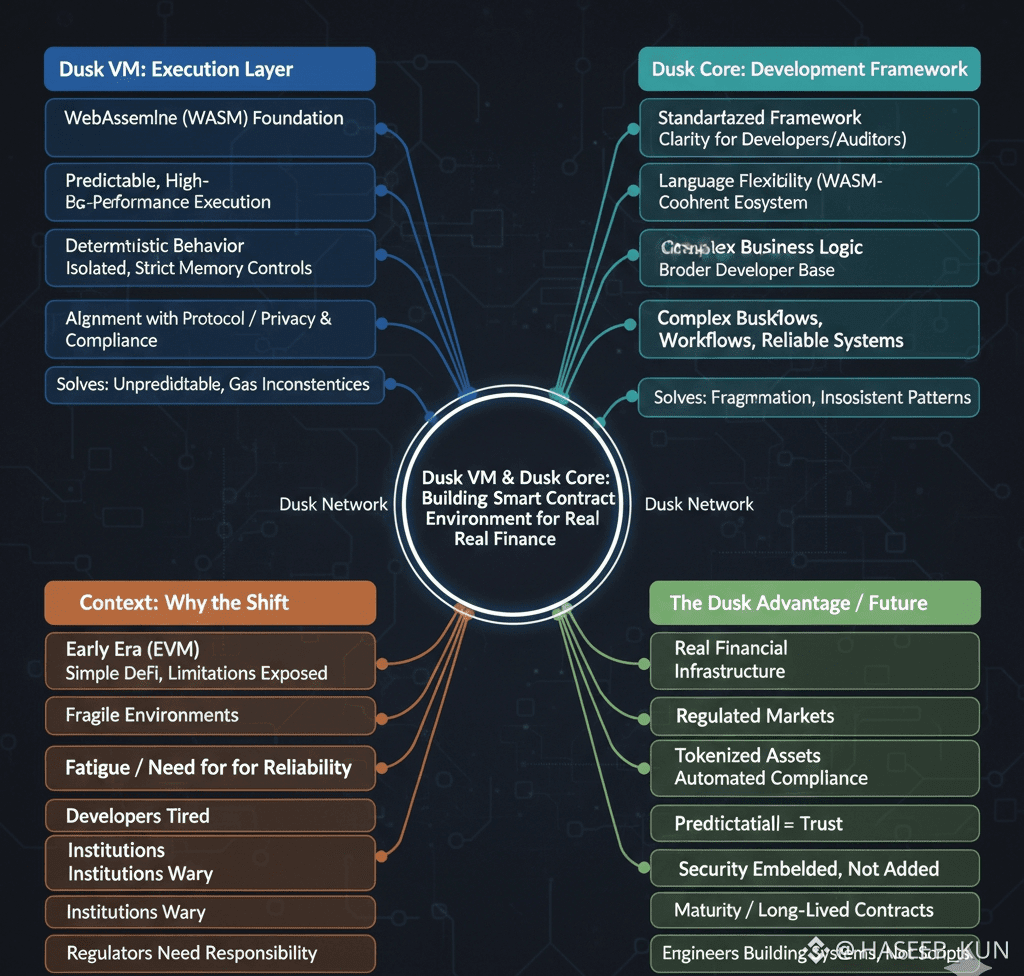
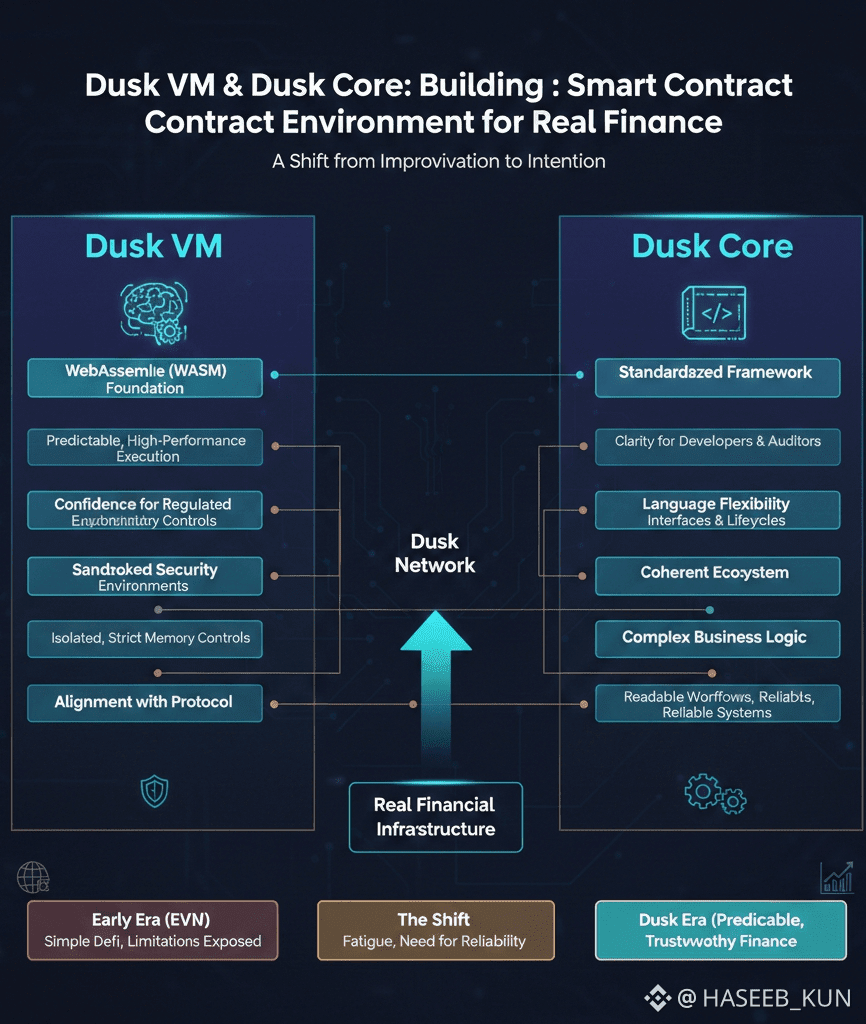
Rather than competing for attention with surface-level features, Dusk focuses on something far more fundamental: how smart contracts are executed, understood, and trusted when they are meant to power real financial systems. At the center of this focus are two tightly connected pillars—Dusk VM and Dusk Core—which together form the execution and development backbone of the Dusk network.
This is not a story about incremental improvements. It’s about changing the expectations developers should have from a smart contract platform altogether.
When Smart Contracts Outgrew Their Environment
Smart contracts were never supposed to remain simple forever. The early era of token transfers and basic DeFi proved what was possible, but it also exposed what was missing. As use cases expanded into tokenized assets, regulated markets, automated compliance, and institutional workflows, the limitations of existing execution environments became increasingly visible.
Developers learned to live with unpredictability. Gas models that behaved inconsistently. Execution paths that required defensive coding. Tooling that worked well enough—until it didn’t. These compromises were tolerable when contracts were experimental. They are unacceptable when contracts become infrastructure.
Dusk was designed with this maturity in mind. Its architecture assumes that smart contracts will be long-lived, audited, extended, and relied upon. That assumption changes everything.
Why Dusk VM Is Built on WebAssembly
At the heart of Dusk’s execution layer is Dusk VM, a virtual machine built on WebAssembly (WASM). This choice alone places Dusk in a different category from EVM-only blockchains.
WebAssembly was not created for experimentation. It was created for predictable, high-performance execution in production environments. It powers real applications across browsers, cloud platforms, and enterprise systems. Its behavior is deterministic by design. Its security model is strict. Its performance characteristics are well understood.
For Dusk, WASM is not a convenience—it is a foundation.
Dusk VM uses WASM to ensure that smart contracts behave consistently across environments. The logic you test locally is the logic that runs on-chain. Execution does not shift subtly under load. Outcomes do not depend on hidden variables. This level of determinism is essential when contracts encode financial agreements rather than casual interactions.
Predictability, on Dusk, is not marketed as a feature. It is treated as a baseline requirement.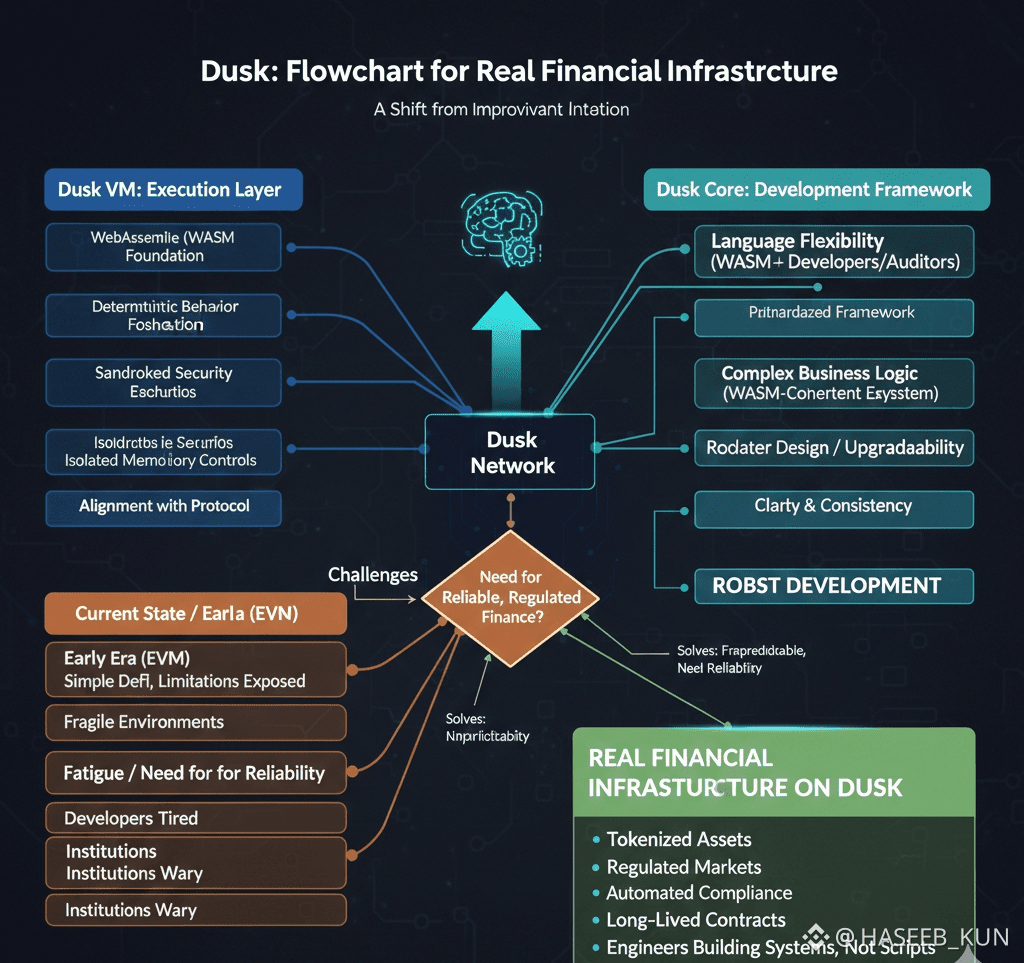
Deterministic Execution as Financial Infrastructure
In traditional software, determinism is assumed. In blockchain systems, it is often compromised in favor of flexibility or speed. Dusk refuses that tradeoff.
Dusk VM enforces deterministic execution so that developers, auditors, and institutions can reason about smart contracts with confidence. Inputs lead to defined outcomes. State transitions are explicit. Execution paths are stable.
This matters deeply in regulated environments. A contract that behaves differently under edge conditions introduces uncertainty. Uncertainty erodes trust. And trust is the currency of financial infrastructure.
By anchoring execution in WASM, Dusk ensures that smart contracts act like real programs—predictable, testable, and reliable.
Security That Is Embedded, Not Added
Security failures in smart contracts rarely come from obvious mistakes. They emerge from unintended interactions, memory assumptions, or execution quirks that surface only in production.
Dusk VM reduces these risks through sandboxed execution. WASM contracts operate in isolated environments with strict memory controls and clearly defined boundaries. Contracts cannot interfere with one another. They cannot escape their execution context. These guarantees are enforced by the runtime itself, not by developer discipline.
More importantly, Dusk aligns its execution environment with its protocol-level design. Smart contracts operate natively within a system built for privacy, compliance, and regulated asset flows. The VM does not exist in isolation—it understands the environment it serves.
This alignment removes a major burden from developers. Security is not something they must constantly reconstruct at the application layer. The infrastructure carries its share of responsibility.
Dusk Core: Structure Without Restriction
If Dusk VM defines how contracts execute, Dusk Core defines how they are built.
One of the most underestimated problems in blockchain development is fragmentation. Projects invent their own patterns. Teams rely on informal conventions. Over time, ecosystems become inconsistent and hard to reason about—especially for newcomers or auditors.
Dusk Core addresses this by providing a standardized development framework for smart contracts on Dusk. It defines how contracts are structured, how they interact, and how they progress through their lifecycle. This standardization does not limit creativity. It creates clarity.
Developers entering the Dusk ecosystem don’t have to decipher unfamiliar patterns. Contracts feel coherent. Interfaces behave consistently. Execution expectations are shared. This consistency compounds over time, strengthening the ecosystem as it grows.
For regulated finance, this kind of discipline is not optional. It is foundational.
Language Flexibility Without Losing Coherence
Dusk VM’s WASM foundation enables smart contracts to be written in multiple languages that compile to WebAssembly. This opens the door to a broader developer base, including engineers with deep experience outside traditional blockchain tooling.
However, language flexibility can easily fragment an ecosystem if left unchecked.
Dusk Core prevents that fragmentation. Regardless of language choice, contracts adhere to the same execution rules, interface expectations, and lifecycle patterns. The ecosystem remains coherent even as developer diversity increases.
This balance—flexibility with structure—is rare. It allows Dusk to welcome experienced engineers without sacrificing consistency or security.
Smart Contracts That Can Handle Real Business Logic
Most real financial workflows are not atomic actions. They involve conditions, approvals, states, exceptions, and time-based rules. Modeling this complexity in many smart contract environments feels forced. Logic becomes opaque. Maintenance becomes risky.
Dusk VM changes this dynamic.
Contracts can express complex workflows naturally. State machines are readable. Error handling is explicit. Logic mirrors real business processes instead of contorting around execution constraints. Combined with Dusk Core’s structure, smart contracts on Dusk begin to resemble well-designed backend systems rather than brittle scripts.
This clarity benefits everyone. Developers write safer code. Auditors understand intent. Institutions trust outcomes.
Predictable Evolution in a World That Assumes Change
Financial infrastructure is never static. Rules change. Products evolve. Systems adapt.
Many smart contract platforms treat upgrades as an afterthought. Dusk treats them as inevitable.
Dusk Core encourages modular design and explicit interfaces. Dusk VM ensures execution behavior remains stable over time. Together, they make evolution manageable. Contracts can be extended without fear. Changes are deliberate, not desperate.
This mindset is essential for long-term systems handling regulated assets and institutional workflows.
Performance That Serves Reliability
WASM brings performance advantages, but Dusk does not chase speed at the expense of trust. Execution efficiency is valuable only when outcomes remain deterministic and verifiable.
Dusk VM maintains this balance. Performance enhances usability without introducing unpredictability. Developers don’t trade clarity for throughput. They get both.
A Developer Ecosystem Built for Maturity
The combined effect of Dusk VM and Dusk Core is subtle but powerful. Developers are treated as engineers building systems, not experimenters writing scripts. Smart contracts are treated as infrastructure, not disposable code.
This changes how teams collaborate. Knowledge transfers more easily. Best practices become visible. Documentation aligns with reality. The ecosystem scales socially as well as technically.
For developers building serious applications, this environment feels familiar—in the best possible way.
Why Dusk’s Approach Matters Now
As blockchain moves deeper into regulated finance, expectations will rise. Execution environments will be audited. Development frameworks will be scrutinized. Predictability will become non-negotiable.
Dusk is already built for that future.
Through Dusk VM’s WASM-based execution and Dusk Core’s standardized development framework, Dusk offers a platform where smart contracts behave like real software—secure, predictable, and understandable.
This is not about abandoning the EVM. It is about acknowledging its historical role and building infrastructure that reflects where the industry is going.
The Quiet Advantage That Compounds Over Time
Dusk VM and Dusk Core do not rely on spectacle. Their value reveals itself slowly—in stable deployments, clean audits, confident upgrades, and systems that behave exactly as intended.
They represent a shift from improvisation to intention. From experimentation to execution. From novelty to reliability.
For developers and institutions building the next generation of financial infrastructure, that shift is not optional. It is inevitable.
Dusk simply chose to arrive there early.
