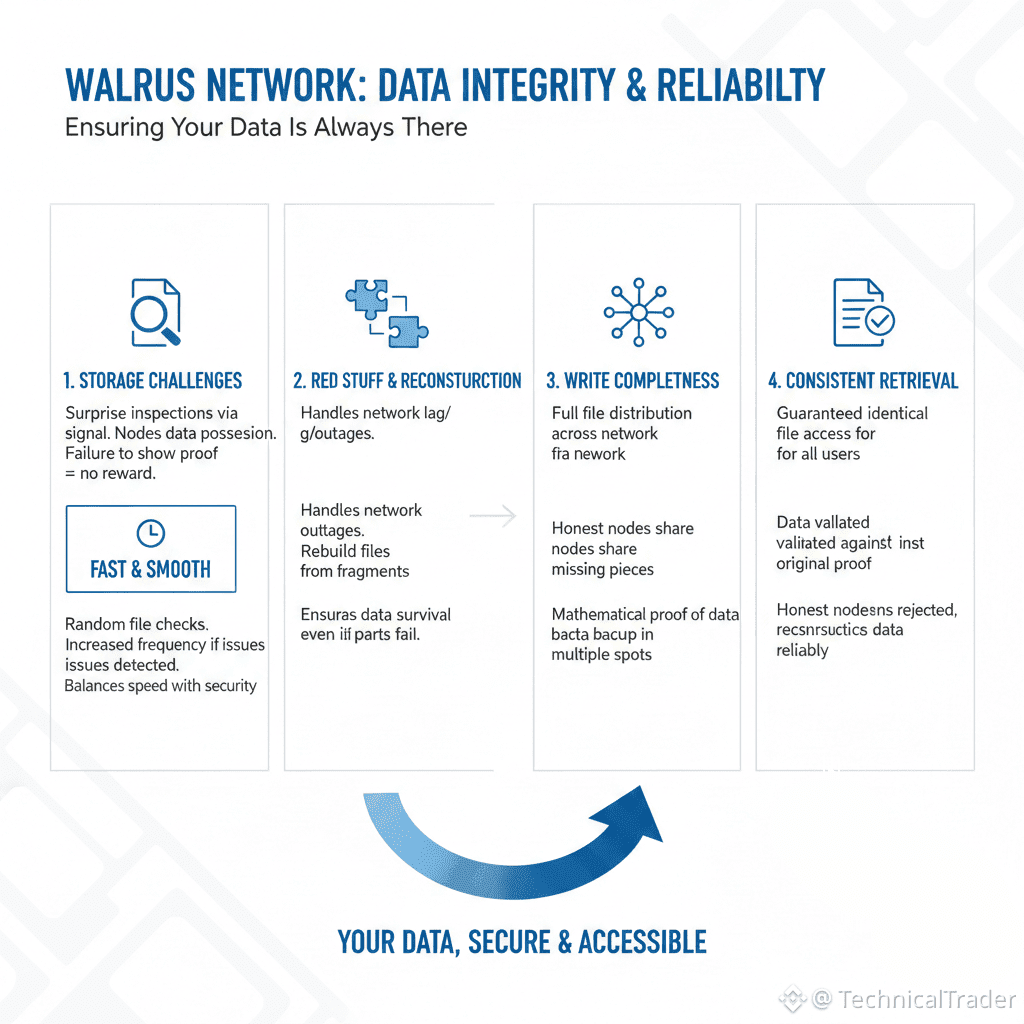
Have you ever wondered what happens to your files after you upload them to a decentralized network? It is a bit like sending a package through many different couriers at once. You want to be absolutely sure that they aren't just losing your boxes or lying about having them. In the Walrus network, we use something called a storage challenge to keep everyone in line. It is our way of making sure that the people we pay to keep your data are actually doing their job and not just pretending to be helpful while doing nothing at all.
This system is pretty special because it does not assume that every computer in the world is perfectly in sync. We know the internet can be laggy or slow, so we built Walrus to handle those hiccups. We use a clever method called Red Stuff that lets us rebuild your files even if some parts of the network go dark. Let's look at how we keep these storage nodes honest so you never have to worry about your data disappearing.
How They Catch the Cheaters
When it is time to check on the nodes, a signal goes out on the blockchain. I like to think of this as a surprise inspection. At this point, the nodes stop their regular chores and focus entirely on the challenge. They have to prove to each other that they still hold the specific pieces of data they were assigned. If a node cannot show its work, it does not get rewarded. It is a simple but very effective way to make sure no one is taking shortcuts with your files.
During this inspection, nodes exchange proof that they have the right symbols for each blob of data. They need to collect signatures from their peers to prove they are telling the truth. If they cannot get enough signatures, they fail the challenge. We designed it so that even if a bad actor tries to slow things down or hide data, they simply won't have enough pieces of the puzzle to trick the rest of the honest group.
Making Things Fast and Smooth
Now, you might be thinking that stopping the whole network for an inspection sounds a bit slow. You are right! That is why we also have a faster, more relaxed version of the challenge. Instead of checking every single file every single time, we use a random tool to pick a few files at a time. This keeps the nodes on their toes because they never know which file we are going to ask for next. It is much like a teacher calling on a random student in class to make sure everyone is paying attention.
If we ever notice that people are having trouble reading their files, we can instantly make the challenges harder. We can turn up the frequency until we are sure the malicious nodes have nowhere to hide. This balance allows Walrus to stay incredibly fast for you while still being a nightmare for anyone trying to cheat the system. We want your experience to be seamless, but we also want the security to be rock solid.
Making Sure Your File Is Everywhere
When you save something on Walrus, we want to make sure it is fully stored across the whole network. This is what we call Write Completeness. We make sure that even if the network is a bit messy at first, every honest node eventually gets the pieces they need. If one node is missing a part, it can talk to its neighbors to fill in the gaps. We have math that proves that as long as we have enough honest players, your data will always be fully backed up in multiple spots.
It is a team effort. Each node holds different types of data pieces, and they help each other reconstruct the full picture. This means that once you hit save, you can rest easy knowing that the network is working behind the scenes to spread your file out safely. Even if a few computers fail, the rest of the Walrus community has your back and will make sure the data stays alive and well.
Getting Your Data Back Every Time
The final piece of the puzzle is making sure you can actually read your data when you need it. We have a rule that says if you and I both try to open the same file, we should get exactly the same thing. There are no surprises here. The system is designed so that the data is checked against an original proof. If a node tries to give you a fake version of your file, the system will reject it immediately. This keeps everything consistent for everyone.
Because we have these strong rules in place, we can guarantee that your data is valid. If you are an honest user and you store a file correctly, the Walrus network promises you can get it back. The honest storage nodes will always have enough pieces to put your file back together for you. It is a reliable, human centered way to handle digital storage that puts your needs first. We are building a system where trust is earned through proof, and your data is always right where you left it.
What you think about this? don't forget to comment 💭
Follow for more content 🙂