

@Walrus 🦭/acc The thing you learn quickly, living close to Walrus, is that “storage” is a social promise before it is a technical one. Someone puts a piece of their life into a file—an identity credential, a model snapshot, a game item, a receipt, a legal artifact—and they are not really asking whether it can be written. They’re asking whether it will still be there later, when they’re tired, when they’re under pressure, when the network is noisy, when the people operating the machines have incentives to cut corners, and when the world has moved on and nobody remembers that this particular blob ever mattered. Walrus is built around that uncomfortable gap between what people assume and what distributed systems actually do in the wild.
Asynchronous challenges sound abstract until you remember what “asynchronous” means in human terms: delays, partial outages, jitter, congestion, and the kind of messy timing that shows up precisely when stakes are highest. In a calm lab network, you can pretend that time behaves. In the real world, time misbehaves, and adversaries love that. The point of Walrus leaning into challenges that don’t depend on tidy timing assumptions is not academic purity. It’s a refusal to let “the network was slow” become a loophole that lets a storage operator appear honest without doing the work of actually holding the data. The Walrus paper is direct about this: it frames a challenge protocol designed to make no synchrony assumptions, so delay can’t be weaponized as a hiding place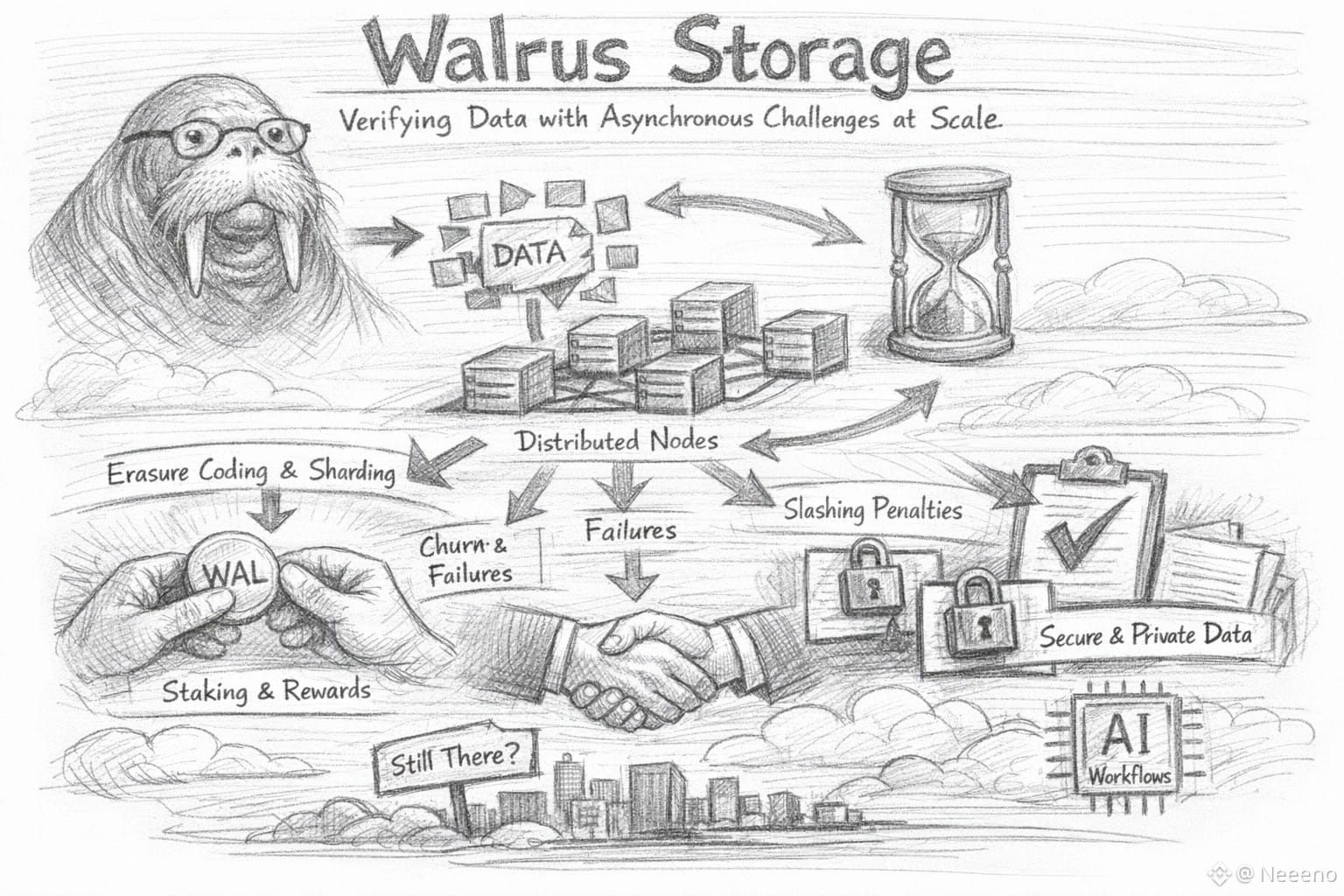
What’s quietly intense about Walrus is that it treats verification as something that must scale with the emotional reality of users. People don’t check their stored data every hour. They assume, and then they forget. And the most painful failures happen when the user returns months later, often at the exact moment the data becomes important again—an appeal, an audit, a dispute, a recovery, a moment of proof. Walrus pushes against that pattern by making “being available” something the network can continuously test and account for, rather than a faith-based claim made at upload time. That’s why the project keeps returning to the idea of an onchain audit trail for custody, where proofs and rewards are tied to verifiable behavior over time, not to reputation or marketing.
Under the hood, the system’s efficiency choices are also trust choices. Walrus is designed so that data can be reconstructed even if a large fraction of nodes disappear or fail, and it does so without relying on crude full replication as the only safety mechanism. The research describes a two-dimensional erasure-coding approach with a stated replication factor around 4.5×, and emphasizes recovery that is proportional to what was lost rather than forcing a full re-download of everything. That matters economically, but it also matters psychologically: recovery that is practical is recovery that actually happens, which is the difference between resilience as a slogan and resilience as lived experience. 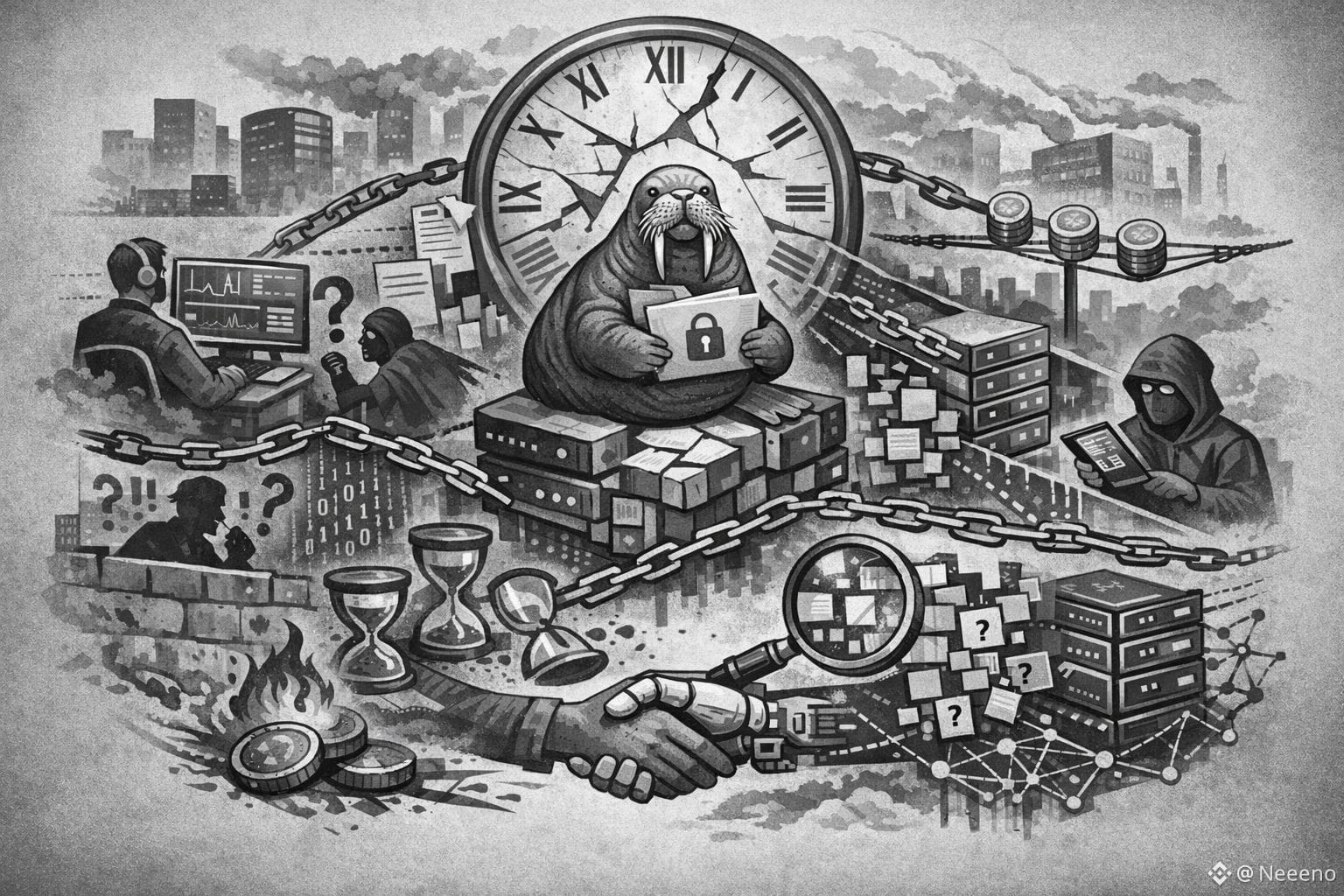
The scale problem isn’t just size, it’s churn. Storage networks don’t fail only through malice; they fail through boredom, bills, hardware decay, and operators leaving without ceremony. Walrus’s design leans into the idea that membership changes are normal and must be survived without drama, including during committee transitions. The paper describes a multi-stage epoch-change approach intended to handle churn while maintaining availability through transitions. This is the part most users never see: the network continuing to behave like a reliable shelf even while the people carrying the shelf swap positions mid-walk.
But challenges alone don’t create honesty. People become honest when honesty is the easiest way to make money over time, and dishonesty is expensive, humiliating, and hard to sustain. Walrus anchors that reality in its token economics. The official WAL pages describe delegated staking as the security backbone, and they’re explicit that stake influences which nodes are entrusted with data. The system doesn’t just ask nodes to perform; it makes users complicit in picking who performs, and then it enforces consequences when that choice is careless. Low performance can be punished through slashing, and Walrus notes that part of slashed amounts are intended to be burned, turning failure into a direct cost rather than a soft reputational bruise.
Even the way payments are framed is revealing. Walrus describes a payment mechanism designed to keep storage costs stable in fiat terms, with users paying upfront for a fixed storage period and that payment being distributed over time to nodes and stakers. That structure quietly reduces a common kind of panic: the fear that a token price move will suddenly turn “keeping your data alive” into an unpredictable obligation. People don’t just want decentralization; they want a bill they can understand, and a time horizon they can trust.
The network’s public milestones tell the same story in concrete numbers. Walrus’s mainnet launch announcement in March 2025 described a network with over 100 independent node operators at launch and a resilience target where data remains available even if up to two-thirds of nodes go offline. Those claims aren’t just performance chest-beating; they’re an attempt to set expectations around what “still there” should mean when things go wrong, not when everything is healthy.
As Walrus grew in 2025, its updates looked like fixes for real problems people were facing, not just future plans. In early September 2025, Walrus added a way to lock and protect data, so apps could keep some information private while still using the network to store and check files. That’s the kind of release you prioritize after you’ve listened to builders admit, quietly, that “public by default” is not compatible with many legitimate uses of data—identity, sensitive business logic, proprietary datasets, or anything involving safety. Walrus didn’t frame it as a moral shift; it framed it as infrastructure becoming honest about how people actually live.
In late 2025, the partnerships started to carry measurable load. The Humanity Protocol migration announcement is unusually specific: it references over 10 million credentials stored on Walrus and an ambition to grow toward 100 million credentials by the end of 2025, alongside an estimate of over 300GB of data by year’s end. Numbers like that matter because they force the verification story out of theory. Ten million is where edge cases become normal cases. That’s where asynchronous challenge design stops being a clever paper and becomes the quiet reason a system doesn’t embarrass people at scale.
Around the same period, Walrus positioned itself more explicitly as a data layer for AI-heavy workflows, where “bad data” isn’t an inconvenience but a financial and safety hazard. The project’s own recent writing leans into the idea that unverifiable origin and invisible manipulation are structural problems, not mere UX issues, and that a decentralized storage layer only matters if it makes provenance and availability legible under adversarial conditions. You can feel the ecosystem’s direction here: verification isn’t being treated as a niche crypto obsession, it’s being treated as a necessary boundary around reality when incentives push everyone to cut corners. 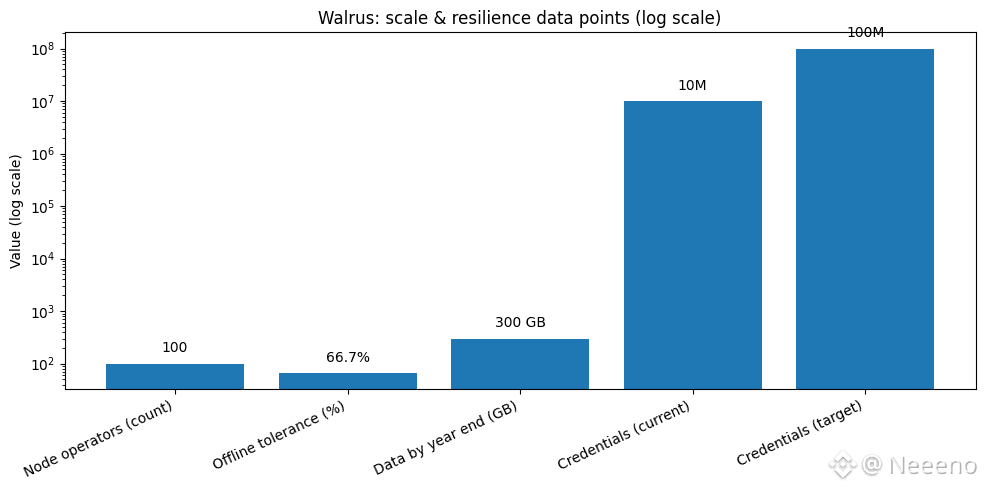
If you zoom out, the asynchronous challenge idea is really Walrus admitting something uncomfortable about people: we will always try to get away with less work if nobody can prove we didn’t do it. The protocol’s answer is not to moralize. It is to create a setting where “pretending” is hard, where delays don’t grant cover, where churn doesn’t erase responsibility, and where the economics reward the operators who keep showing up after the novelty fades. That’s why the token distribution and launch communications keep emphasizing a long runway for ecosystem growth and early subsidies—because the hardest phase for honest behavior is early adoption, when the fee base is small and the temptation to underperform is high.
And there’s one more subtle thing: decentralization doesn’t preserve itself. Walrus’s January 2026 writing about staying decentralized at scale reads like a confession that growth naturally concentrates power unless the system makes concentration feel less profitable than steady, verifiable reliability. The argument is not that large operators are evil; it’s that incentives drift, and infrastructure has to be designed as if drift is guaranteed. In a storage network, that drift shows up as quiet censorship, preferential treatment, and the slow conversion of “permissionless” into “you can participate, but you won’t matter.” The project’s emphasis on performance-linked rewards is a way of making fairness enforceable without asking anyone to be virtuous.
So when you say “verifying data with asynchronous challenges at scale,” what you’re really describing is Walrus trying to make reliability a measurable property rather than a promise. It is data split and spread so loss is survivable. It is challenge design that refuses to treat time as trustworthy. It is staking that turns attention into responsibility, because delegators shape which operators get entrusted with real data. It is penalties that make neglect costly, and payment design that tries to keep the user’s relationship with storage emotionally stable even when markets are not.
More and more, Walrus’s public updates show where real demand is showing up: mainnet in March 2025, access control in September 2025, big credential moves by October 2025, and a steady shift toward verifiable data for the AI era—because unreliable inputs aren’t a “maybe” anymore. In the end, Walrus feels less like a product and more like a promise to do the quiet work. No one cheers when a file is still there.Nobody celebrates the absence of loss. And that’s the point: the best infrastructure earns less attention over time, because it removes the need for vigilance. The deeper promise Walrus is making—through asynchronous challenge design, through its WAL-aligned incentives, through its insistence that verification must survive real network mess—is that reliability should not be a luxury good purchased by the paranoid. It should be the default posture of the system, even when nobody is watching, even when the easiest path would be to fake it, and especially when the world is loud and uncertain. That kind of reliability doesn’t look like excitement. It looks like restraint, continuity, and the calm dignity of something that keeps holding weight long after the crowd has moved on.

