
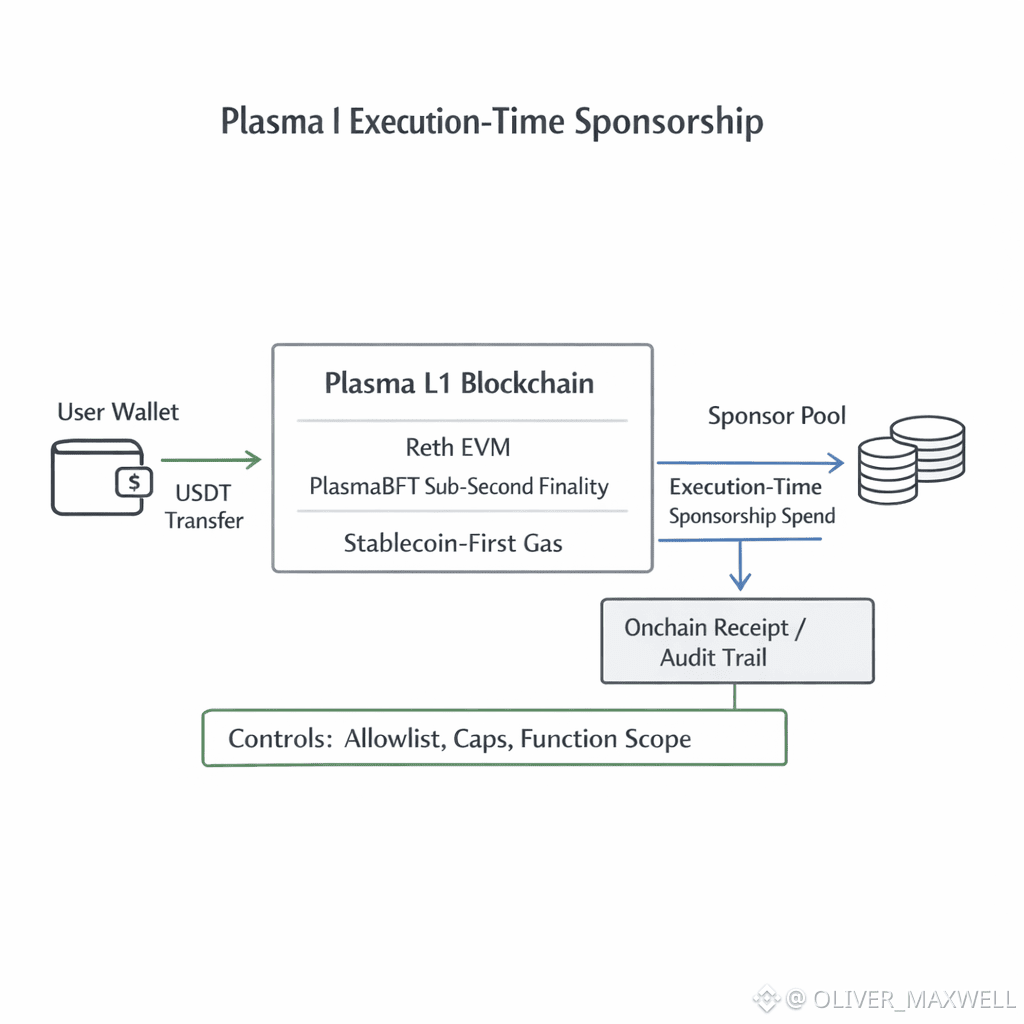
Plasma is built for stablecoin settlement when a visible fee breaks checkout, so it treats gasless Tether USDT transfers as an execution-time sponsorship expense that can be audited. On Plasma, a gasless USDT transfer is not a promise that someone will reimburse fees later. It is a spend that exists only when the transfer actually executes. The sponsorship spend is triggered only when a real USDT transfer executes, so the subsidy becomes an accountable expense tied to completed settlement, not a marketing line item that drifts away from usage.
That execution-time rule changes how Plasma can safely offer gasless transfers without losing track of leakage. With full EVM compatibility via Reth, Plasma can express sponsorship as onchain logic around a specific call path, for example paying for the exact USDT transfer invocation and nothing adjacent. With PlasmaBFT’s sub-second finality, the sponsor’s balance reduction and the user’s USDT movement converge into one operational event, which matters because auditability collapses if usage happened and subsidy was charged land in separate timelines.
Plasma can treat a sponsor deposit as a spendable pool that is consumed inside the same transaction that moves USDT. When the chain is designed so the subsidy is paid at execution time, the sponsor does not need an offchain reconciliation process to discover what they owe after the fact. The chain’s state already contains the spend trail, and every paid transfer leaves a native record of who sponsored it, what function was sponsored, and when the spend occurred.
Plasma’s stablecoin-first gas design keeps the sponsorship budget aligned with the same unit that businesses already use for settlement accounting. If the protocol supports fee payment in a stablecoin context, the sponsorship budget can be managed in the same unit that the business already uses for settlement accounting, rather than forcing a separate treasury workflow that oscillates with a volatile native asset. Plasma’s gasless USDT transfer feature becomes closer to a predictable operating cost because the system is built to measure it in the act of transferring USDT, not as a secondary reimbursement program.
Abuse resistance is measurable on Plasma because sponsorship spend only increments on executed transfers, so leakage shows up as spend per completed USDT move. A sponsor policy on Plasma can be tight enough to define what real means operationally, for example limiting sponsorship to transfers that match a known ABI signature, bounding maximum sponsored gas per sender per time window, or restricting sponsorship to flows that originate from specific contract wallets. Those controls are not cosmetic on Plasma because the sponsor only pays when execution happens, so tightening policy immediately reduces spend on the next block rather than waiting for a reporting cycle.
That policy control creates a trade-off on Plasma because sponsors can exclude flows that do not match their criteria even when transfers are otherwise valid. If sponsorship is policy-controlled, then the sponsor becomes a gatekeeper for which transfers are free, and Plasma has to earn trust that this does not become selective exclusion. If Plasma’s Bitcoin anchoring is implemented as planned, it should strengthen the neutrality of the settlement record, but it will not remove sponsor policy power.
For retail in high-adoption markets, this execution-time model is operationally different from a generic fee subsidy. A sponsor can fund small transfers as a customer acquisition expense, but Plasma forces that expense to track completed USDT movements, not app opens, not signups, not eligible users. If a spammer tries to farm sponsorship, Plasma’s accounting shows it immediately as executed transfer spend, and the sponsor can respond with stricter criteria that still preserve gasless UX for the intended corridor. Plasma’s fast finality matters here because a sponsor cannot operate a tight budget if cost attribution lags behind settlement.
For institutions, the same property reads like controllable settlement plumbing rather than a promotion. A payments firm sponsoring gasless USDT transfers on Plasma can map sponsor spend to the transaction ledger with a traceable link between expense and settlement outcome, which fits internal controls and external audit expectations better than reimbursements that occur after execution. Plasma’s EVM surface area also matters because institutions often need deterministic contract behavior for accounting integration, and the sponsorship logic is itself a contract-level control surface that can be reviewed, versioned, and monitored.
My own observation is that Plasma’s most credible differentiation sits in how it forces honesty in subsidy programs. When sponsorship spend is only recorded on executed USDT transfers, the chain turns growth spend into a measurable cost of throughput, and that makes it harder to misprice free transfers as a vague perk. Plasma is effectively telling sponsors that if they want gasless settlement, they must accept a per-execution expense trail that can be scrutinized by anyone who can read the chain state, including risk teams and counterparties.
That scrutiny cuts both ways, and Plasma has to live with the operational consequences. If sponsorship budgets are public or inferable, a sponsor’s willingness to subsidize a corridor can become visible, which may invite adversarial probing for the cheapest ways to consume the budget. Sponsorship farming can still happen on Plasma via low-value transfers designed to drain budgets, so sponsor policies must rate-limit and scope what they pay for. Plasma’s design still helps because the attack surface is quantified as executed-transfer sponsorship spend, which lets sponsors tighten caps, allowlists, and function scope immediately. The project is not claiming that abuse disappears. On Plasma, abuse is harder to obscure because sponsorship spend posts at the same time the draining transfer executes.
Plasma must keep validator compensation and any fee conversion transparent, because execution-time sponsorship only stays auditable when sponsors can reconcile what they paid with what validators received. If validators ultimately need compensation that is not identical to USDT, Plasma must ensure the mechanism that turns sponsored stablecoin-funded fees into validator revenue does not introduce opaque slippage or discretionary pricing, because that would erode the very auditability the model depends on. Plasma’s sponsorship model is strongest when the sponsor can forecast spend per executed transfer within bounded variance and explain deviations as network conditions rather than hidden policy shifts.
When sponsorship is charged at execution on Plasma, subsidies behave like settled receipts that clear as each USDT transfer finalizes. Sponsors can compete on how efficiently they can fund real USDT movement, and users can judge reliability by whether sponsorship policies remain stable under load. On Plasma, a subsidy is a receipt written at execution, which keeps gasless USDT settlement a controllable expense rather than an offchain promise.

