
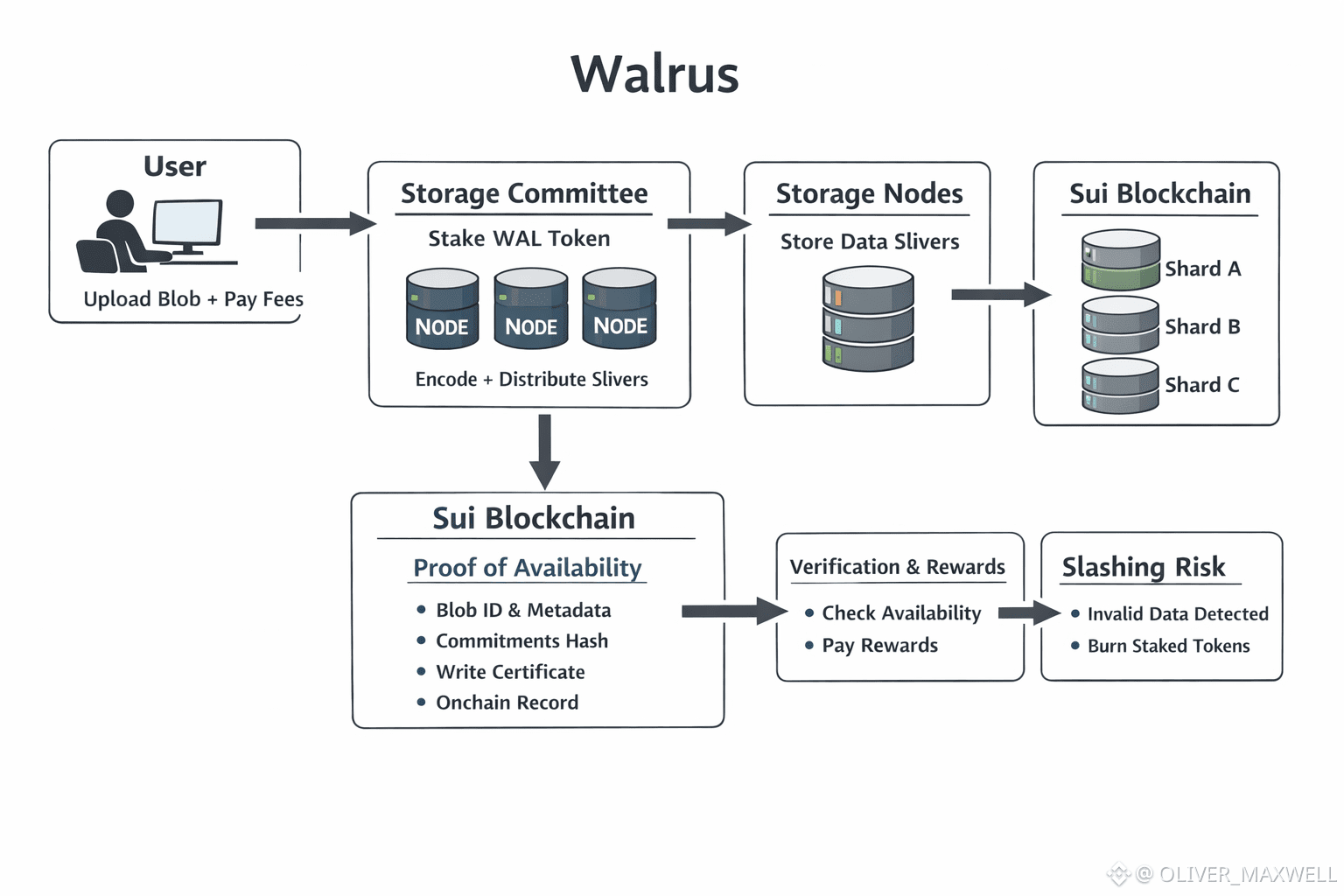
Walrus treats decentralized storage on Sui as an economic contract, with Move smart contracts coordinating payments, committees, and Proof of Availability records for each stored blob. Right now, a Walrus write becomes an onchain Proof of Availability on Sui that starts fee distribution and ties the storage committee to stake that can later be penalized, which makes uptime a priced obligation. On Sui, a blob is represented as an object whose metadata binds an identifier, commitments, size, and paid duration. The write flow registers intent and payment on Sui. It encodes the blob with Red Stuff into slivers, sends slivers and commitments to the storage committee, collects signed acknowledgements, aggregates them into a write certificate, and publishes that certificate on Sui as Proof of Availability.
Walrus security uses delegated proof of stake around the WAL token, storage nodes stake WAL to join the storage set, and delegators assign stake that drives committee weight and shares reward flow. Stake influences committee and shard assignment by epoch, and committee selection for an epoch is decided midway through the previous epoch to give operators time to provision for their assignments. Storage pricing follows node proposals at epoch start, with the selected price derived from a stake weighted percentile rule. Users pay storage fees in WAL for a specified duration, fees are paid upfront, and rewards are distributed over time to storage nodes and delegators. Governance uses WAL weighted voting to adjust parameters and penalties, and slashing is defined as burning stake.
Red Stuff is described as achieving a 4.5 times replication factor. Walrus runs asynchronous storage challenges that result in threshold signed certificates posted on Sui. If a publisher sends incorrect slivers or commitments, nodes can attest invalidity on Sui after a quorum threshold, and the network will refuse to serve slivers for that blob. Walrus uses a multi stage epoch change protocol intended to maintain availability during committee transitions under quorum assumptions.
In Walrus, the Proof of Availability posted on Sui is the point where a storage promise becomes an enforceable claim against stake. That onchain receipt gates fee accrual over time and it identifies which stake is exposed when slashing activates. Because the receipt lives on Sui, a verifier can read one record to see when custody starts and what commitments were made, instead of trusting operator logs. Publishing Proof of Availability ties storage accountability to Sui liveness and to Sui fee conditions. That publication step is the boundary that makes the storage obligation binding.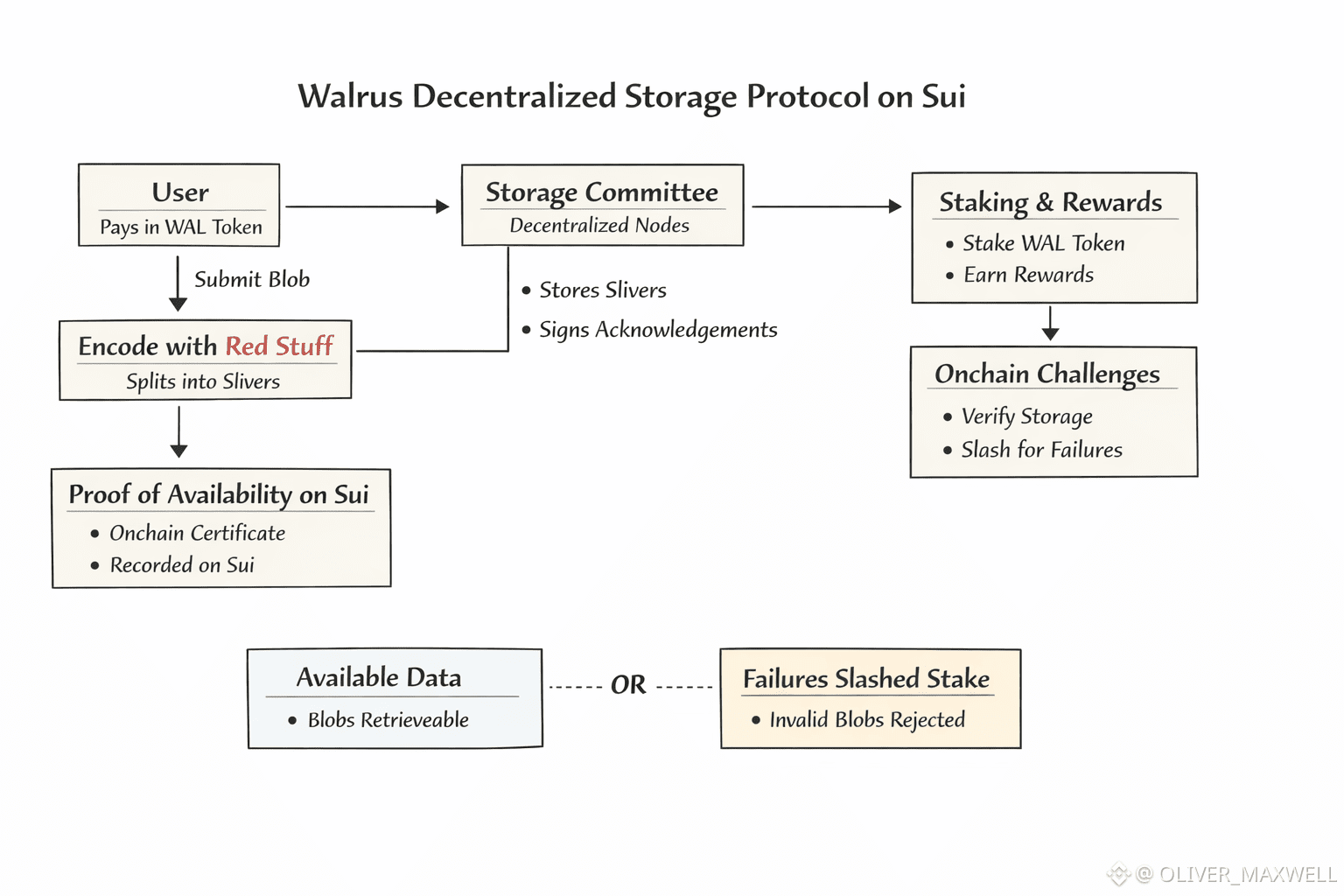
Red Stuff lowers the cost of maintaining availability by trading extra encoded pieces for easier repair. A 4.5 times replication factor means availability is paid for as encoded redundancy rather than as full copies, which changes what operators are actually committing to keep. The accepted constraint is that encoding correctness and repair coordination must hold under churn for the redundancy budget to work. A misencoded blob can be marked invalid through onchain attestations after a quorum threshold on Sui, and nodes then refuse to serve its slivers.
WAL stake determines which operators can join committees that store slivers and earn the stream of fees tied to Proof of Availability. Delegated proof of stake ties committee participation to WAL stake, and it gives delegators a direct lever over which operators get custody weight and reward flow. The midpoint committee selection rule forces long range commitment, since stake changes after the cutoff cannot rewrite the next committee immediately, which is a deliberate constraint that converts availability into an epoch scoped obligation. Price selection adds a second incentive signal, since a stake weighted percentile price reduces how often low stake proposals can set the clearing storage fee.
Challenges are the check that links ongoing custody to onchain certificates. A practical integration risk is publisher side mistakes, incorrect slivers or commitments can be attested as invalid on Sui after a quorum threshold, and nodes then refuse to serve that blob. Application teams should treat encoding correctness and Proof of Availability confirmation as the first operational gates, since reward and penalty logic only executes against those receipts.
Consider a hypothetical incident during an epoch boundary. A publisher stores a large blob, then delegators shift stake toward a different node set right after the midpoint cutoff, expecting to chase a higher return implied by the next epoch price selection. Custody does not move immediately because the committee is already locked, so the publisher remains bound to the prior committee until the epoch boundary, while the multistage transition completes under quorum rules. To me, that structure prices patience, stake can signal the next committee but it cannot unwind the obligation already recorded in Proof of Availability.
I would watch whether committee transitions and challenge certificates remain routine under churn, because that is where an availability asset either stays enforceable or becomes operationally noisy. The operational test is whether applications can plan around receipt finality, epoch boundary pricing, and the invalidation path for incorrect blobs without unexpected loss of service. When slashing activates, the decision point is whether Proof of Availability receipts and threshold signed challenge certificates stay consistent across epoch changes, and whether refusals to serve are confined to the explicit invalidation path on Sui.

