

When we think about growth in Web3, our minds often jump to technology faster consensus mechanisms, lower gas fees, or innovative tokenomics. But in reality, technology alone does not scale ecosystems. People do. And in crypto, “people” means community.
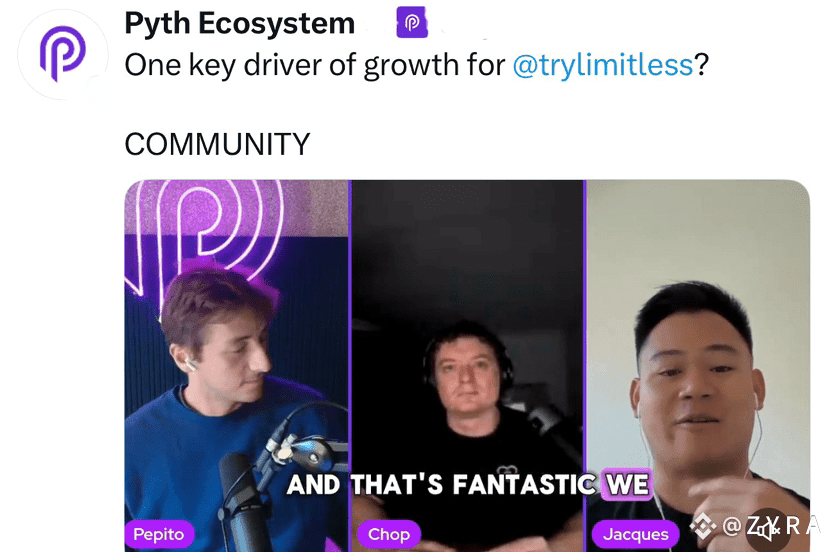
The @Pyth Network Ecosystem’s recent spotlight on Limitless brings this truth to the forefront: the strongest driver of growth isn’t necessarily the most advanced code or the biggest capital raise it’s the ability to mobilize, energize, and sustain a community.
Part 1: The Anatomy of Community Power
Community is often oversimplified as “having a lot of followers” or “a big Discord.” But in decentralized ecosystems, community is multi-layered capital:
1. Social Capital: The collective trust, reputation, and narratives that projects build with their users.
2. Intellectual Capital: Community members contribute ideas, governance decisions, and even code.
3. Financial Capital: Communities don’t just talk they stake, farm, and trade, fueling liquidity.
4. Cultural Capital: Memes, vibes, and shared values that bind strangers into movements.
Unlike Web2, where users are passive consumers, Web3 transforms communities into stakeholders.
Part 2: Community as a Growth Engine
For Limitless and others in the Pyth ecosystem, community drives growth in three critical ways:
• Adoption Multiplier: Communities amplify adoption by acting as decentralized marketing networks. A single enthusiastic holder can onboard dozens of peers.
• Resilience Builder: In bear markets, strong communities become shock absorbers. They provide conviction when speculation dries up.
• Innovation Catalyst: Open ecosystems thrive when community members propose use cases the core team never envisioned.
In other words, community converts technology into movement.
Part 3: Case Study – Limitless in Pyth’s Ecosystem
Limitless didn’t emerge in isolation. It grew because:
• Pyth’s decentralized oracle infrastructure gave it credibility.
• Its community-centric strategies (transparent communication, community incentives, collaborative spirit) created a feedback loop.
• Users weren’t just customers they were advocates, builders, and validators of the vision.
This formula infrastructure + community = growth flywheel is the playbook for sustainable Web3 projects.
Part 4: The Practical Blueprint for Community Growth
From a conceptual lens, community growth looks abstract. Practically, it follows clear steps:
1. Early Alignment: Communities rally around why the project exists, not just what it does.
2. Shared Ownership: Tokens, governance, and rewards create financial + emotional buy-in.
3. Transparency: Trust grows when decisions, risks, and updates are openly shared.
4. Empowerment: Letting the community lead (rather than control from the top) turns them into builders.
5. Recognition: Acknowledging community contributions creates lasting loyalty.
Projects that master these steps move from users to tribes.
Part 5: Conceptual Implications
The community-as-growth-driver perspective also reshapes how we think about competition:
• In traditional industries, firms compete on product features.
• In Web3, projects compete on community resilience, conviction, and mobilization.
Limitless shows that a community-first strategy isn’t a marketing gimmick, it’s survival.
Conclusion
The future of decentralized ecosystems won’t be won by the most elegant protocol design or the flashiest UI. It will be won by those who nurture the strongest, most committed communities.
In the words of the Pyth Ecosystem: the key driver of growth is clear. It’s community.