

@Plasma s wager starts with an uncomfortable observation: most people don’t experience stablecoins as “crypto.” They experience them as a digital dollar that either moves when they need it to, or doesn’t. In the places where USDT is already daily infrastructure, the user’s mental model is painfully simple. If sending it requires acquiring a second asset just to pay a toll, the system feels like it was designed for insiders. Plasma is trying to erase that moment of friction so completely that the transfer feels like the stablecoin itself is the rail, not a passenger on someone else’s rail.
That sounds like a product decision, but it’s actually a deep economic claim about who should carry the cost of settlement. Plasma’s own documentation makes the key point explicit: the fee is not “refunded later” and it is not magically created; it is sponsored at the moment the transfer happens, funded up front rather than reimbursed after the fact. In other words, the chain is choosing to treat basic USDT movement as a public good it is willing to underwrite, at least while it proves that the behavior is real and the demand is durable. That is not a cosmetic tweak. It is a statement that the first job of the network is to make the most common action—sending a dollar token—feel emotionally safe and mechanically boring.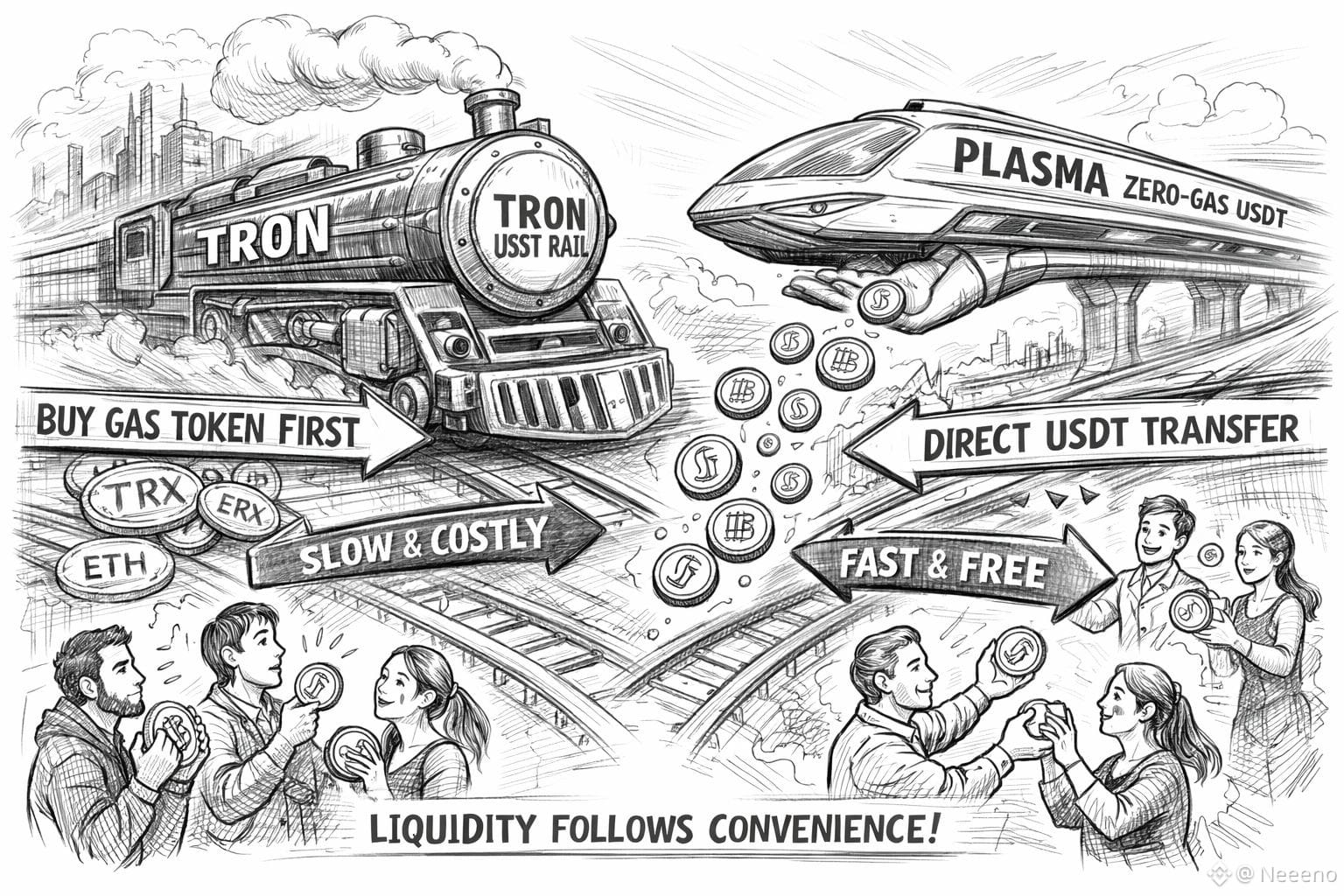
Where this becomes more than a slogan is in the way Plasma tries to keep “free” from turning into “abused.” The documentation is unusually candid that the current implementation is still being hardened and may evolve as performance and security assumptions are validated. That kind of honesty matters because the easiest systems to market are the ones that pretend edge cases don’t exist. Plasma points directly at the edge case: if you sponsor transfers, you invite spam, laundering patterns, and automated extraction. So the network wraps sponsorship in controls that treat identity and behavior as first-class risk signals, not moral judgments. Rate limits exist not as a punishment, but as a way of preventing one actor from turning a public subsidy into a private weapon. This is the moment where the chain stops being a fantasy of perfect users and starts acting like infrastructure built for the real world.
You can also see the worldview in how Plasma insists that the sponsorship mechanism lives in a place normal users never touch. Integrations are described as something that should run server-side, with keys never exposed to browsers, and with an explicit requirement to pass through real end-user network information so abusive patterns can be throttled. That design choice is easy to dislike if your religion is maximal permissionlessness in every layer, but it becomes easier to respect if you’ve ever watched a payments system collapse under bot traffic. Plasma is telling builders, quietly, that the privilege of removing friction comes with responsibility for attribution and containment. And it’s telling users, just as quietly, that their experience should not be held hostage by someone else’s ability to automate chaos.
The reason the title frames this as a direct challenge to Tron’s stablecoin empire is not mainly ideological. It’s arithmetic and habit. Public research and reporting around Tron’s USDT flows paints a picture of a settlement rail that has become a default for retail-sized transfers at enormous scale, with estimates placing circulating USDT on Tron in the tens of billions and annual transfer volume in the trillions. That scale isn’t just a leaderboard; it’s a behavioral moat. When a network becomes the place people expect USDT to work, switching costs become emotional as much as technical. Plasma is not trying to win an argument; it’s trying to interrupt a habit by removing the one moment that still feels like “crypto” to a stablecoin user: the moment you must hold something else to move your dollars.
But if you live inside this ecosystem, you know the hard part isn’t making a transfer free once. The hard part is making it free when everything is going wrong. Volatility spikes, bridges get congested, centralized endpoints degrade, and suddenly a “simple send” becomes a support ticket. Reliability isn’t something you can claim in advance. You prove it during the worst weeks. That’s why Plasma’s docs talk about what to do when things degrade, how to run basic health checks, and how to read clear failure codes. The user never reads those pages, but the user feels them when the payment either lands, or hangs, or fails with a reason that can be acted on. Emotional safety in money movement often comes down to one quiet thing: do you know what is happening when it doesn’t work?
This is also where Plasma’s relationship with USDT stops being a marketing association and becomes operational reality. A sponsored transfer system pushes questions upstream: who pays, how much, under what conditions, and for how long. Plasma answers part of that today by stating that the foundation funds the subsidy initially, and by emphasizing that spending is observable and tied to actual USDT transfers, not to vague growth promises. It’s a subtle but important distinction. If you’re going to tell the world “you can send dollars with no fee,” you need to show that the cost is not being hidden in the dark where users can’t audit it. Even for users who never audit anything, the existence of observable spending is a backstop against the feeling that the rules are arbitrary.
Now add the token, because Plasma is unusually explicit about how it thinks security budgets should work. According to Plasma’s own tokenomics documentation, the initial supply at mainnet beta launch is 10,000,000,000 XPL. It lays out a distribution that is heavy on ecosystem growth and long-term incentives, with 10% allocated to a public sale, 40% to ecosystem and growth, and 25% each to team and investors. It also spells out a concrete detail that matters more than people admit: U.S. public-sale tokens are locked until July 28, 2026. That date is not trivia. Lockups shape who can sell, who can’t, and therefore who carries price risk during the early years when narratives are fragile. In a payments-first chain, that kind of clarity reduces the background anxiety that everything is secretly liquidity engineering.
The inflation plan is equally direct. Plasma states that validator rewards begin at 5% annual inflation and decline by 0.5% per year until reaching a 3% baseline, with emissions only activating when the validator system expands and delegation goes live. It also states that locked team and investor tokens are not eligible for those unlocked rewards, which is a small sentence with big implications: it narrows the set of actors who can farm early issuance without bearing immediate liquidity risk. Then it pairs inflation with a burn mechanism modeled on Ethereum’s EIP-1559, explicitly framing it as a way to counter long-term dilution as usage grows. The promise here is not that the token magically accrues value. The promise is that the security budget has a ceiling, a slope, and a balancing force, so the economics can be reasoned about instead of worshipped.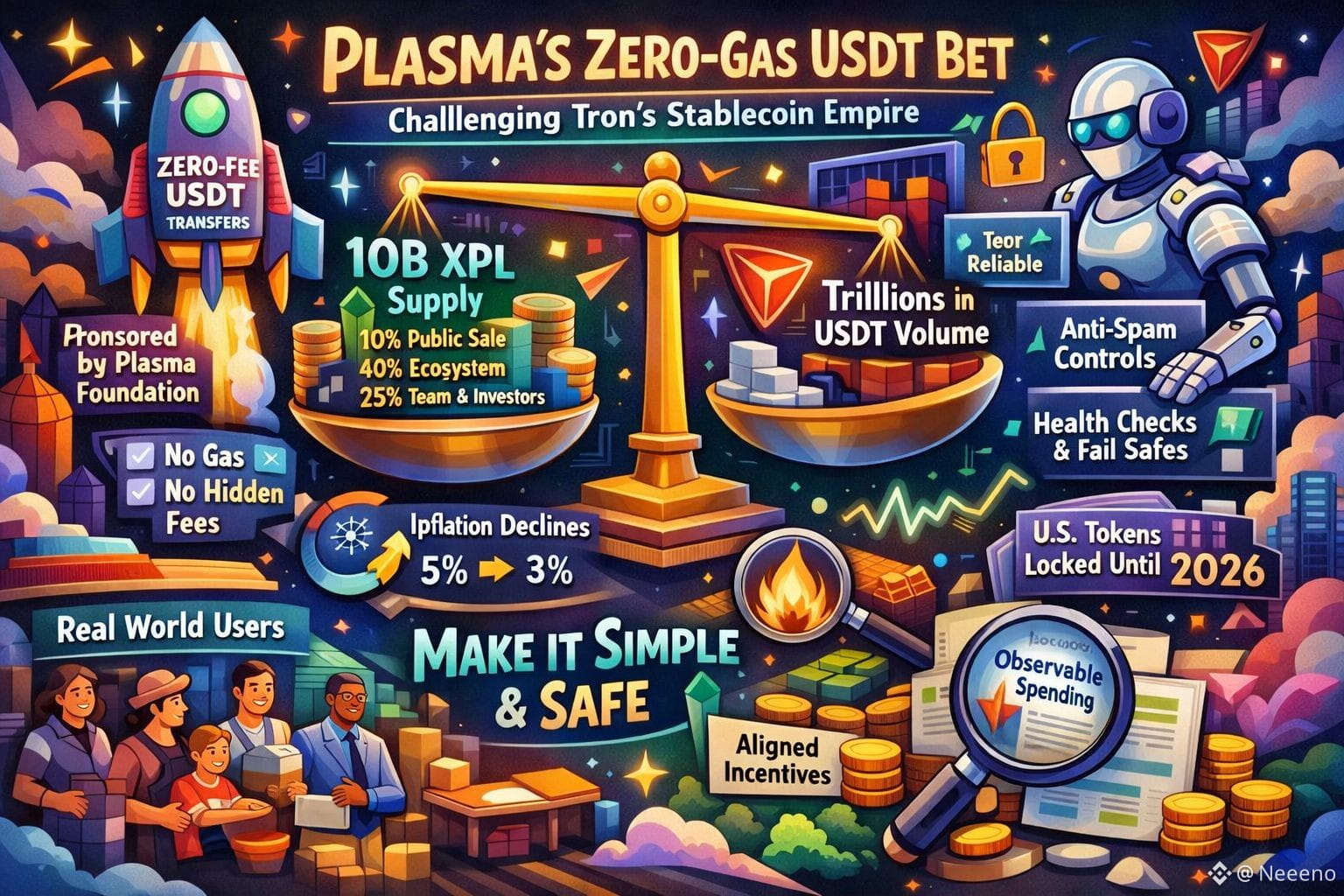
If you zoom out, you can see why Plasma’s funding history matters to the story, not as a flex, but as an explanation of runway. Plasma announced it raised $24 million across seed and Series A led by Framework and Bitfinex/USDT0, with additional participants spanning market makers, exchanges, and named individuals including Paolo Ardoino. That mix is revealing. Payments infrastructure is expensive because the work is mostly invisible: integrations, compliance interfaces, operational tooling, incident response, and the slow grind of winning trust from teams who have been burned before. Capital doesn’t guarantee success, but it does buy time to learn the painful lessons before scale forces those lessons onto users.
The emotional core of the “zero-gas USDT” bet is that it tries to realign blame when something breaks. In many systems, the user is blamed for not holding the right fee token, not setting the right gas parameters, not understanding congestion, not anticipating volatility. Plasma is effectively saying: for the most common stablecoin action, the network will take responsibility for making the transaction legible and for absorbing the complexity that normally leaks onto the user. That shift matters because stablecoins are increasingly used by people who do not consent to being “power users.” They are merchants, families, small importers, payroll operators—people who want the transfer to feel like a utility bill, not a game. When the system forces them to learn weird details to move dollars, it quietly teaches them that their money is conditional. When it removes that lesson, it can teach the opposite: your money is dependable even when you’re not an expert.
At the same time, Plasma can’t escape the off-chain reality that stablecoins come with governance, enforcement, and sometimes freezes. Recent reporting on USDT-related enforcement actions on Tron is a reminder that dollar tokens are not neutral objects; they exist inside legal systems, investigations, mistakes, and disputes. In that world, “infrastructure” means more than fast settlement. It means building flows where compliance pressure doesn’t turn into random user harm, and where honest users can keep functioning even as bad actors are constrained. Plasma’s documentation hinting at identity-aware controls and scoped sponsorship is one way of admitting that tension instead of pretending it won’t arrive.
So the challenge to Tron is not that Plasma claims to invent demand. The demand is already here, measurable in the scale of USDT circulation and transfer activity that external researchers track. The challenge is narrower and sharper: if the dominant stablecoin behavior is “send USDT cheaply and quickly,” then the most dangerous competitor is the one that makes that behavior feel simpler than people thought possible. Tron’s numbers show how large the habit has become. Plasma’s design is aimed at the exact psychological hinge where habits can change: the moment the user realizes they no longer need to prepare, preload, or learn anything extra to move a digital dollar.
The quiet risk, of course, is sustainability. Sponsoring fees is easy to love and hard to maintain.Plasma says that one day validator income might help pay for the “sponsored” USDT transfers, but today it’s still the foundation covering the cost. That honesty matters because it forces the real question: can “free” become self-sustaining through incentives, with spending that’s visible and rules that keep the scope tight? It’s not chasing a miracle. It’s trying to engineer a budget line that can survive the moment growth stops being cute and starts being adversarial.
If you want the data points to hold onto, they’re unusually concrete for a young chain: an initial 10 billion XPL supply at mainnet beta, a defined distribution split, a public-sale allocation with a U.S. lockup ending July 28, 2026, an emissions curve that starts at 5% and steps down toward 3%, and a burn model intended to counter dilution as activity grows. On the usage side, Plasma’s own documentation makes clear that the zero-fee USDT pathway is scoped to direct transfers, sponsored at execution time by a foundation-funded pool, with rate limits and identity-aware controls, and with implementation details still being refined. And on the market reality side, public research around Tron’s USDT flows helps explain why Plasma chose this exact wedge: the “stablecoin rail” category is already massive, with billions of transfers and trillions in annual USDT movement being attributed to the incumbent network. 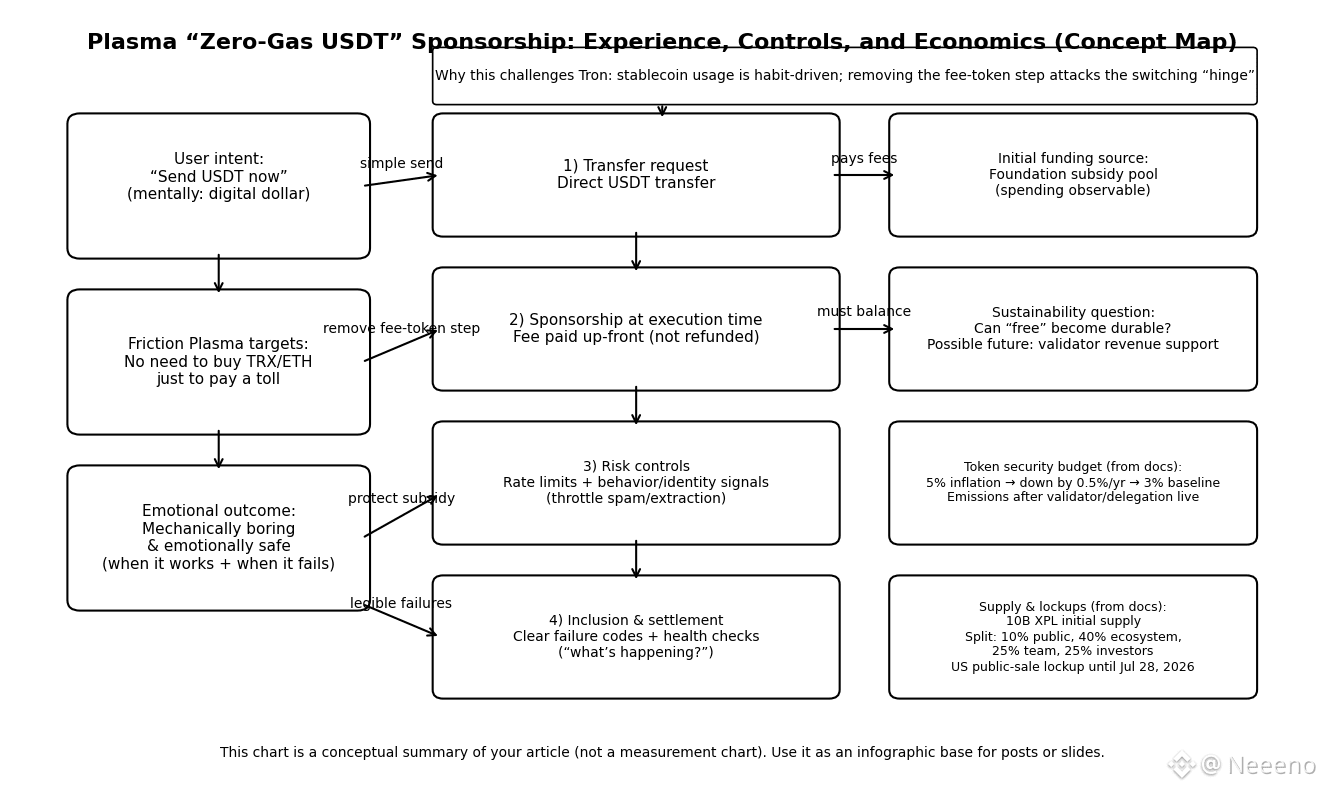
In the end, the most important part of Plasma’s bet isn’t that it wants attention. It’s that it is trying to take responsibility for the parts of payments most systems outsource to user frustration. The chain is building around the idea that reliability is a moral stance as much as a technical one: you either design for the moments when people are scared and in a hurry, or you design for demos. Invisible infrastructure is what keeps families from feeling panic when money is late, what keeps merchants from blaming customers for network quirks, what keeps teams from improvising under stress. If Plasma succeeds, it won’t be because it won a narrative war. It will be because, in the unglamorous daily act of sending USDT, it made responsibility feel normal—and made “it just works” more valuable than being seen.


