


Dusk Network feels like it was built with one real world question in mind: how do you move regulated finance on chain without forcing every participant to broadcast their balances, counterparties, and trading intent to the entire internet. That is the identity of the project in one sentence. The official documentation frames Dusk as a privacy blockchain for regulated finance, designed so institutions can meet regulatory requirements on chain, users can keep balances and transfers confidential, and developers can still build using familiar EVM tooling with native privacy and compliance primitives.
Dusk That matters because most financial systems run on closed rails and private databases, yet the settlement layer is slow, fragmented, and expensive. Public blockchains solve parts of this by making settlement programmable and globally verifiable, but they introduce another problem: everything is visible forever by default. Dusk tries to keep the advantage of programmable settlement while protecting counterparties and sensitive activity, and it explicitly connects its compliance posture to regimes like MiCA, MiFID II, the DLT Pilot Regime, and GDPR style requirements.
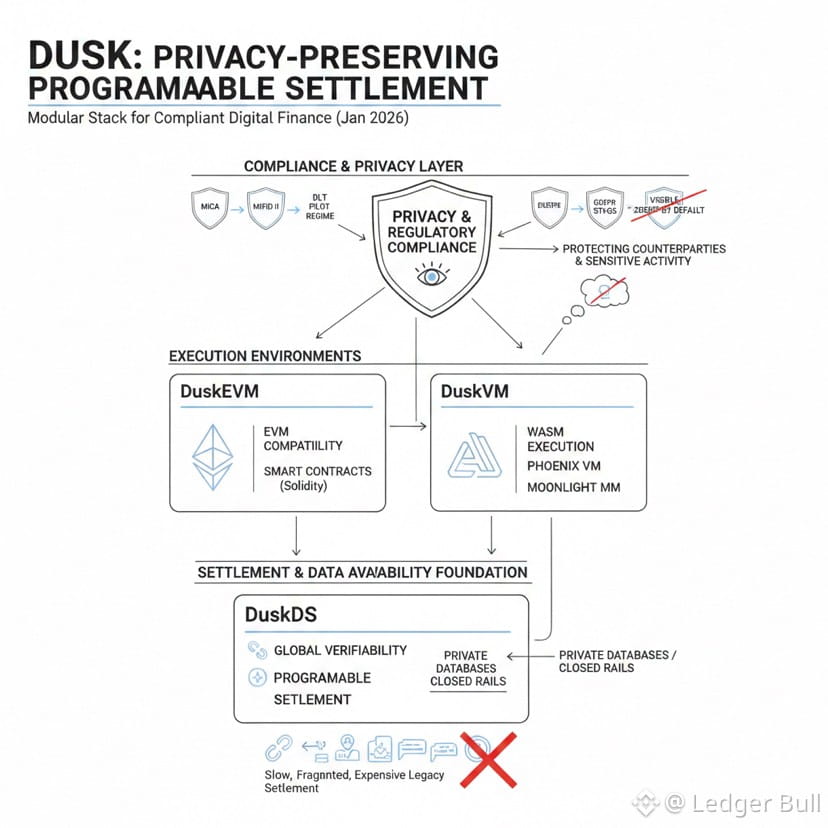
Dusk Under the hood, the project is not a single execution environment with one transaction format. It is designed as a modular stack, where DuskDS acts as the settlement and data availability foundation, and multiple execution environments can run above it. The DuskEVM documentation makes this separation very clear: DuskDS is the settlement and data availability layer, DuskEVM is the EVM execution environment, and DuskVM is a WASM execution environment that can use Phoenix or Moonlight.
Dusk This modularity is a big deal because it lets the base layer focus on what finance cannot compromise on: deterministic settlement, clear finality, and a robust security model. The core components documentation describes DuskDS as having dual transaction models, Phoenix and Moonlight, and it notes that DuskDS also exposes a native bridge for seamless transfers between execution layers.
Dusk Phoenix and Moonlight are not just branding. Moonlight provides public transactions, while Phoenix enables shielded transactions, and that dual model is presented as a way to combine privacy and compliance features depending on what the specific workflow needs.
Dusk Phoenix itself is presented by the team as a core privacy breakthrough for Dusk. In their long form writing, they describe Phoenix as a transaction model designed to preserve confidentiality even when users spend public outputs like rewards or gas change, by storing both public and confidential outputs in a Merkle tree and proving membership and commitment openings.
Dusk Later, they published an update saying Phoenix achieved full security proofs using zero knowledge proofs, and they position those proofs as a major step for confidence in the model.
Dusk becomes even more specific is in how it treats tokenized securities and regulated instruments. The project describes an XSC Confidential Security Contract standard for creating and issuing privacy enabled tokenized securities, and it explicitly says traditional financial assets can be traded and stored on chain under this standard.
Dusk On the transaction model side, they connect this to Zedger, which they describe as a hybrid transaction model created to support XSC functionality, combining UTXOs with account based capabilities so issuers can enforce compliance logic while preserving confidentiality, without relying on a trusted third party.
Dusk If you want the simplest way to understand the design philosophy, it is this: Dusk is trying to make privacy and compliance coexist at the protocol level instead of forcing builders to bolt compliance onto transparent rails or bolt privacy onto systems that were never built for it.
Dusk On consensus and settlement finality, the official docs describe Succinct Attestation as the DuskDS committee based proof of stake consensus protocol, designed for fast deterministic finality, with randomly selected provisioners proposing and committees validating and ratifying blocks.
Dusk The same section also explains that the Rust based implementation called Rusk is the heart of the protocol, integrating core components and hosting node software, chain state, and external APIs.
Dusk Now, about the EVM angle. DuskEVM is described as an EVM equivalent execution environment inside the modular Dusk stack, letting developers deploy with standard EVM tooling while inheriting settlement guarantees from DuskDS.
Dusk It also clearly states a current limitation that is important for anyone thinking about production finance workloads: DuskEVM currently inherits a 7 day finalization period from the OP Stack, described as temporary, and future upgrades are planned to introduce one block finality.
Dusk The same page also shows network information where mainnet is listed as not live, while testnet is live, which is useful context for setting expectations about the rollout stage.
Dusk When people ask what the team is doing behind the scenes, a lot of it is exactly this kind of plumbing: building a settlement layer that can support regulated workflows, building privacy transaction models that are not optional add ons, and building execution environments that developers can actually use, while keeping the whole thing composable. The documents emphasize separation of settlement from execution so Dusk can add specialized execution environments without changing the settlement layer.
Dusk The most important recent operational update is the Bridge Services Incident Notice dated January 17, 2026. In that notice, Dusk states their monitoring detected unusual activity involving a team managed wallet used in bridge operations. They say they disabled and recycled related addresses, temporarily paused bridge services, and based on available information they do not expect user losses to materialize. They also state it was not a protocol level issue on DuskDS and the network continued operating normally.
Dusk They also describe immediate mitigations including a web wallet recipient blocklist and a broader hardening pass across bridge related infrastructure and operational controls.
Dusk That incident notice also answers what is next in a very direct way. They say the bridge will remain temporarily closed until their review is concluded, and that they will publish a follow up update once the review is complete and they have a confirmed plan and timeline for reopening bridge services and resuming the DuskEVM launch.
Dusk So in practical terms, the next phase is gated by operational hardening and a reopening plan, not by a vague roadmap promise.
Dusk Alongside infrastructure and security hardening, Dusk has been pushing its regulated finance integration story through partnerships and standards. One notable example is the Dusk and Chainlink announcement from November 13, 2025, where they describe using Chainlink CCIP as a canonical interoperability layer for regulated assets issued on DuskEVM, and adopting data standards to bring verified market data on chain, including DataLink and Data Streams.
Dusk Even if you ignore the names, the direction is clear: regulated assets need both compliant settlement and reliable data inputs, and they are trying to make that part of the base narrative rather than leaving it to third parties.
Dusk Now the token story, explained cleanly and only from project sources.
Dusk The official tokenomics documentation says the protocol uses the DUSK token both as an incentive for consensus participation and as its primary native currency. It also states DUSK is currently represented as ERC20 and BEP20, and since mainnet is live, users can migrate tokens to native DUSK via a burner contract.
Dusk The same page gives the supply framework: an initial supply of 500,000,000 DUSK, a total emitted supply of 500,000,000 DUSK over 36 years to reward stakers, and a maximum supply of 1,000,000,000 DUSK combining both.
Dusk For benefits and utility, Dusk does not frame DUSK as a passive asset. It is explicitly tied to securing the network and paying for usage. The docs list staking as a core mechanism for network security, with a minimum staking amount of 1000 DUSK, a stake maturity period of 2 epochs or 4320 blocks, and unstaking with no penalties or waiting period.
Dusk So the token utility is meant to be structural: staking aligns security and finality, and fees align network usage and resource consumption.
Dusk Where the token exists is equally straightforward. On chain, the ERC20 representation is the contract you shared on Etherscan, and the Dusk docs describe migration to native DUSK via a burner contract.
Dusk This matters because it connects the token to the networks maturity path: representation tokens on other chains are accessibility layers, while the native token is what actually secures and powers the main network design.
Dusk For the last 24 hours update, the cleanest verifiable snapshot from your link is activity on the ERC20 representation. On the Etherscan token page, the 24H transfers count is shown as 604 at the time of access, along with the holder count shown as 19,581.
Dusk On the project side, as of January 31, 2026, the most recent official news item on the Dusk site that materially affects operations remains the Bridge Services Incident Notice dated January 17, 2026, and that notice itself says the follow up will come after the security review and a confirmed reopening timeline.
Dusk So what is next, in a grounded way, looks like this.
Dusk First, operational hardening and bridge reopening, because the team explicitly says the bridge stays closed until the review is concluded and a reopening plan and timeline are ready.
Dusk Second, resuming the DuskEVM launch flow, because the same notice ties the confirmed plan and timeline to reopening bridge services and resuming the DuskEVM launch.
DuskEVM toward the stated goal of one block finality, since the documentation calls the current 7 day finalization period temporary and points to future upgrades.
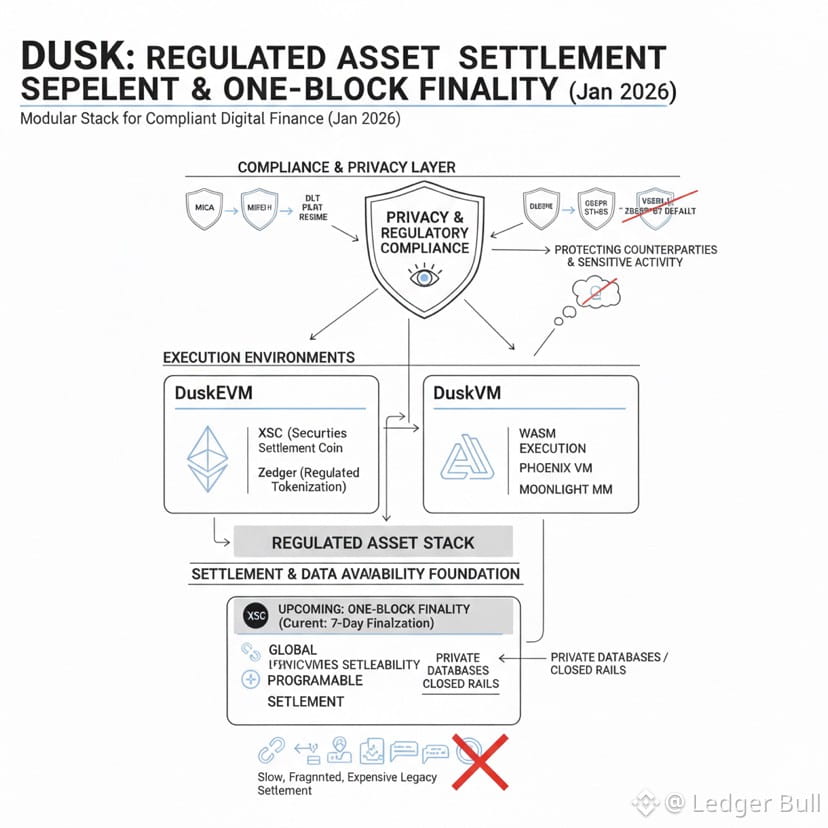
Dusk And throughout, continuing to deepen the regulated asset stack where XSC and Zedger sit, because those are presented as the core of the regulated securities use case.
Dusk is building a financial rails project, not a trend project. The architecture is designed for settlement finality and compliance needs, the privacy design is not an add on, and the execution layer strategy is about meeting developers where they already are while keeping settlement anchored to DuskDS.
