
Come closer, friend let me explain this face-to-face like we’re having chai in Peshawar. When people talk about “front-end distribution” in the Walrus world, they’re rarely talking about something cosmetic. They’re talking about the part of an app that users actually touch when they’re scared, impatient, angry, or just trying to get something done before the window closes. In those moments, the front end stops being a design choice and turns into a trust boundary. If it fails, users don’t experience an “outage.” They experience a personal loss of control. Walrus treats that reality with an unusual seriousness: it makes the front end feel less like a fragile storefront and more like a piece of shared infrastructure that can survive the messy parts of human behavior and the internet.
What changes when Walrus carries the front end is the feeling of who is allowed to decide what users see. Not in a dramatic, ideological way, but in the quiet way that matters when things go wrong. A front end is a bundle of files, yes, but it’s also the place where the user learns what is true. It’s where they see balances, permissions, warnings, and the subtle cues that tell them whether they’re safe. When that surface is delivered through Walrus, the act of “serving the app” starts to behave like data publication, with consequences that are easier to reason about under stress than a shifting pile of runtime assumptions. That’s the first emotional shift: fewer invisible hands, fewer uninspectable last-minute edits, fewer moments where users wonder if the interface changed because the app evolved or because someone panicked.
Walrus makes this possible by treating the front end as data that is published and then referenced by on-chain metadata, so the application can point to a specific published set of files rather than a moving target. The official documentation describes the publishing flow as uploading a directory of web files and then writing the related metadata onto Sui, with the entry point expected to be present in the directory. That sounds straightforward until you live with it. Then you realize the psychological benefit is that the “what” of the front end becomes something you can anchor, name, and verify, rather than something you hope will still be there when users arrive.
Time is a big part of how Walrus makes that anchoring feel real. On mainnet, the system’s rhythm is organized in longer cycles, with epochs described as two weeks, and storage purchases framed in those units, up to a maximum number of epochs. That matters for front-end distribution because it forces teams to internalize that availability isn’t a vague promise. It’s a paid-for commitment with a clock. Users may never think in epochs, but they feel the result as a kind of steadiness: a sense that the app won’t quietly disappear because someone forgot to renew a service, lost a password, or stopped paying a bill during a downturn.
This is where $WAL stops being “a token” in the abstract and becomes the emotional plumbing behind reliability. Walrus explains $WAL as the payment token for storage, and it’s explicit about designing the payment mechanism to keep costs stable in fiat terms, even if $WAL’s price moves, while the upfront payment is streamed out over time to storage nodes and stakers as compensation. For front-end distribution, that design choice is not a detail it’s a defense against the most human failure mode in crypto: building something that works in calm weather and collapses in volatility because the economics stop making sense. When the unit of payment is meant to feel stable to the user, the front end becomes less likely to be held hostage by sudden market emotion.
Walrus went from idea to real pressure quickly. Mainnet went live on March 27, 2025, and the tone of the launch announcement made it clear this wasn’t being positioned as a toy environment anymore. A week earlier, reporting around the project highlighted a $140 million token sale ahead of that mainnet launch. Those dates matter because front-end distribution is one of the first places where “production” becomes undeniable. It’s easy to claim decentralization in backend flows that only developers see. It’s much harder when the UI itself is what’s being delivered through the system, because users immediately punish you for latency, missing assets, broken links, and confusing recovery paths.
Inside the $WAL distribution details, you can also see how Walrus tries to navigate that first-year fragility without pretending it doesn’t exist. A UK asset statement published by Kraken in March 2025 lays out the allocation and unlock structure in a way that’s unusually concrete: a 10% user drop split into 4% pre-mainnet and 6% post-mainnet, a 43% community reserve with 690 million WAL available at launch and linear unlock until March 2033, 7% for investors unlocking 12 months from mainnet launch, 30% for core contributors with a portion under a multi-year schedule and a one-year cliff, and 10% subsidies unlocking linearly over 50 months. If you care about front-end distribution, those numbers translate into a question of endurance: can the system keep paying honest operators, keep costs predictable for builders, and keep the UI reachable for users even when the hype cycle moves on?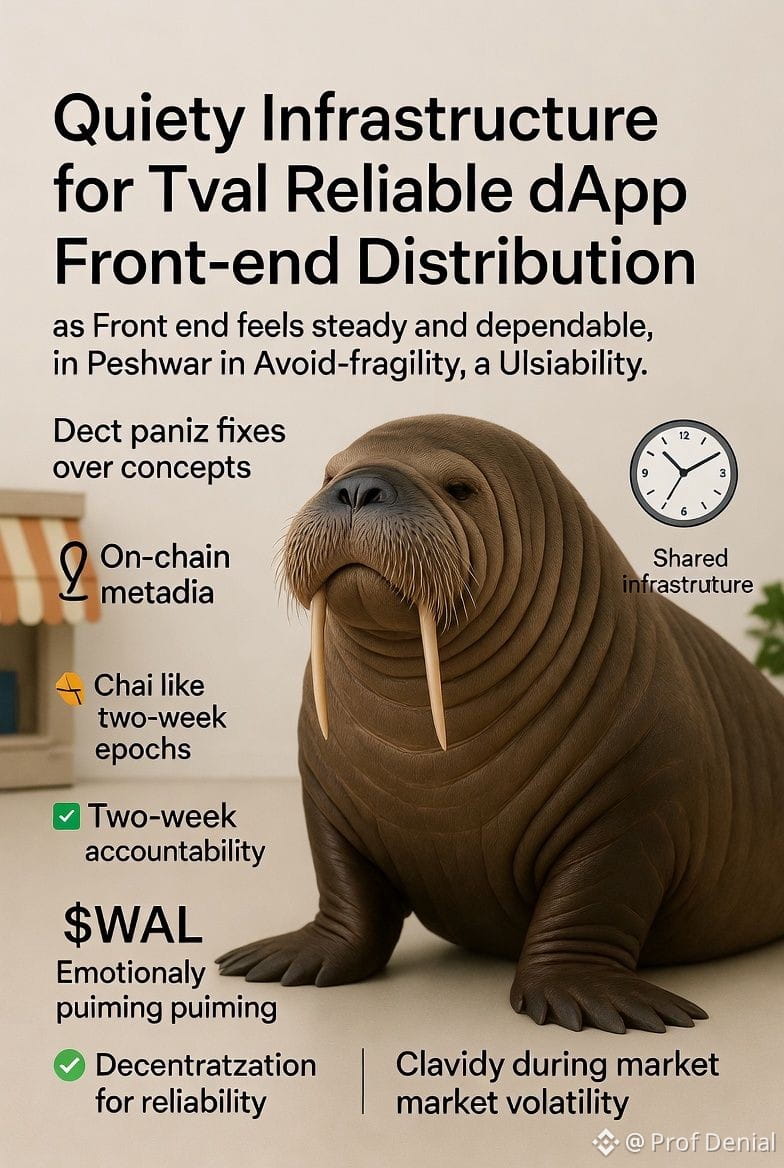
The subsidy line is especially revealing for how Walrus thinks about real users. Walrus has written that part of the early allocation can be used so users access the network at a fraction of market price while still ensuring operators cover fixed costs, with the expectation that over time operators seek efficiencies and improvements in storage hardware costs flow through into cheaper onchain storage pricing. In practice, that means the front end is less likely to become a luxury good right when it’s most needed. The system is acknowledging something uncomfortable but true: if publishing the UI becomes too expensive during volatility, teams cut corners, and the first corner they cut is usually the thing users rely on to understand what’s happening.
There’s also a subtle pressure Walrus introduces for builders: update behavior. Walrus documentation describes an approach where site resources are grouped, and when changes happen, the system may re-upload the whole group rather than letting teams patch only a single tiny file. That design has a human consequence that isn’t talked about enough. It changes how teams think about “small fixes” during incidents. If your UI breaks only during rare market events, you don’t want the repair to turn into a mess. Walrus’s way of publishing pushes teams to release more carefully, avoid panic fixes, and know exactly which version users are using. This can feel restrictive until you’ve lived through the alternative, where nobody can confidently answer the simplest question during a crisis: “Which front end is live right now?”
Front-end distribution also becomes a problem of accountability. If users are going to rely on the interface to guide real money decisions, they need a way to know that the UI they’re using corresponds to what the project claims. Walrus’s approach publish data, anchor references, make the retrieval path something multiple parties can serve creates space for that accountability without forcing users to become auditors. The people who do care deeply can verify. The people who don’t still benefit because the system is harder to quietly rewrite from the shadows.
That last point connects directly to how Walrus talks about decentralization under scale. In a January 8, 2026 post, Walrus described splitting data across multiple independent nodes to avoid a single point of failure, and it framed the network’s health in terms of resisting the quiet centralizing pull that comes with growth. Even if you never read that post, you feel its intent when you depend on a front end during conflict. The distribution path isn’t a single chokepoint where a dispute, a policy change, or a targeted attack can simply erase the interface people need to coordinate reality.
There’s also a social dimension that shows up when communities disagree. Front ends become contested terrain in crypto: people argue about what the app “should” do, whether it should block certain actions, how it should display risk, or which warnings are fair. Walrus doesn’t solve human disagreement. But by making front-end publication feel more like a durable act than a temporary server response, it can reduce a particular kind of fear: the fear that the rules changed without anyone admitting it. When users suspect that, they don’t just lose trust in an app. They lose trust in each other, because they no longer share the same reference point.
Token realities still matter here, too, because they shape who can afford to be honest. By October 2025, Binance’s listing post for WAL said the total supply was 5,000,000,000 WAL, and the circulating supply at listing was 1,478,958,333 WAL (29.57%). Those numbers affect how easy it is to trade, how much influence holders have, and how stressed people feel about the token. If the market gets shaky, users check the front end first to understand what’s going on. If the interface is unreliable, they assume the worst. If it stays accessible and consistent, it can be the difference between a stressful day and a catastrophic loss of confidence.
Walrus’s recent communications also show the ecosystem leaning into real-world scale rather than hypothetical scale. On January 21, 2026, Walrus announced a migration of 250TB of content for Team Liquid, describing it as the largest single dataset entrusted to the protocol to date. That kind of number matters for front-end distribution even if the front end itself is much smaller than 250TB. It shows the network is being used for real data work where mistakes can damage a reputation. When organizations commit at that level, people’s mindset changes. The system starts to feel like something they’ll be responsible for keeping stable and working.
Later in 2025, Walrus’s year-in-review message described 2026 as a year to make the system easier to use and to move privacy forward as the normal direction.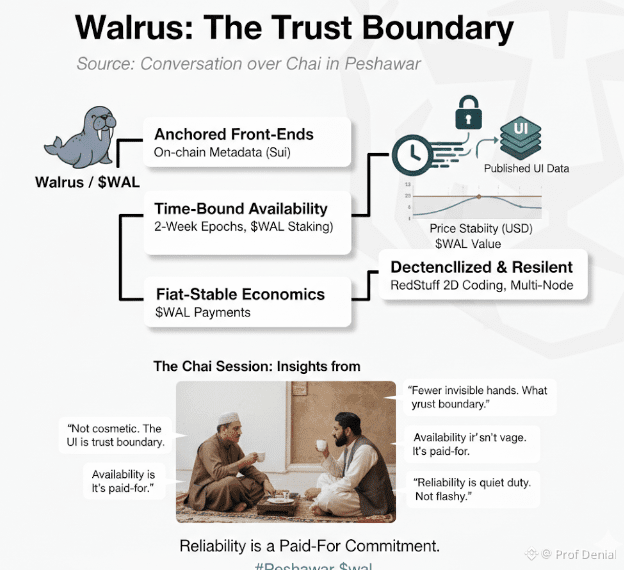
I’m careful with those kinds of statements because they can read like aspiration. But in the context of front-end distribution, they point to something practical: the UI is where “simple” and “private” either become real, or they remain marketing. If publishing and serving the front end is too complex, teams centralize out of fatigue. If privacy isn’t integrated into how data access feels, users treat the UI as unsafe and start behaving defensively splitting accounts, minimizing usage, or avoiding features that could have helped them.
The deeper lesson, if you’ve been around Walrus long enough to care about these details, is that front-end distribution is a reliability problem disguised as a convenience problem. It’s about making sure the interface is still there when people are anxious, when rumors spread faster than confirmations, when markets gap and communities fracture, when teams are asleep in one time zone and users are panicking in another. Walrus approaches that by making the front end behave like published data with economic commitments behind it, timed availability, and incentives that try to keep honest operators solvent even when conditions are ugly.
In the end, the most meaningful thing Walrus does for dApp front ends is not flashy. It’s a quiet kind of duty: turning the UI from something risky into something people can rely on. That means being clear about costs, timelines, and rewards built for long boring periods with a few scary moments. Mainnet dates, token unlocks, circulating supply, and real moves aren’t random they show the system growing up in public, under real pressure. Reliability doesn’t ask for attention, but it changes how people act: they panic less, doubt less, and work together more calmly when things get uncertain.

