I watched traders delay moves, developers add disclaimers, and users ask the same question again and again: “Why do I need this extra token just to send money?” Back then, we accepted it as normal. Now, in 2024 and early 2025, that frustration is exactly why gas abstraction is trending.
Gas abstraction sounds technical, but the idea is simple. Users shouldn’t have to care about how fees are paid. On most blockchains, you must hold a specific native token to pay gas, even if you’re just moving stablecoins or interacting with a simple app. If you don’t have it, your transaction fails. Gas abstraction removes that requirement. The network handles the complexity in the background.
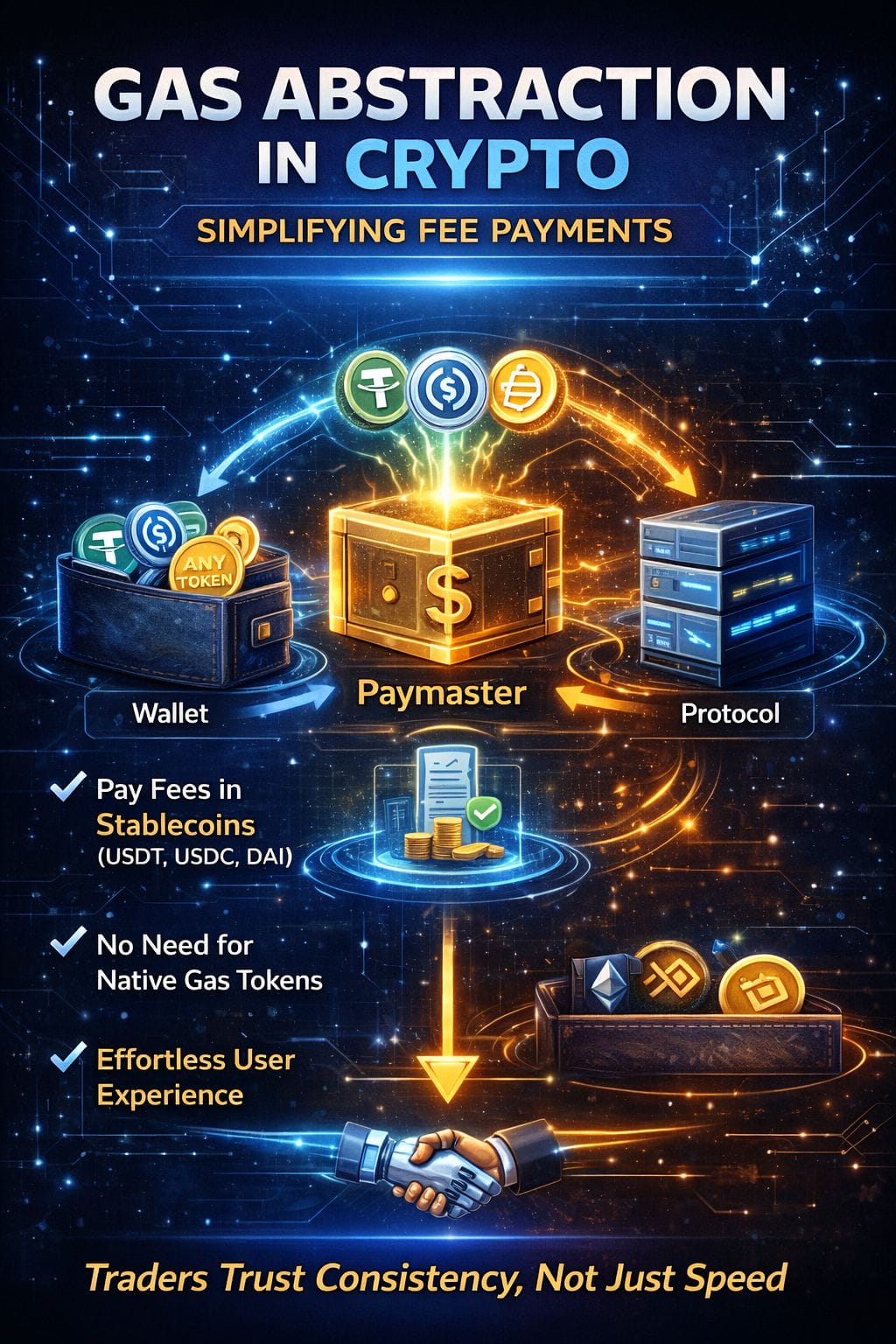
Plasma’s whitepaper leans into this idea strongly. Instead of forcing users to manage gas tokens, Plasma allows fees to be abstracted away, often paid in stablecoins like USDT. Under the hood, this is handled by mechanisms often called paymasters. A paymaster is a smart contract that sponsors or converts fees so the user doesn’t have to think about gas at all. For non-technical readers, it’s like a card machine that accepts any payment method, even though the bank settles everything later.
Why is this trending now? Because crypto is finally trying to behave like infrastructure. In 2024, stablecoin usage continued to dominate on-chain activity. Public data showed trillions of dollars in annual stablecoin transfers, mostly for settlement, not speculation. Yet users were still being asked to hold volatile gas tokens just to move stable value. That mismatch became impossible to ignore.
Plasma’s approach addresses this friction directly. By combining gas abstraction with a stablecoin-first design, the network removes one of the biggest onboarding barriers. Traders can move funds without worrying about topping up gas. Developers can design apps without adding “make sure you have gas” warnings. That sounds small, but it changes behavior.
From a trading perspective, this matters more than most people think. Execution speed isn’t only about block time. It’s also about readiness. I’ve missed entries simply because an account didn’t have enough gas at the wrong moment. Gas abstraction reduces that operational risk. It makes capital more fluid. And fluid capital moves faster.
Progress here hasn’t been theoretical. Throughout 2024, more wallets and protocols experimented with abstracted gas models, especially in account abstraction standards. Plasma aligns with that direction rather than fighting it. Its design assumes users don’t want to think about fees at all. That assumption feels realistic.
Of course, abstraction introduces new responsibilities. Someone still pays the fee. Someone manages conversion and risk. In Plasma’s case, this is handled at the protocol and application level, not pushed onto the user. That’s an important distinction. The complexity doesn’t disappear; it moves to where it can be managed professionally.
There’s also a trust angle. When users don’t see gas directly, they must trust the system to be fair and transparent. Plasma’s design acknowledges this by keeping fee logic predictable and denominated in stable units. Predictability builds confidence. Hidden complexity without clarity destroys it.
Personally, I see gas abstraction as a sign of maturity. Early crypto expected users to adapt to the system. Mature systems adapt to users. Banks don’t ask you to understand settlement layers. Payment apps don’t ask you to manage liquidity pools. They just work. Crypto doesn’t have to copy that model blindly, but it should learn from it.
Philosophically, gas abstraction challenges a long-held belief that users must feel friction to understand value. I don’t agree with that anymore. Value is not taught through inconvenience. It’s proven through reliability. When systems work quietly, trust grows.
I’ve learned that adoption isn’t driven by features. It’s driven by relief. Relief from friction, confusion, and constant vigilance. Plasma’s gas abstraction doesn’t promise profits. It promises fewer reasons to give up. And in a market where attention is scarce, that promise carries real weight.
In the long run, chains that hide complexity responsibly may outlast those that celebrate it. I tend to trust designs that assume users are busy, not careless.