
The most profound strength of Walrus lies not merely in its technical capabilities as storage, but in its deep, philosophical, and structural alignment with the very core of Sui's architecture—the object-centric data model. This is not a forced integration or a compatibility layer built after the fact; it is a native alignment that makes Walrus feel like a natural, seamless extension of the Sui environment itself. In Sui's world, everything is an object—a discrete package of data with a unique ID, defined attributes, and clear ownership, enabling parallel execution and fine-grained control. Walrus extends this elegant paradigm beyond the chain. When data is committed to the Walrus network, it doesn't just vanish into a decentralized abyss; it generates a corresponding, living data object on the Sui blockchain. This on-chain object is not a simple pointer or hash; it is a rich asset that holds the cryptographic commitments to the data, its storage parameters, and, most importantly, its ownership and access logic. This creates a powerful unity: the off-chain data blob and its on-chain representative are two facets of a single entity, governed by the same rules.
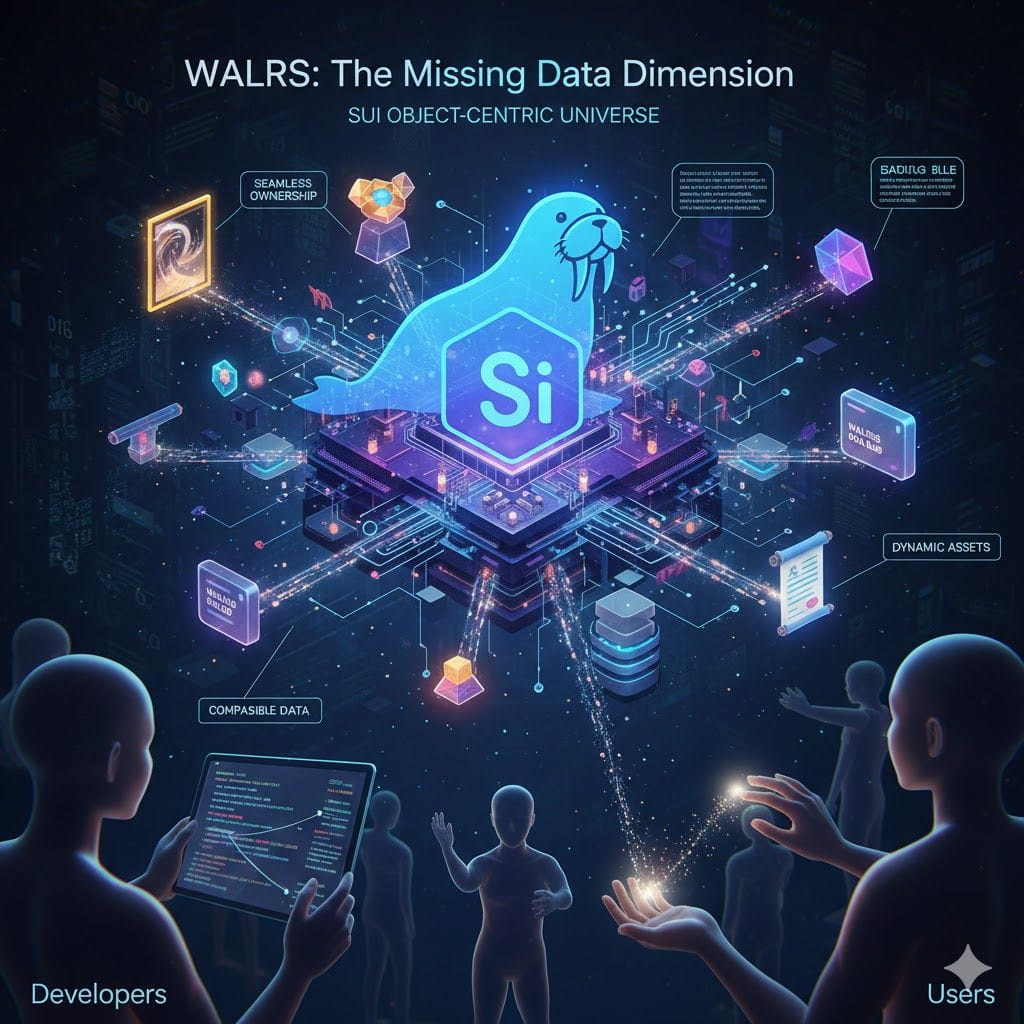
This native alignment manifests in transformative ways for developers and users. Ownership and transfer become seamless and atomic; when you sell a digital artwork NFT represented as a Sui object, all the associated high-resolution content stored on Walrus is inherently and permissionlessly transferred with it because the same owning object controls access. The powerful resource-oriented Move programming language can now be used to write smart contracts that manage, trade, and compose data assets with the same safety and certainty as managing tokens. This enables dynamic objects whose state and attached content can evolve based on complex on-chain logic—a video game item that gains new visual effects stored on Walrus as it levels up, or a digital identity credential that accumulates verified attestations. The composability inherent to Sui objects now extends fully to data, allowing for intricate relationships and structures where objects can own, reference, and interact with other objects that, in turn, govern substantial off-chain data. For developers, this alignment erases the cognitive and technical friction typically encountered at the on-chain/off-chain boundary. They interact with data using the same principles of ownership, transfer, and dynamic fields that they use for any other Sui object, creating a consistent and powerful programming model. In this way, Walrus does not simply plug into Sui; it completes it, providing the missing data dimension to Sui's object universe and ensuring that the network's groundbreaking performance and flexibility are never bottlenecked by a disconnected, archaic storage layer. The synergy is such that the two systems co-elevate each other, creating a whole that is far more capable than the sum of its parts.
@Walrus 🦭/acc $WAL #walrus $SUI

