


In decentralized storage systems, metadata is just as important as the actual data. People often focus on blobs because that is where the content lives. But metadata tells you what the data is, where it is stored, and how it can be checked and recovered. In Walrus, metadata is treated as a core part of the system. It is designed to support scaling, verification, and fault tolerance without creating any central control points.
In Walrus, metadata mainly consists of commitments to encoded data fragments called slivers. When a blob is written, it is first split and encoded using Walrus’s two dimensional erasure coding method. Each sliver is stored in a node and for each one the system calculates vector commitments over the encoded symbols. These commitments act like cryptographic fingerprints. They bind the storage node to the exact data it should hold without needing to store or transmit the full data repeatedly.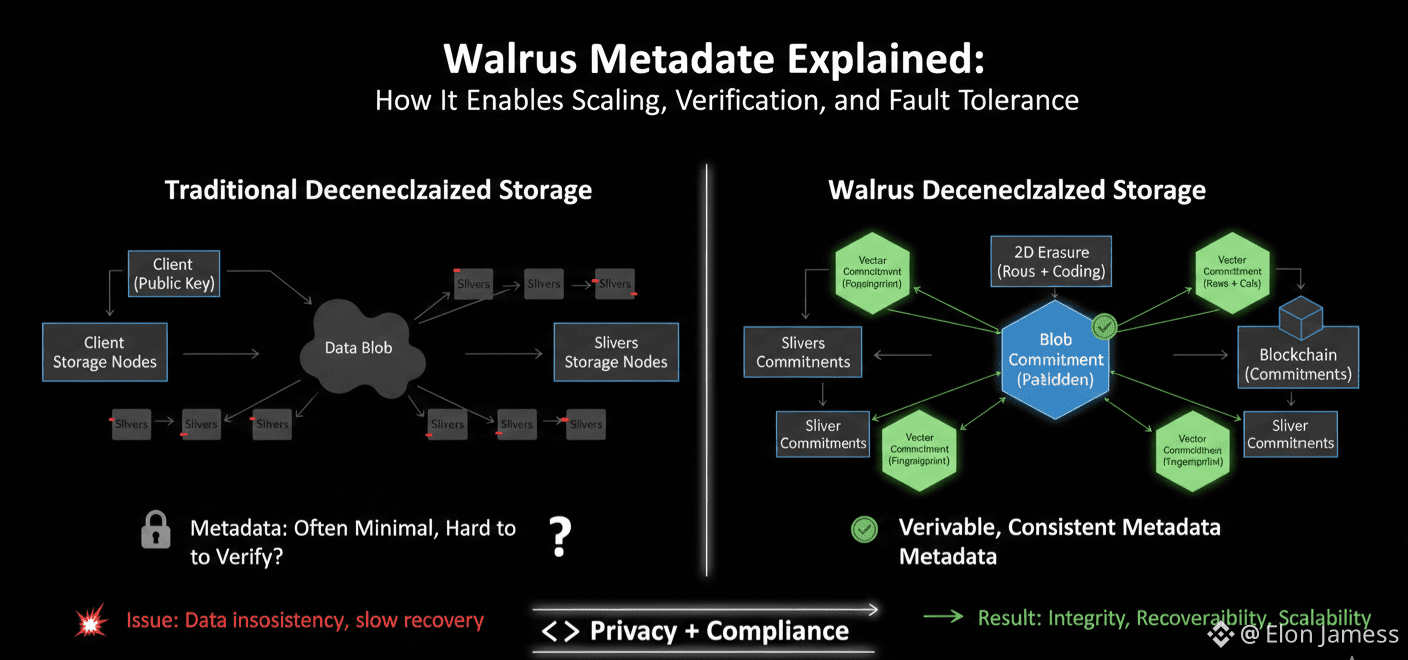
Every primary sliver commitment represents all symbols in an expanded row of the encoding matrix. Every secondary sliver commitment represents all symbols in an expanded column. This structure makes metadata match the layout of the encoded data. That is important because it allows the system to verify consistency during recovery, reads, and reconfiguration. A storage node cannot silently change or replace data because any mismatch will fail verification against the committed metadata.
After sliver commitments are created, the client makes a blob commitment. This is a commitment over the full set of sliver commitments. The blob commitment becomes the official identifier for the stored data. It is recorded on the external blockchain through Walrus’s control layer. The blockchain does not store the data itself. It only stores the minimal metadata needed to prove availability, correctness, and state changes.
This separation keeps metadata light and efficient. Storage nodes only keep the commitments for the slivers they store. Global metadata such as blob commitments and availability proofs are handled through the blockchain. This avoids bloating on chain storage while still giving strong global consistency guarantees.
Handling metadata this way also enables advanced features like partial recovery, shard migration, and asynchronous challenges. During failures or reconfiguration events, nodes can rebuild missing slivers using metadata alone, without any trusted intermediaries. Readers can verify that recovered data is correct, and malicious writers can be detected through provable inconsistencies.
Walrus metadata design ensures decentralization does not come at the cost of reliability. By combining cryptographic commitments, structured encoding, and blockchain anchored coordination, Walrus makes metadata a powerful tool for correctness, accountability, and long term durability instead of being a hidden source of weakness.

