
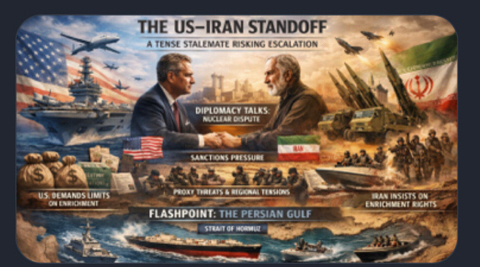
 The standoff between the United States and Iran is not a sudden crisis that appeared overnight, nor is it a conflict driven by emotion alone. It is a long, grinding confrontation built on decades of mistrust, layered grievances, and strategic fear on both sides. What makes the current phase feel heavier than before is not only what is being said publicly, but how many pressure points are being activated at the same time, leaving very little margin for error.
Right now, diplomacy exists, military signals are active, and economic pressure continues to tighten, all moving in parallel rather than sequence. When these tracks overlap, the situation does not stabilize; instead, it becomes fragile, because any shock in one area immediately affects the others.
Why tensions are rising again
At first glance, the presence of talks suggests de-escalation, yet the reality is more complicated. Negotiations are happening under pressure, and pressure changes behavior. Each side wants to appear strong, not flexible, because weakness at the table can carry domestic and regional consequences. For Iran, the core issue remains sovereignty and deterrence, especially around its nuclear program. For the United States, the concern is preventing Iran from reaching a level of capability that could alter the balance of power in the region.
This unresolved contradiction sits at the center of every discussion. Iran views continued enrichment as a right and a security necessity, while the United States views expanded enrichment as an unacceptable risk. Because neither side is willing to concede this foundation, talks tend to circle around limits, timelines, and safeguards rather than final resolution.
Alongside diplomacy, warnings have grown more explicit. Iran has openly signaled that any direct attack would not stay confined, making it clear that regional U.S. military positions would be part of its response. This messaging is not impulsive; it is meant to raise the cost of military action and force decision-makers to consider second-order consequences. The United States responds less loudly, but no less clearly, through force posture and readiness, ensuring that deterrence runs in both directions.
The Gulf as the most dangerous pressure point
The most fragile element of this standoff is geography. The Persian Gulf is crowded, narrow, and constantly active, which makes it a place where intention can be misunderstood in seconds. Warships, drones, patrol aircraft, and commercial vessels operate close to one another every day, often under heightened alert conditions.
Neither side is looking for a naval clash, yet both sides train and behave as if one could happen. This contradiction is where danger lives. In such an environment, escalation does not require a strategic decision; it can begin with a maneuver interpreted as hostile or a moment where restraint is misread as hesitation.
The Strait of Hormuz amplifies this risk because it is not just a military chokepoint but a global economic artery. Even limited disruption or perceived instability there immediately affects energy flows, shipping insurance, and global market sentiment. This is why the standoff extends far beyond Washington and Tehran, pulling in global stakeholders who may have no direct role in the confrontation itself.
Sanctions as permanent pressure
Economic pressure has become the background noise of the US–Iran relationship. Sanctions are no longer treated as temporary leverage designed to produce quick concessions; they have evolved into a long-term condition shaping Iran’s economic environment and strategic planning.
From the U.S. perspective, sanctions restrict resources, signal resolve, and create bargaining leverage. From Iran’s perspective, they reinforce the belief that compromise brings vulnerability rather than relief. Over time, this dynamic hardens positions on both sides. Economies adapt under pressure, political narratives shift toward resistance, and the incentive to make painful concessions decreases rather than increases.
This is why sanctions and diplomacy often move together but rarely reinforce each other. Pressure is meant to push talks forward, yet it frequently convinces the targeted side that patience and endurance are safer than compromise.
Regional spillover and silent anxiety
The US–Iran standoff never remains bilateral for long. Regional actors feel its gravity constantly. Countries hosting U.S. forces understand that they could become indirect targets even if they play no role in decision-making. Groups aligned with Iran watch for shifts in red lines and signals that might justify action or restraint.
Behind closed doors, many regional and European players push for de-escalation not because they doubt the seriousness of the threat, but because they understand how easily escalation can spread once deterrence fails. Public statements may sound firm, but private diplomacy often focuses on containment and restraint, especially when tensions spike.
What is happening behind the scenes
Despite the harsh public tone, both sides are working to avoid uncontrolled conflict. Back-channel communication continues quietly, serving as a safety valve to clarify intentions and prevent miscalculation. These channels are not about trust; they exist precisely because trust is absent.
At the same time, neither side relies on diplomacy alone. Military readiness remains high, and economic tools remain active, creating a situation where preparation for failure exists alongside hope for progress. This dual posture is rational from a strategic standpoint, yet it also increases the risk that preparation itself becomes a trigger.
What comes next
The most realistic near-term outcome is continuation rather than conclusion. Talks are likely to persist in narrow formats, sanctions will remain and evolve, and military postures will stay elevated. Incidents may occur, but most will be managed before crossing the threshold into open conflict.
The true danger lies in the unexpected moment, the incident that happens at the wrong time, under political pressure, with limited room for restraint. In such moments, leaders may feel compelled to respond decisively even if escalation was never the goal.
A limited understanding on nuclear issues could temporarily lower tensions, but it would not end the standoff. It would simply slow the cycle and reset expectations until the next phase emerges.
Final perspective
The US–Iran standoff is not a contest of emotion or pride; it is a test of risk management under extreme mistrust. Both sides believe they can control escalation while maintaining pressure, yet history shows that confidence often fades faster than expected when events move faster than plans.
For now, stability depends less on grand agreements and more on restraint, communication, and the ability to absorb shocks without reacting impulsively. How long that balance can hold remains the most important unanswered question.