
I wasn't looking for another novel chain story when I initially looked into Plasma. The reason for this was that a pattern kept emerging in the dull aspects of cryptocurrency, which people only discuss until something goes wrong. Even while stablecoins were performing more useful tasks than other tokens, they still had to navigate through systems that seemed to be made for purposes other than the transfer of money. The user who possesses USDT but is unable to pay gas, the company that wishes to settle bills but finds itself juggling three networks, and the treasury team that prioritizes certainty over composability are just a few examples of the little points of friction. I was drawn to #Plasma because it views friction as the fundamental issue rather than an isolated incident.
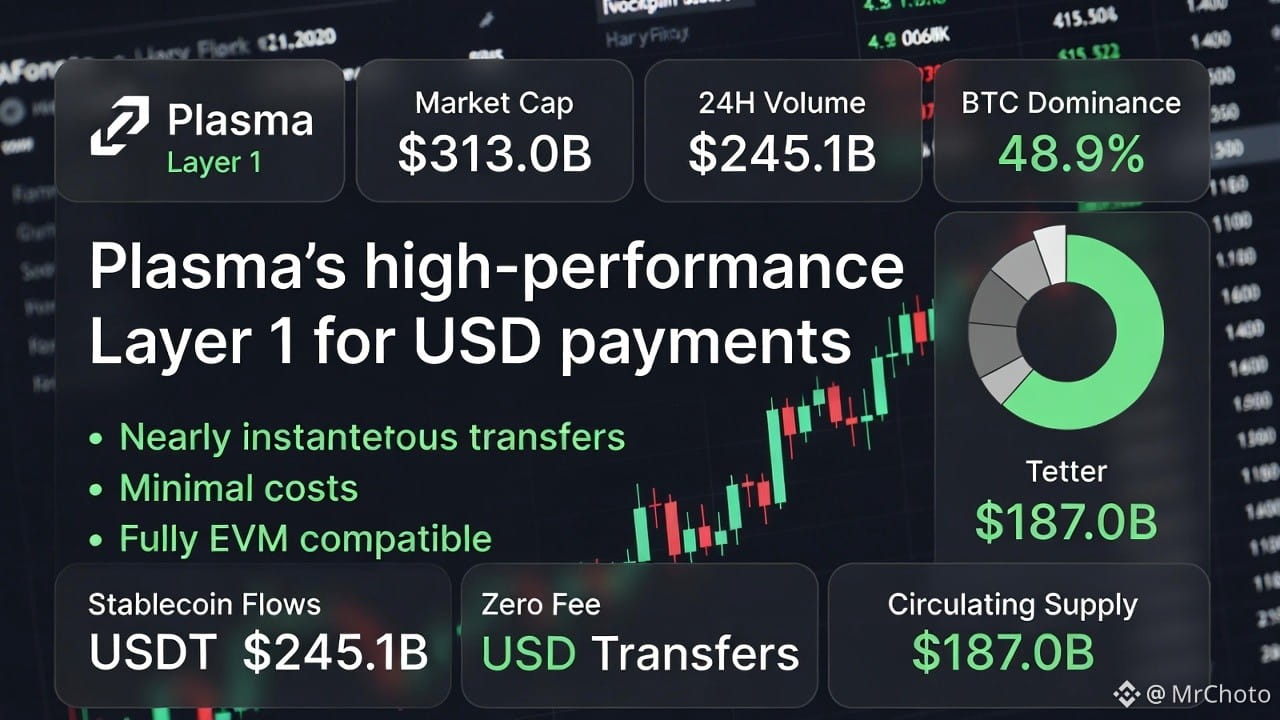
The abrupt loudness of this angle can be explained by the timing. The market for stablecoins is no longer a specialized area. The stablecoin category on CoinMarketCap has a market capitalization of about $313.0 billion and a reported 24-hour trading volume of about $245.1 billion. The context is important because such data are easily misinterpreted. Market cap is essentially outstanding supply, which serves as a stand-in for the amount of dollar-like liquidity stored on the chain. Stablecoins are the grease in the pipes, and the pipes are busy. This is the genuine message, even though the 24-hour volume is mostly exchange-driven churn, which exaggerates "economic activity" in the conventional sense.
The same trend might be triangulated from different sources. According to a recent Finance article that cited DeFiLlama statistics, the stablecoin market capitalization peaked on January 18, 2026, at about $311.3 billion, and a few days later, it was close to $309.1 billion. That is a continuous accumulation that resembles people using these products as financial plumbing rather than a speculative spike. In the meantime, Visa is discussing stablecoin settlement in public, but even it presents the size honestly: the yearly run rate of stablecoin settlement via Visa is approximately $4.5 billion, whereas Visa's total payments volume is over $14.2 trillion. That is the story's gap. The majority of the leverage is found in the infrastructure between stablecoins, which are ubiquitous in the cryptocurrency space but are still in the early stages of mainstream payments.
According to Plasma, designing a chain as a payments network from the outset will result in different decisions than designing a chain as a general-purpose world computer and adding payments afterward. According to its own description, Plasma is a high-performance Layer 1 designed for USD₰ payments, with nearly instantaneous transfers, minimal costs, and compatibility with EVM. EVM is not the most important detail; many teams can use it. The crucial aspect is that it is prepared to special case stablecoin flows at the protocol level since it believes the main task is the dependable, large-scale transfer of a dollar token from point A to point B.
The "zero fee USD₰ transfers" mechanism is the most tangible example of that. According to Plasma's documents, a protocol-maintained paymaster contract that sponsors gas for qualified USD₰ transfers covers the cost of gas for typical transfer calls with minimal identity verification and protocol-level rate constraints. If you've spent enough time in the cryptocurrency space, you understand why this is important. UX is broken by the gas tax, and it does so in a very particular way. In order to transfer the stable asset they truly came for, it compels consumers to hold a volatile asset they did not want. Beneath the surface, consumers become trapped before they ever make their first payment, which leads to compliance and support issues.
In actuality, @Plasma is transforming a wallet and customer service issue into a basic protocol. It appears to be fee-free transfers at first glance. The chain is specifically budgeting for payments, much like a payments business would, because it is a controlled subsidy system with eligibility criteria and constraints below. This makes it possible for developers to have more predictable prices and a nicer user experience. Additionally, it generates new hazards. Someone must determine what qualifies as "eligible," and someone must cover the cost of the subsidy. The simplicity that makes the concept appealing is lost if the inspections are overly stringent. You attract abuse if the checks are too loose, and misuse in fee subsidy systems usually manifests itself immediately.
This is where Plasma's stablecoin-first stance becomes intriguing, as it makes you wonder what exactly "decentralization" in the context of payments actually means. Because you have permissionless flexibility in a general purpose chain, you typically accept untidy UX and treat neutrality as a default. Neutrality is still important in a payments rail, but practical clarity is more important than ideological purity. Plasma is subtly stating that consumers desire stable, earned, and predictable money movement rather than "permissionless gas markets."
That leads to another design decision. According to Plasma, it can execute thousands of transactions per second and is performance-engineered, supporting bespoke gas tokens. Once more, it is simple to toss the figure around, but the backdrop is that payments flow is vulnerable to operational fluctuations. High TPS in a lab can still cause a chain to malfunction as a payment system if it is unable to provide reliable confirmation times when under load or if fees increase at the most inconvenient time. Variance is penalized in the domain of stablecoin payments. When a wallet is slow, users may shrug. When a payment rail is slow, the company loses faith in it.
The fact that Tether's USDT is still the most popular dollar token, with a circulation of about $187 billion as of mid-January 2026, further contributes to the explanation of why Plasma is so clearly linked to USD. When constructing for "real world money movement," you should begin by determining which stablecoin is now used by individuals in terms of size, in emerging markets, and across exchanges, rather than by asking which one is philosophically preferable. The moat is the distribution, and the distribution of USDT is quite actual.
Nevertheless, creating a chain centered around USDT also concentrates your reliance. The Reuters coverage of Tether's holdings and operations serves as a reminder that stablecoins operate in a hybrid environment that combines elements of financial issuer and cryptocurrency rail. Whether you like it or not, your "money movement chain" inherits shocks from issuer risk related to prices, regulatory pressure, and changes in banking relationships. The adoption of USDT is therefore in line with Plasma's upside, but USDT-specific events are also in line with its tail risk.
The backers and funding indicate what Plasma believes to be its rivals. Trading and market structure names like DRW and Flow Traders, among others, participated in Plasma's $24 million seed and Series A funding rounds, which were led by Framework Ventures and Bitfinex. A Founders Fund strategic investment is detailed in a subsequent Plasma post. Take that as a hint about the desired outcome. This goes beyond simply saying, "Let's get some DeFi apps." "Let's build a settlement network that institutions and payment companies can reason about" is more accurate.
In parallel moves, you may observe the pressure from the larger market. Stablecoin payments are Polygon Labs' stated goal, and the company has made acquisitions in that area with reported deal values exceeding $250 million. Although it frames the environment, that datapoint is not unique to Plasma. Several teams are arriving to the same conclusion: the infrastructure stack surrounding stablecoins is fractured, and they are starting to become a primary product.
The obvious counterargument is that this doesn't require a new chain. On current L2s or appchains, you can implement stablecoin-centric UX, gas sponsorship, and fee abstraction. That is accurate, and Plasma needs to surpass it. Implicitly, Plasma's response is that making the changes at the protocol level allows for simpler defaults and more stringent assurances. When the chain is under pressure, when subsidy budgets are attacked, and when compliance standards increase, the question is whether those guarantees remain valid. Hackathons don't test payments infrastructure; instead, months of tedious throughput, edge cases, chargeback-like arguments, and the tedious grind of operational risk do.The obvious counterargument is that this doesn't require a new chain. On current L2s or appchains, you can implement stablecoin-centric UX, gas sponsorship, and fee abstraction. That is accurate, and Plasma needs to surpass it. Implicitly, Plasma's response is that making the changes at the protocol level allows for simpler defaults and more stringent assurances. When the chain is under pressure, when subsidy budgets are attacked, and when compliance standards increase, the question is whether those guarantees remain valid. Hackathons don't test payments infrastructure; instead, months of tedious throughput, edge cases, chargeback-like arguments, and the tedious grind of operational risk do.
This indicates a more significant change in the center of gravity of cryptocurrency if it continues until 2026. For many years, we viewed stablecoins as an add-on, a practical trading unit of account. They now resemble the first thing to truly leave the laboratory. Another consequence of this momentum is that everything else turns into support infrastructure once stablecoins are the final product. Wallet design, onramps, KYC layers, paymasters, monitoring, and even consensus tuning begin to resemble judgments made by payment companies rather than discussions of crypto ideologies.
According to my working hypothesis, the market will cease debating whether stablecoins "count" as actual payments in 2026 and instead begin to compete on the dull fronts of uptime, predictability, regulatory stance, integration cost, and distribution. That viewpoint is the foundation of Plasma. Because it is targeted, it could prevail. It could lose because payments are where reputations die, and trust and distribution are harsh moats. Early indications point to a genuine opportunity, but it's unclear if the model can grow without consolidating too much power in the name of improved user experience.
The best way I can describe it is this: the next stage of cryptocurrency won't be determined by who can do the most things; rather, it will be determined by who can move dollars with a texture that seems stable enough for no one to worry about.$XPL

