
With every step forward in Web3, an old flaw in standard blockchains stands out more how they store data. Though built for safety and openness, these networks often buckle under heavy information loads. That pressure has sparked interest in systems capable of holding vast amounts of data without sacrificing cost or decentralization. Into this gap walks Walrus, offering a response that feels both timely and practical.
The Walrus lives on the Sui blockchain, working as shared digital storage without central control. Instead of just holding files like a folder, it runs more like fast-moving infrastructure for live Web3 systems. Starting up from DeFi tools to evolving NFT experiences, its rhythm matches intense data needs. Blockchain-powered games flow through it, metaverse zones rely on it, even smart software shaped by AI leans into its structure. Built not for quiet archives but constant motion, Walrus feeds what comes next quietly, steadily.
Deep inside Walrus runs erasure coding - data chopped into secure fragments, scattered over separate storage spots. When files break apart like this, each piece lands on a different node, far from its siblings. Lose a few locations? No problem. The system rebuilds what's missing without needing complete duplicates around. Because it skips redundant copies, space use drops sharply. Yet safety stays high, defenses hold firm, breakdowns get shrugged off.
Off to one side, the Walrus setup leans on layers that think for themselves. Sui steps in as the conductor handling agreements, money moves, and promises about stored files. Elsewhere, far from the chain itself, real data fills up space across Walrus nodes. Because they split these jobs apart, Sui stays quick on its feet, never bogged down. Data bulk gets managed by Walrus, avoiding traffic jams before they start. Growth happens naturally, like roots spreading, yet still firm in structure and speed.
What sets Walrus apart? Deep links to smart contracts. Inside app code, devs pull up saved data without detours - opening doors to bold new uses. Think: AI model inputs, digital items in games, high-res videos, virtual world pieces, even NFTs that shift form as time passes. Builders drawn to edge experiments on Web3 find it fits like a glove.
WAL sits at the core of everything Walrus does. Payment for storage runs on it, node runners earn it, while holders get a say through voting power tied to it. In this setup, people building, using, and supporting the system move together. Growth pulls more usage, which tightens supply pressure across the board. Stability sticks around because incentives hold steady even when things shift.
Where others offer scattered solutions, Walrus moves quicker while costing less. Because it fits right into Sui, builders find it easier to work with. Speed matters when apps must fetch data without delay. Reliability shows up where systems often fail. Flexibility means changes happen without breaking flow. Performance isn’t just claimed here it runs every task. Developers notice how smooth integration feels. Storage needs shift constantly this adapts without extra steps. While Filecoin and Arweave exist, different tools solve different problems. Efficiency becomes obvious once you measure real usage.
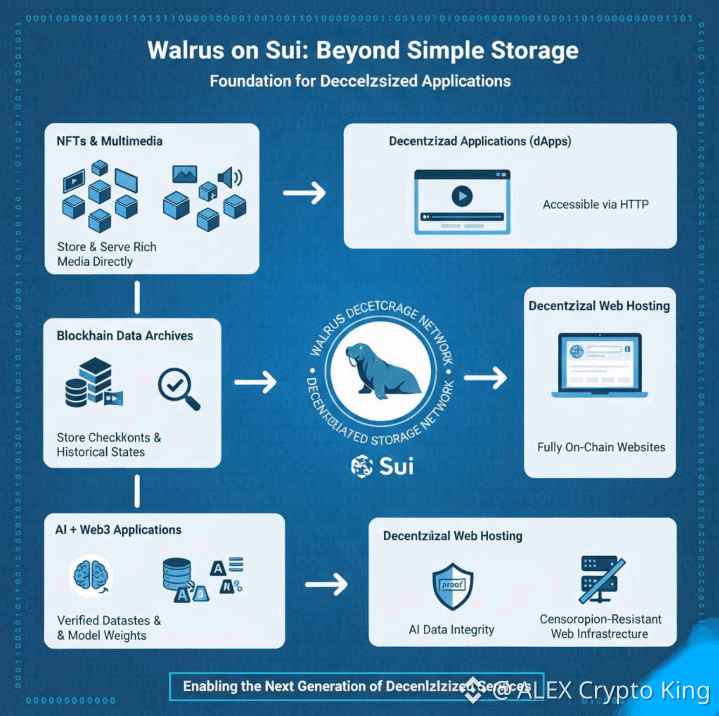
What sets Walrus apart isn’t its name but what it actually does. Instead of following old models, it builds a new path for how data lives on blockchains. Because current systems struggle with size and speed, something like Walrus steps in where others stall. Security matters, scalability counts Walrus weaves both into one design. When apps need room to grow without risk, they might lean on this kind of foundation. Over time, pieces like these don’t just help Web3 they hold it up.
walrus at Walrus dot WAL


