#plasma story begins with a quiet human frustration rather than a loud technological breakthrough, because for years people were told that blockchain would change money, yet when ordinary individuals tried to use it for the simplest need—sending stable value to another person—they ran into walls of confusion, unpredictable fees, slow confirmations, and the strange requirement to first buy a separate volatile token just to move their own digital dollars, and in that gap between promise and lived reality Plasma found its emotional reason to exist, not as another chain chasing hype cycles but as an answer to the question millions of users never phrase in technical language but feel deeply in practice, which is why does moving money on the internet still feel harder than sending a message.
The purpose of Plasma grows from empathy before engineering, because the team’s core observation is that stablecoins have quietly become the working class of crypto, the assets people actually use when they are not speculating but surviving, paying, saving, sending, and protecting themselves from unstable local currencies, and this shift transforms stablecoins from a side character in DeFi into the bloodstream of digital finance, so Plasma chooses to build around that reality with the belief that infrastructure should bend around human behavior rather than forcing humans to bend around protocol design, and that belief gives the chain a different moral center, one that measures success in smoother remittances, easier onboarding, and fewer abandoned transactions rather than in abstract metrics that impress insiders but do not change daily life.
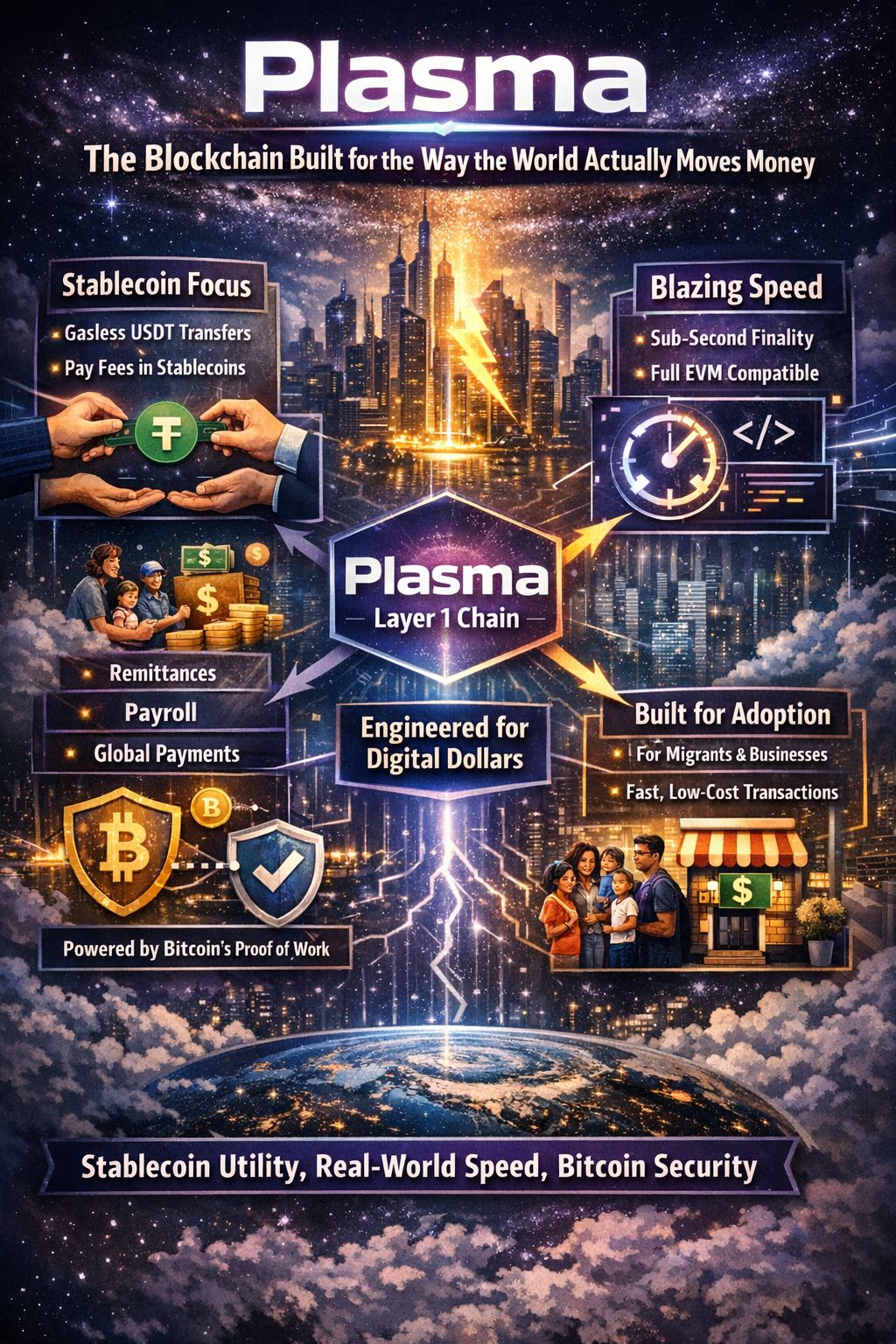
Technically, Plasma translates that human-centered mission into a design that feels familiar to builders but radically smoother to users, because it embraces full EVM compatibility so developers from the Ethereum world can deploy contracts, tools, and patterns without relearning their craft, while underneath that familiar surface runs a consensus system engineered for speed and certainty so transactions reach finality in fractions of a second rather than lingering in probabilistic limbo, and this combination matters emotionally as much as technically since waiting for money to be final creates anxiety, especially for people moving meaningful portions of their income, so faster finality is not only a performance metric but a psychological relief that makes digital value transfer feel trustworthy instead of tense.
Where Plasma becomes truly human in its mechanics is in how it treats fees, because the traditional gas model of blockchains unintentionally sends a message that the system was built by insiders for insiders, requiring users to understand tokens, swaps, and balances before they can even perform a basic transfer, whereas Plasma restructures this experience so stablecoins themselves can be used to handle fees and certain transfers can feel gasless from the user perspective, dissolving one of the biggest invisible barriers to adoption and turning a multi-step ritual into a natural action, and that shift has deep social implications for migrants sending wages home, freelancers paid across borders, and small businesses operating in dollarized digital economies where every extra step means lost time, extra cost, or abandonment.
Security in Plasma’s design is shaped by another emotional truth, which is that money demands trust that outlives hype cycles, so the chain aligns its settlement assurances with Bitcoin’s gravity, borrowing from the most battle-tested and politically neutral ledger in crypto to anchor its own guarantees while still offering the flexibility of modern smart contracts, and this dual structure speaks to two audiences at once, reassuring institutions that care about durability, censorship resistance, and long-term survivability, while giving developers the expressive environment they need to build applications, creating a bridge between the conservative instincts of capital and the experimental energy of Web3 innovation.
Looking ahead, Plasma’s path is less about flashy features and more about quiet integration into the plumbing of real finance, focusing on partnerships with stablecoin issuers, payment processors, wallets, and fintech platforms, on predictable fees and liquidity corridors rather than temporary liquidity mining spikes, and on tools that let businesses and developers embed stablecoin settlement into products without exposing users to blockchain complexity, a roadmap that suggests Plasma wants to disappear into usefulness, becoming the invisible layer that simply works rather than the visible star of speculative cycles.
The risks are real and human as well, because regulation around stablecoins can shift, competitors are racing toward similar optimizations, and any system promising smooth payments must prove itself under stress, attack, and macro volatility, while gas abstraction and sponsored flows must be balanced carefully to avoid abuse or unsustainable economics, meaning Plasma’s challenge is not only to build fast code but to sustain trust, coordinate ecosystems, and adapt to a moving legal and financial landscape.
Yet the possibilities carry emotional weight equal to the risks, because if Plasma succeeds it could help normalize a world where sending digital dollars is as natural as sending a photo, where remittances arrive quickly and cheaply, where businesses operate across borders without banking friction, and where blockchain finally fulfills one of its oldest promises by becoming invisible infrastructure that serves real human needs, positioning @Plasma not as just another network in a crowded market but as a purpose-built artery in the global flow of value, designed around the simple but powerful idea that stability, usability, and trust are what turn technology into something people can truly rely on.