
Imagine you are a CFO of a mid-sized electronics firm in Berlin. You need to settle a $500,000 invoice with a supplier in Tokyo. In the traditional world, this involves a "black box" of correspondent banks, 3% in hidden FX fees, and a 4-day wait where your capital is essentially in limbo.
Now, imagine doing this on a public blockchain. It’s instant and cheap, but there’s a catch: your competitors can see the exact amount, the timing of your supply chain moves, and your wallet’s total balance. For a business, this "radical transparency" is a deal-breaker.
This is where Dusk enters the frame. It isn't just another "privacy coin"; it is the first institutional-grade Layer-1 designed to make cross-border payments feel like a private conversation while meeting the world’s strictest financial laws.
1. Privacy That Speaks the Language of Regulators
The biggest hurdle for crypto in global finance has always been the "Privacy Paradox." Regulators want to see everything to stop money laundering; businesses want to hide everything to protect trade secrets.
Dusk solves this using Citadel. Think of Citadel as a "Digital Identity Passport."
• The Scenario: Before you send that payment to Tokyo, you verify your identity once.
• The Magic: Citadel generates a Zero-Knowledge Proof (ZKP). When you transact, the network "knows" you are a verified, authorized sender, but it doesn't reveal who you are or your balance to the public.
It’s like showing a bouncer a "Verified Over 21" stamp on your hand instead of handing over your entire ID card with your home address and height.
2. The Engine Under the Hood: Phoenix and Piecrust
While other blockchains try to "patch on" privacy, Dusk built it into the foundation.
• Phoenix (The Transaction Model): This is Dusk's specialized model for making transactions "shielded" by default. It ensures that when value moves across borders, the "from," "to," and "how much" are encrypted.
• Piecrust (The ZK-VM): This is the world’s first Zero-Knowledge Virtual Machine. It allows developers to write smart contracts that can process private data. For cross-border payments, this means a contract can automatically deduct taxes or compliance fees without ever "seeing" the raw data of the transaction.
The Flow of a Private Cross-Border Payment on Dusk
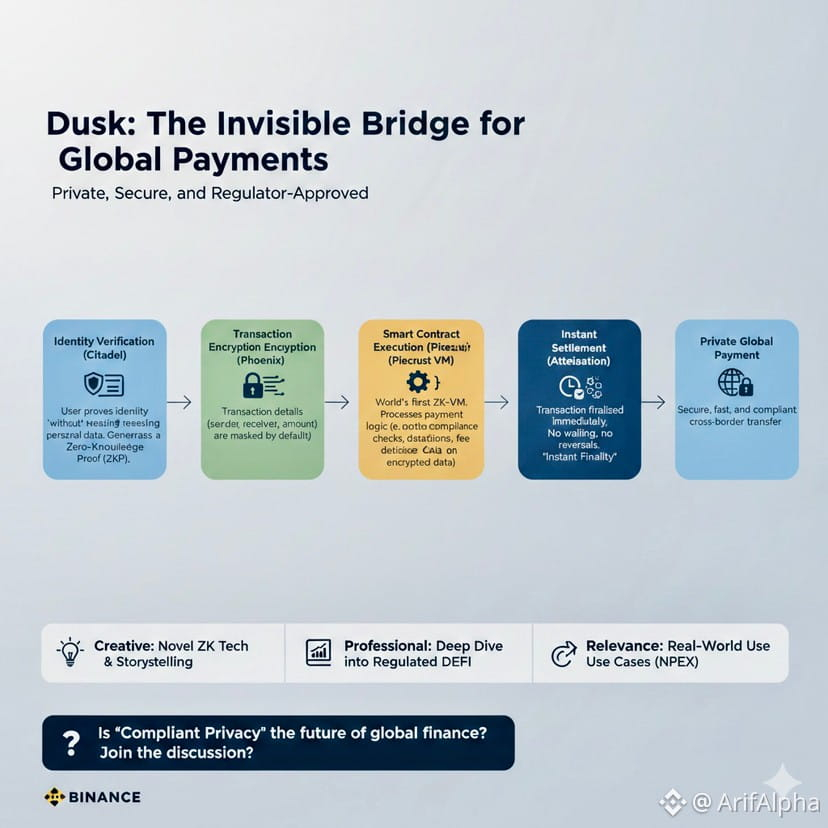
1. Compliance Check: The sender uses Citadel to prove they are KYC-compliant without revealing personal data.
2. Encryption: The Phoenix model masks the transaction details.
3. Execution: The Piecrust VM runs the payment logic (e.g., ensuring the receiver is on an approved list).
4. Settlement: The Succinct Attestation (SA) consensus reaches "Instant Finality." Unlike Bitcoin, where you wait for confirmations, a Dusk payment is settled as soon as the block is processed. No "oops, the transaction reversed" moments.
3. Real-World Impact: Beyond the Speculation
Dusk isn't just theoretical. It has already been put to work in the regulated corridors of the Dutch exchange NPEX. By tokenizing traditional securities, they proved that millions of dollars can move on-chain while satisfying European MiCA regulations.
For cross-border payments, this means a future where a company in Brazil can pay a contractor in London in seconds, for a fraction of a cent, with the same level of privacy as a bank transfer—but without the bank.
The Mindshare Shift
The "Wild West" era of crypto—where you chose between total transparency or total anonymity—is ending. We are entering the era of "Compliant Privacy." Dusk is positioning itself as the infrastructure for this shift. It recognizes that for blockchain to actually replace the SWIFT system, it must be invisible, secure, and above all, respectful of a business’s right to keep its books private.
If you had to choose for your own business, would you prioritize the speed of a public ledger if it meant your competitors could track every dollar you spent? Let’s discuss below—is "Compliant Privacy" the only way for crypto to truly go global?
