
The market late last month went from “euphoria” to “panic” in a matter of days. Prices plunged; leveraged longs were wiped out; small-cap tokens cratered. This wasn’t a single-event collapse — it was the result of several forces colliding. Below I’ll explain what happened, show the technical picture for BTC / ETH / SOL, outline the likely short- and mid-term paths, and give practical survival playbooks for both traders and long-term holders.
What caused the crash? The one-minute summary
Macro risk-off: hawkish headlines and geopolitical uncertainty made risk assets less attractive. Investors rotated into safe havens (gold, bonds).
ETF & fund outflows: spot crypto product redemptions surged — roughly ~$1.05B pulled from BTC/ETH ETFs in a few late-January days, removing a major bid.
Leverage & thin liquidity: a drop into weak order books triggered margin calls; about $1.7B of long liquidations accelerated the move.
Profit-taking by large holders: coins moved out of long-term wallets and were sold into strength.
Market structure: low realized volatility prior to the drop left the system vulnerable to a rapid re-pricing once a shock hit.
When those forces combined, what might have been a 5–10% pullback turned into cascade selling.
Technical snapshot (1-month) — what the charts say
Bitcoin ($BTC )
Immediate picture: broke key support near $94–95K and bounced around $80–82K.
If bulls hold $80–82K: look for consolidation and a potential relief rally back toward $90K–98K.
If $80K breaks: downside can accelerate into the mid-$70Ks or lower.
Takeaway: market is neutral-to-bearish until BTC reclaims ~$90K.
Ethereum ($ETH )
Immediate picture: pulled back into a critical demand zone around $2,700–$2,800.
Bull case: reclaiming $3,000–$3,200 puts ETH back on track.
Bear case: break below ~$2,700 exposes support near $2,300–$2,400.
Takeaway: ETH follows BTC but has its own demand bands to watch — $2.7K is decisive short-term.
Solana ($SOL )
Immediate picture: underperformed during the selloff, trading near $115 after dropping through support.
Risks: validator count and network health showed stress in the period, so SOL is both a sentiment and fundamentals risk.
Takeaway: SOL is higher-beta — expect sharper moves both down and in a future recovery.
Small-cap altcoins
🔸 These took the biggest hit. Lack of liquidity + rotation into BTC caused many microcaps to fall 20–50%. The altcoin season index collapsed, confirming a rotation away from speculative bets.
Short-term & mid-term outlook (what to expect)
Short term (weeks): Expect choppy trading. A relief bounce is probable from oversold levels (fear & greed index hit mid-teens), but any rally must overcome ETF flow reversals and macro headlines to be durable. BTC trading between $80–95K is the likely scenario until a clear macro signal appears.
Mid term (months): If macro risk eases and ETF flows stabilize, markets typically rebuild — altcoins can recover later in the cycle. If macro tightening continues, we could see a prolonged grind or lower lows into H1. The path depends less on crypto-specific news than on global liquidity and risk appetite.
How to survive (practical, actionable playbook)
For traders (short-term):
Cut leverage. This is the single best way to avoid catastrophic loss.
Trade smaller size and use wider stops. Volatility spikes; stops need breathing room.
Prefer range strategies: sell into rallies, buy the support band if you trade intraday.
Watch funding rates & open interest. Large divergences can flag squeezes.
Keep cash ready. Volatility creates high-reward setups — you want dry powder.
For long-term holders (investing):
Dollar-cost average (DCA). Regular buys smooth entry and reduce timing risk.
Hold core positions (BTC/ETH). These remain the deepest liquidity and best odds of recovery.
Keep a stablecoin buffer (10–30%). Gives optionality to buy big dips without selling quality assets.
Staking / conservative yield: consider staking a portion on reputable platforms, but avoid exotic yield during crashes.
Review position sizing & rebalancing rules. Rebalance after volatility — don’t rebalance by panic selling.
Key signals to watch (your dashboard)
BTC closes above $90K on daily/weekly — pivot to constructive bias.
BTC breaks below $80K — deeper correction risk.
ETF flows & custody flows — net inflows > outflows to confirm structural demand.
Funding rates: sharp flips from negative to positive can precede squeezes.
On-chain metrics: realized exchange inflows, large whale transfers to exchanges (sell risk), and decreases in active addresses (weak adoption signal).
Final take — remain tactical, not emotional
Crashes are painful but also normal. This one was driven by macro risk, ETF flows and leverage — not a single protocol failure. If you’re a trader, shrink risk and play ranges. If you’re an investor, use DCA and keep dry powder. Markets are mean-reverting; extreme fear often precedes opportunity — but only if you stay disciplined and protect capital.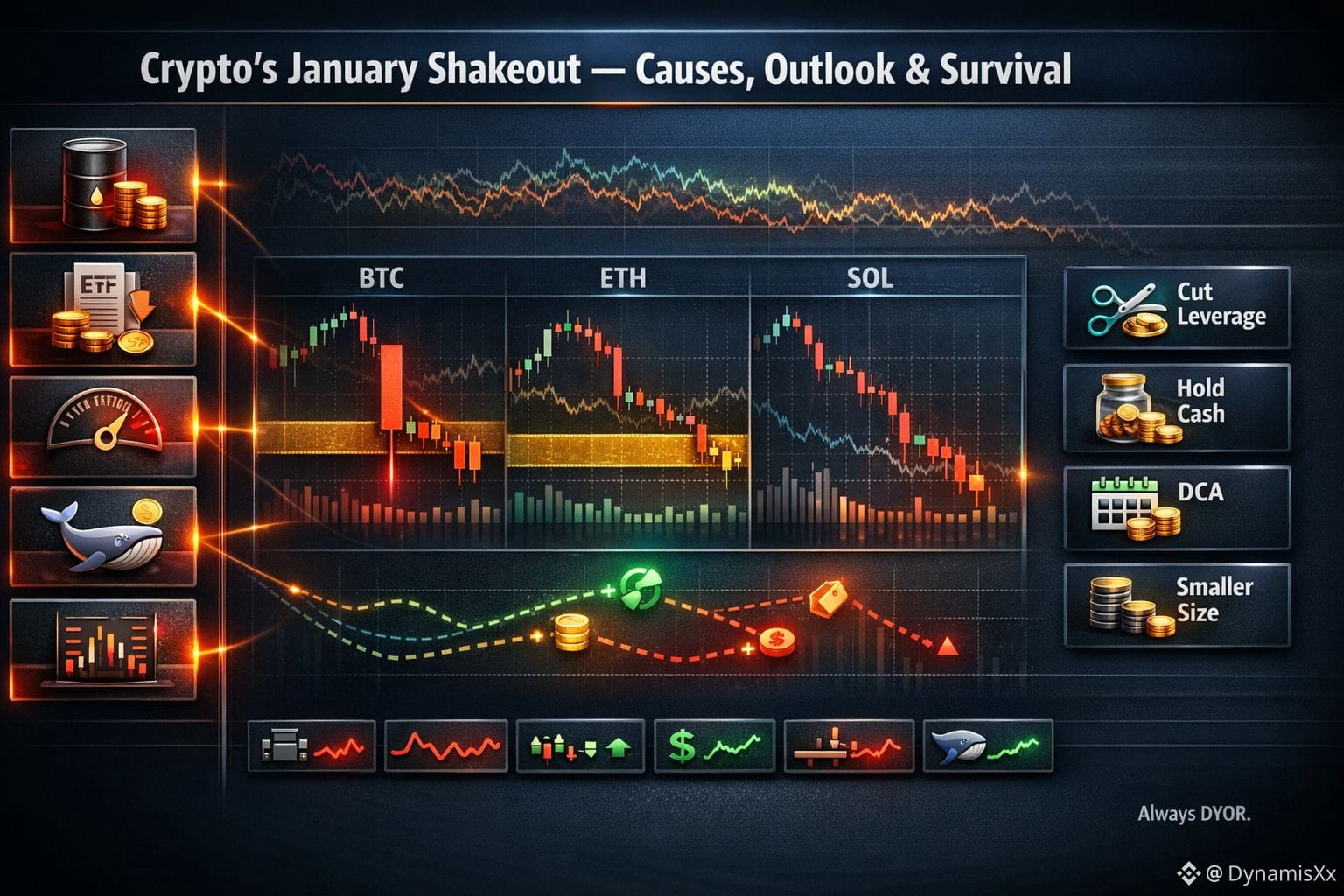
#CryptoMarket #Bitcoin #Ethereum #MarketAnalysis #RiskManagement


