

@Dusk Fair markets aren’t just about speed or access. They’re about whether participants can act without being turned into targets. In most trading environments, the invisible tax isn’t the fee line item—it’s the information you leak by simply showing up. When your intent becomes legible too early, stronger actors can lean on it, price around it, or intimidate it. The promise of privacy on Dusk has always been less romantic than people assume. It reads more like sanitation. Not secrecy for its own sake, but a way to keep markets from getting sick.
That framing matters more now because Dusk is no longer living as a concept.The network reached the point where the timeline stopped being theory and became real: rollout started on December 20, 2024, deposits opened on January 3, and the first permanent (immutable) block was set for January 7. Those dates aren’t just checkpoints.They are the moment a market stops being an idea and starts being a place where someone can be harmed if the design is careless.
The simplest way to understand “privacy as market hygiene” is to stop imagining dramatic villains and start imagining ordinary humans under pressure. A treasury operator who needs to rebalance without spooking counterparties. A fund that must prove compliance without exposing positions to competitors. A market maker who wants to quote fairly without broadcasting inventory stress. A regulator who needs answers that are specific, not a floodlight that punishes everyone. Dusk’s approach is built around the fact that these demands can coexist, but only if visibility becomes something you can control with precision rather than something you either surrender or hoard.
In practical terms, the experience is not “I hide.” It’s “I choose what is revealed, and to whom, and when.” That choice is the difference between a market that feels safe and one that feels predatory. If every action is instantly readable to everyone, then the market rewards surveillance as much as it rewards skill. Over time, that changes behavior. People stop placing honest orders. They split into weird patterns. They delay decisions. They move off-venue. The book looks liquid right up until it isn’t. Hygiene is what prevents that slow decay.
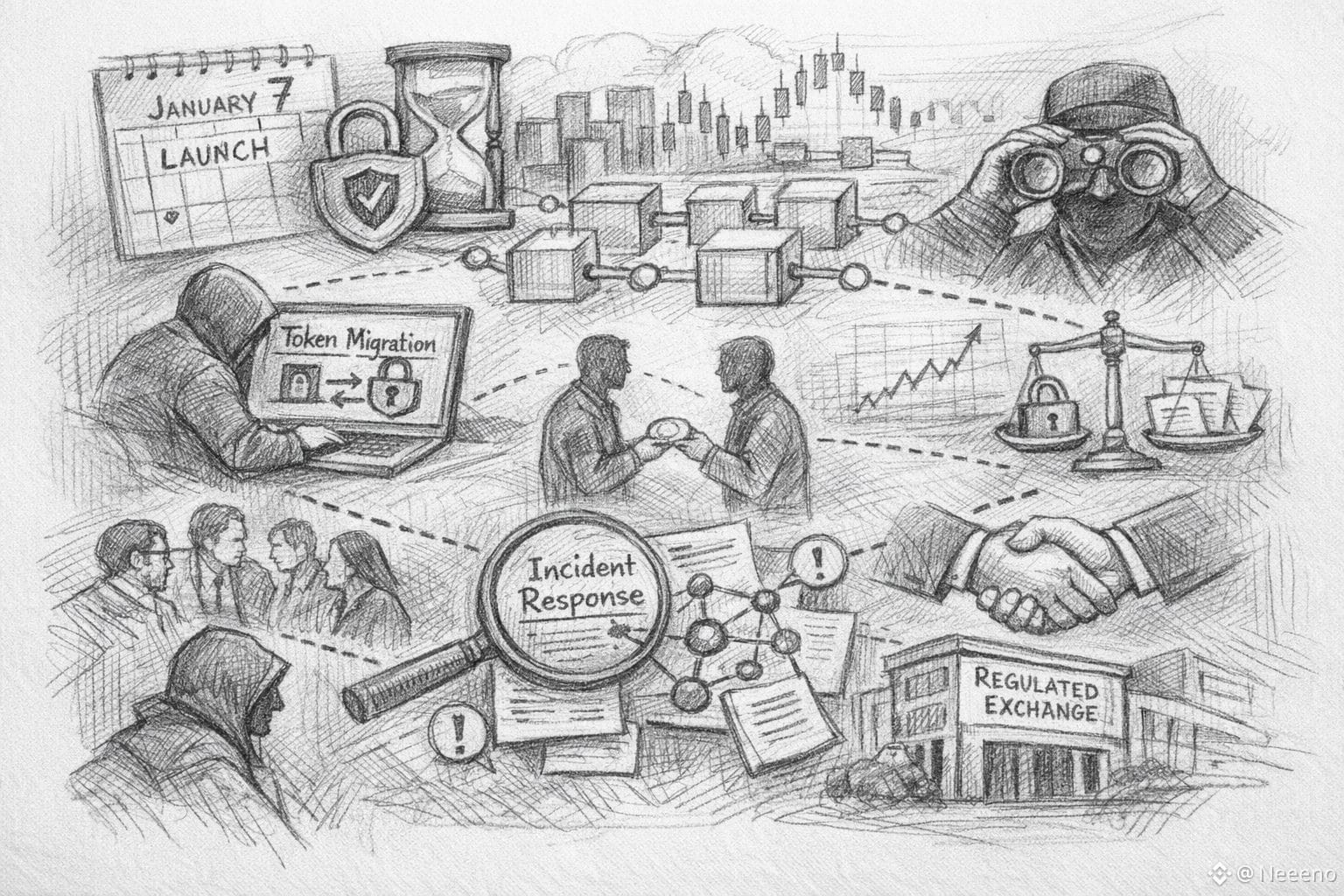
This is where off-chain reality starts pressing against on-chain logic. Real markets don’t run on one clean source of truth. They run on agreements, exceptions, outages, and contradictory records. The question is never “can we make data perfect.” The question is “when sources disagree, who gets hurt.” A system that demands full transparency often “solves” disputes by putting everyone on display. That’s an easy shortcut, and it usually hurts the weakest person most. Dusk is designed around a different idea: disagreements will happen, and fixing them shouldn’t mean taking away privacy or dignity.Even the way Dusk handled the transition into a live network reflects that mindset. Token migration is often discussed like a marketing event, but in reality it’s a high-stress moment where mistakes are easy and permanent. Dusk’s migration flow is deliberately structured: tokens are locked on the origin chain, an event is emitted, and the native balance is issued to the destination wallet, with the process typically completing in about fifteen minutes. That time window matters because it’s long enough for anxiety to rise and short enough to keep the experience from feeling like a leap of faith.
The details people ignore are the ones that tell you what the system believes about human error. Dusk’s native denomination uses a different decimal format than the older representations, and the migration contract rounds down amounts that don’t align cleanly with the native unit. It sounds minor until you’ve seen the mess it creates: unclear rounding, wallets showing slightly different totals, and people sharing screenshots and accusing others of stealing. Good “hygiene” is also about stopping small confusion from turning into real fights.
The DUSK token matters because it helps enforce the “fair deal” of the network. It isn’t about identity or hype—it’s about incentives that push participants to behave properly. The supply is straightforward: 500 million at launch, 500 million released over 36 years, and a hard cap of 1 billion.Those figures are less interesting as “tokenomics” and more interesting as a long horizon commitment. Markets built for regulated assets don’t get the luxury of short-term incentives. They need patient security. Emissions that extend across decades are a way of saying: this network expects to be judged under many different cycles, not just the first one.
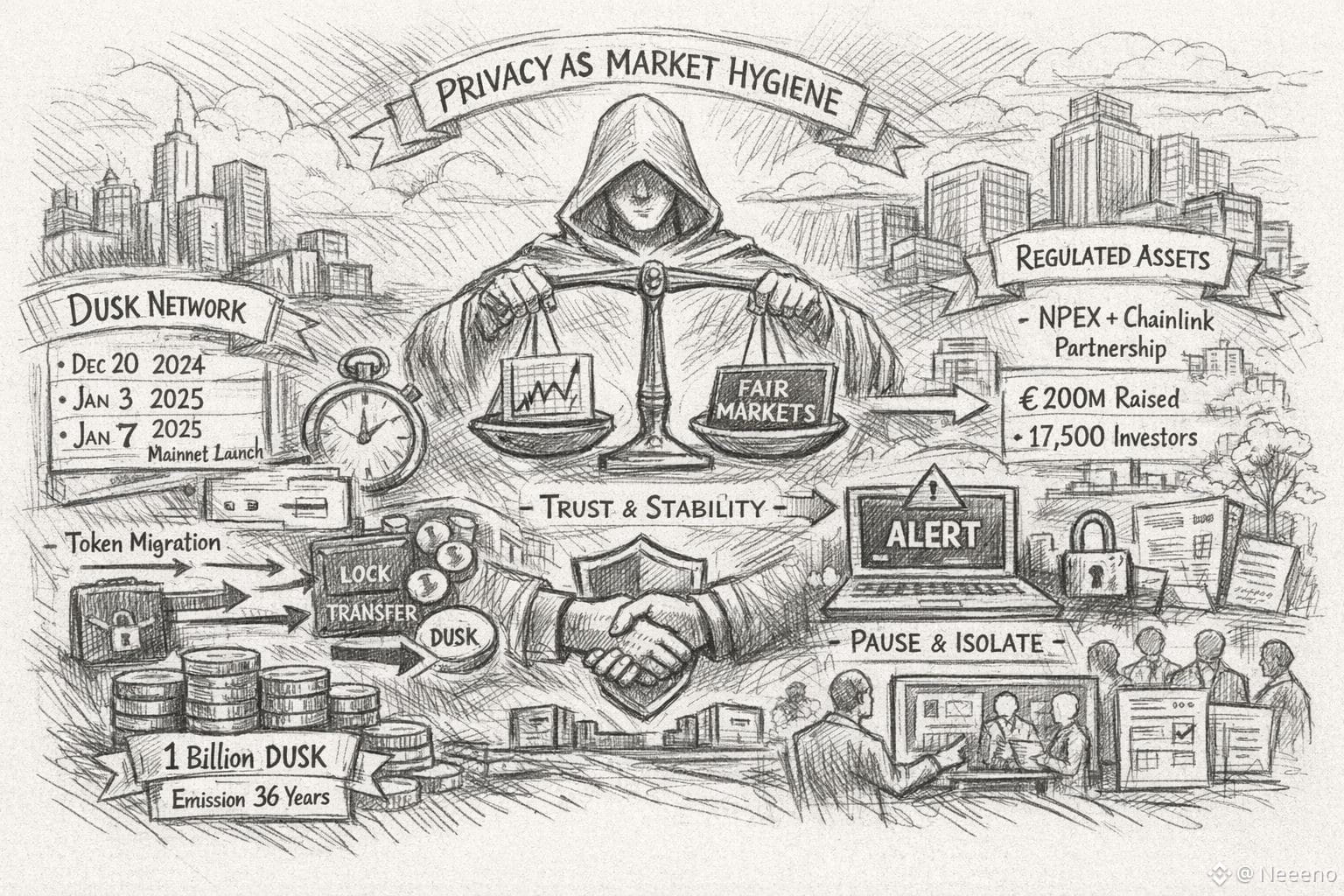
And yet, nothing tests “market hygiene” like the moments when things go wrong. Dusk’s most instructive recent update wasn’t a glossy launch—it was an incident notice dated January 17, 2026. Monitoring detected unusual activity involving a team-managed wallet used in bridge operations..
The bridge was briefly shut down to stay safe, the team swapped out the connected addresses, and they worked with Binance because the flow passed through them. They reported that, as far as they could tell at that moment, no user money was impacted. That’s responsible ops: notice early, lock things down, coordinate across platforms, and explain that the main network itself wasn’t compromised. The deeper point is not “incidents happen.” The point is what an incident reveals about incentives. If a team is rewarded primarily for optics, incidents become denial contests. If a team is rewarded for reliability, incidents become disclosure exercises with a bias toward fast containment. The language in that notice is telling because it treats operational weakness as real, not shameful. It draws a line: the core network continued normally, and the compromised surface was isolated. This is exactly the posture you want when markets are volatile and rumors are more damaging than technical faults.
Privacy plays a subtle role here too. During incidents, transparency can become a weapon. People demand full exposure “for safety,” but what they often mean is “give me information I can trade on.” A well-designed system doesn’t confuse accountability with public spectacle. It makes it possible to prove what happened, to the parties who have legitimate need, without turning the entire market into a live broadcast of vulnerability. That’s emotionally important. Panic is a coordination failure. The calmer the verification pathway, the less room there is for fear to manufacture its own reality.
This is also why Dusk’s real-world market integrations matter more than generic ecosystem talk. In March 2024, Dusk announced an agreement with NPEX aimed at bringing issuance, trading, and tokenization of regulated instruments into a blockchain-powered venue.That kind of partnership is not just “adoption.” It is constraint. It forces the network to behave under rules that don’t care about narratives. If settlement is delayed, someone’s balance sheet feels it. If disclosure is mishandled, someone’s legal team gets involved. If privacy is sloppy, someone’s counterparties change their terms. These pressures are exactly where hygiene either holds or fails.
By November 13, 2025, Dusk and NPEX also announced adoption of interoperability and data standards through Chainlink, alongside details that NPEX had raised more than €200 million in financing through its platform and had over 17,500 active investors.Those numbers ground the conversation in a particular kind of reality: this isn’t a demo audience. It’s a population with expectations shaped by regulated finance, where trust is earned through boring consistency and documented processes, not through excitement.
You can see the same direction in how Dusk is presenting the next layer of user experience around tokenized assets. The Dusk Trade waitlist is live, framed as a gateway for tokenized instruments with compliance and onboarding in mind. Even if you ignore the marketing language around it, the underlying signal is plain: Dusk is positioning itself as infrastructure where identity checks, jurisdictional limits, and investor protections are part of the lived experience. That changes how privacy must behave. It can’t be an on/off mask. It has to be a calibrated instrument that protects participants without obstructing legitimate oversight.
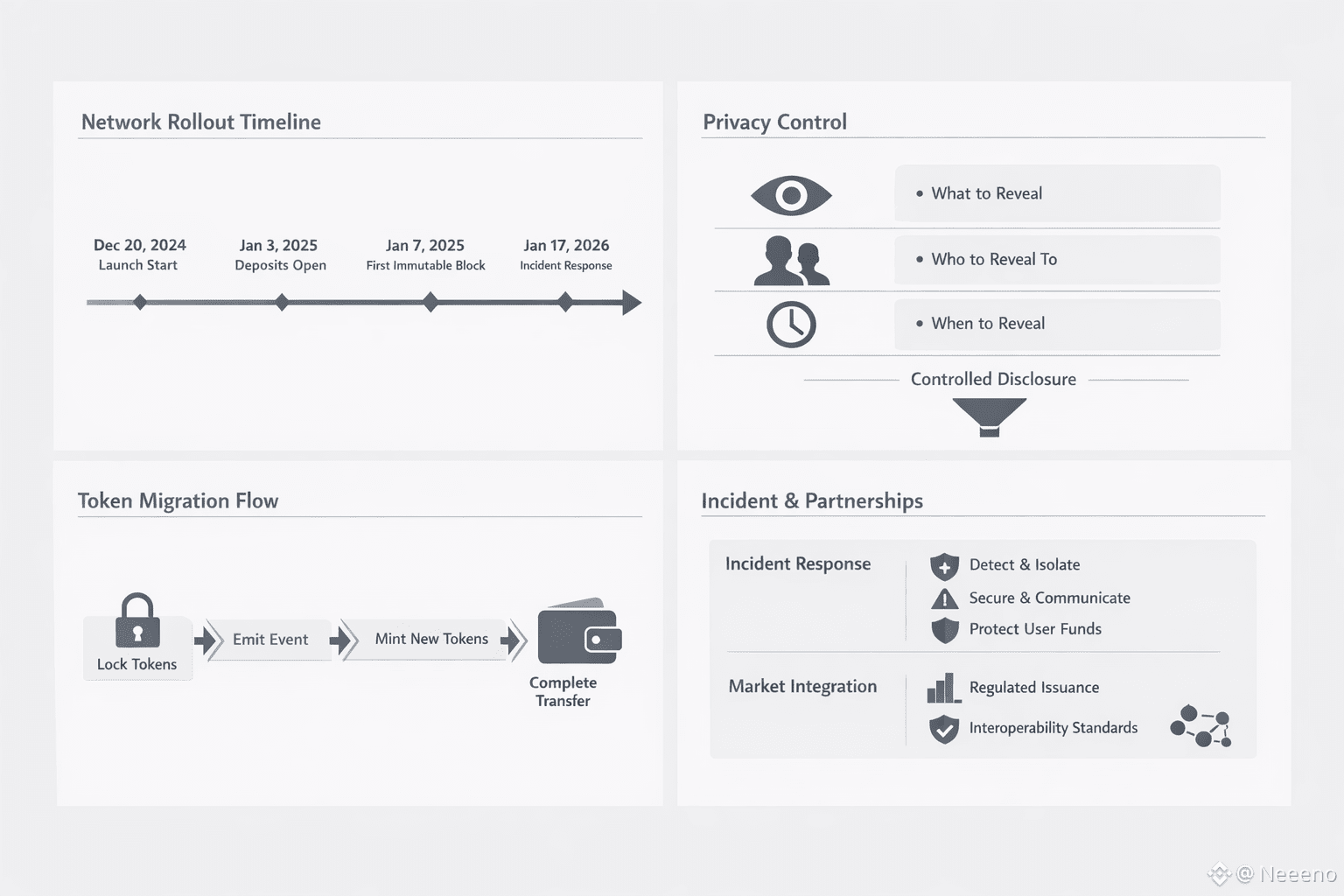
When you put these updates together—the mainnet timeline becoming real, the long-horizon emission model, the migration mechanics designed to reduce ambiguity, the incident response that prioritized containment, and the regulated-market partnerships—you start to see what “fairness” means inside Dusk. It’s not a moral claim. It’s a systems claim: fairness is what emerges when the incentives discourage surveillance, the verification pathways reduce panic, and the default user experience doesn’t punish people for needing confidentiality.
The most important layer is psychological, and it’s easy to miss if you only look at transactions. Markets are social machines. Participants need to feel that the venue won’t betray them when conditions get sharp. They need to believe that mistakes won’t automatically become disasters, that disputes won’t automatically become public humiliation, and that stress events won’t automatically become opportunities for extraction. .Dusk’s recent history shows an emphasis on exactly that kind of trust engineering—quiet, procedural, and grounded in the unglamorous parts of running a network.
In the end, privacy as market hygiene is a commitment to restraint. Not everything needs to be visible to be accountable. Not everything needs to be hidden to be safe. The systems that last are the ones that can carry real money through messy human situations—conflict, uncertainty, volatility—without turning those situations into opportunities for harm.
Dusk’s updates show a team practicing mature, public operations—launching updates, migrating pieces, coordinating responses, partnering where needed, and making regulated on-chain assets possible without stripping people of safety or comfort. That work isn’t flashy, but it’s what survives. The most valuable infrastructure often looks invisible, because it feels calm and dependable.In finance, steady systems are the line between trust and anxiety. When reliability holds during pressure, people don’t have to act paranoid—they can trust the rules, follow the steps, and engage in a market that feels clean enough to be part of.
