
There are moments in this market when nothing is technically “wrong,” yet everything feels slightly off.
Blocks keep producing. Liquidity keeps moving. Dashboards still light up with metrics that look impressive on paper. And yet, after enough cycles, you start to notice that the real tension isn’t about speed anymore. It’s about responsibility. About what happens when systems stop being demos and start being depended on.
That’s the lens through which I eventually started looking at Dusk.
Not because it promised something new, but because it quietly refused to promise what everyone else was selling.
Crypto infrastructure has spent years optimizing for execution. Faster blocks. Cheaper gas. More composability. The assumption underneath all of it is that if execution works, settlement will somehow take care of itself. And when it doesn’t, we invent layers of governance, coordination, or “temporary fixes” to explain why something that was valid yesterday feels questionable today.
You only realize how fragile that assumption is once the system is put under real pressure.
Audits don’t ask how fast something executed. Regulators don’t care how expressive a smart contract was. Courts don’t evaluate throughput. They ask one uncomfortable question: can you explain, consistently and defensibly, why this outcome exists?
Most blockchain architectures postpone that question. Dusk does the opposite. It pulls it forward.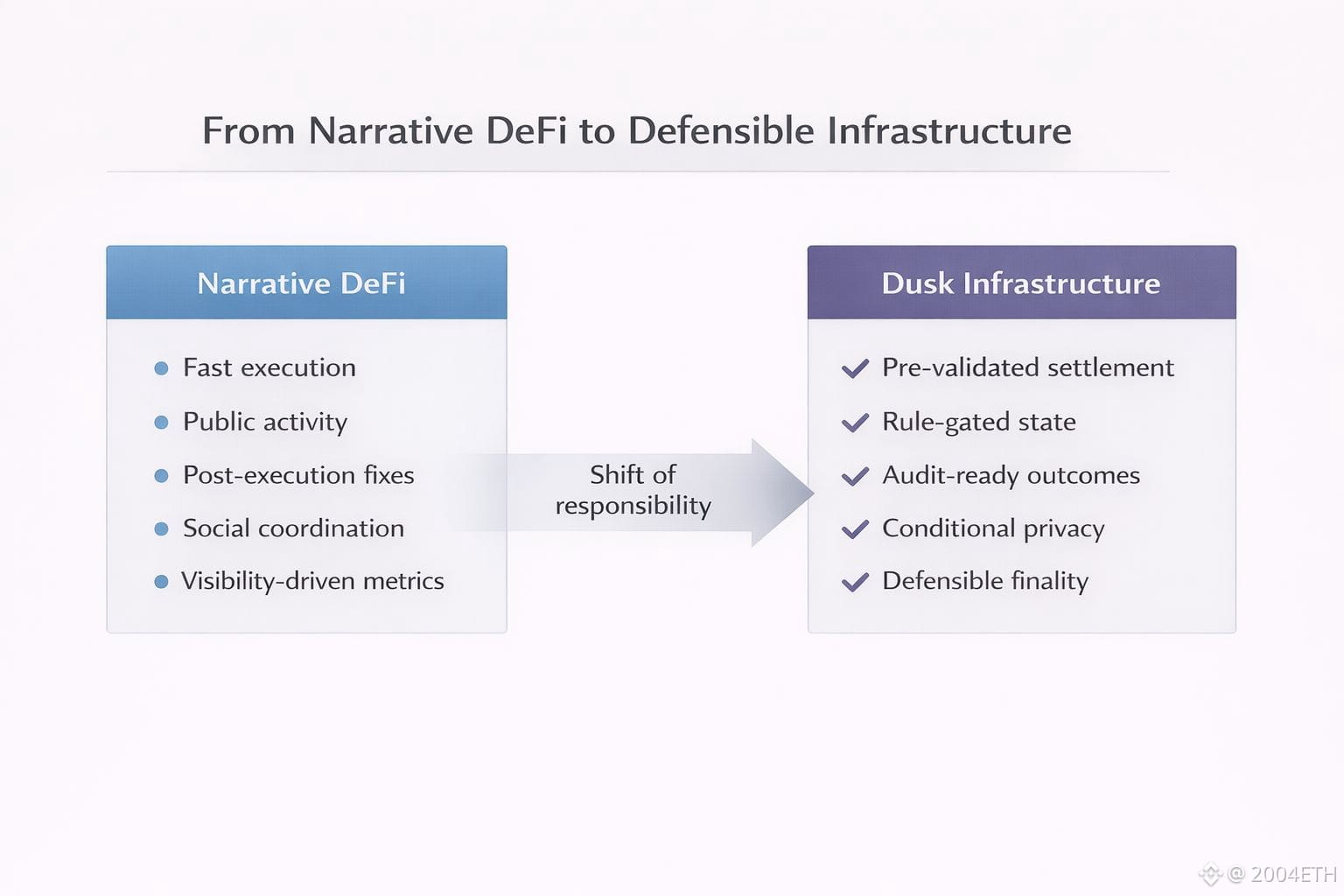
When I first dug into Dusk’s design, what stood out wasn’t privacy, or compliance, or even modularity. It was a quiet decision embedded deep in the stack: settlement is treated as a boundary, not a byproduct. Once something crosses that boundary, its meaning is fixed.
That sounds obvious until you realize how rare it actually is.
In many systems, execution creates state, and interpretation follows. Logs are analyzed later. Exceptions are handled downstream. Meaning becomes something that evolves with context. That flexibility feels powerful in early stages, but it becomes a liability the moment different parties need the same outcome to mean the same thing months later.
Dusk’s answer to that problem lives at the DuskDS layer.
DuskDS is deliberately unexciting. It doesn’t host applications. It doesn’t chase developer mindshare. It doesn’t try to be expressive. Its job is narrower and stricter: decide whether a state transition is allowed to exist at all. If it passes eligibility rules, permissions, and protocol constraints, it settles. If not, it simply never becomes part of history.
There is no reverted state to interpret. No failed transaction to analyze. No soft finality that depends on future coordination.
This is where many people misunderstand Dusk. They see limited visible activity and assume inactivity. In reality, much of the work happens before execution ever becomes visible. Rules are defined upstream. Constraints are evaluated early. By the time something appears on-chain, ambiguity has already been removed.
That design choice reshapes everything above it.
DuskEVM exists because Dusk understands a hard truth about the market: without EVM compatibility, ecosystems struggle to form. Tooling matters. Familiarity matters. Time-to-integration matters. But DuskEVM is not a concession that hands authority to execution. It’s a controlled interface.
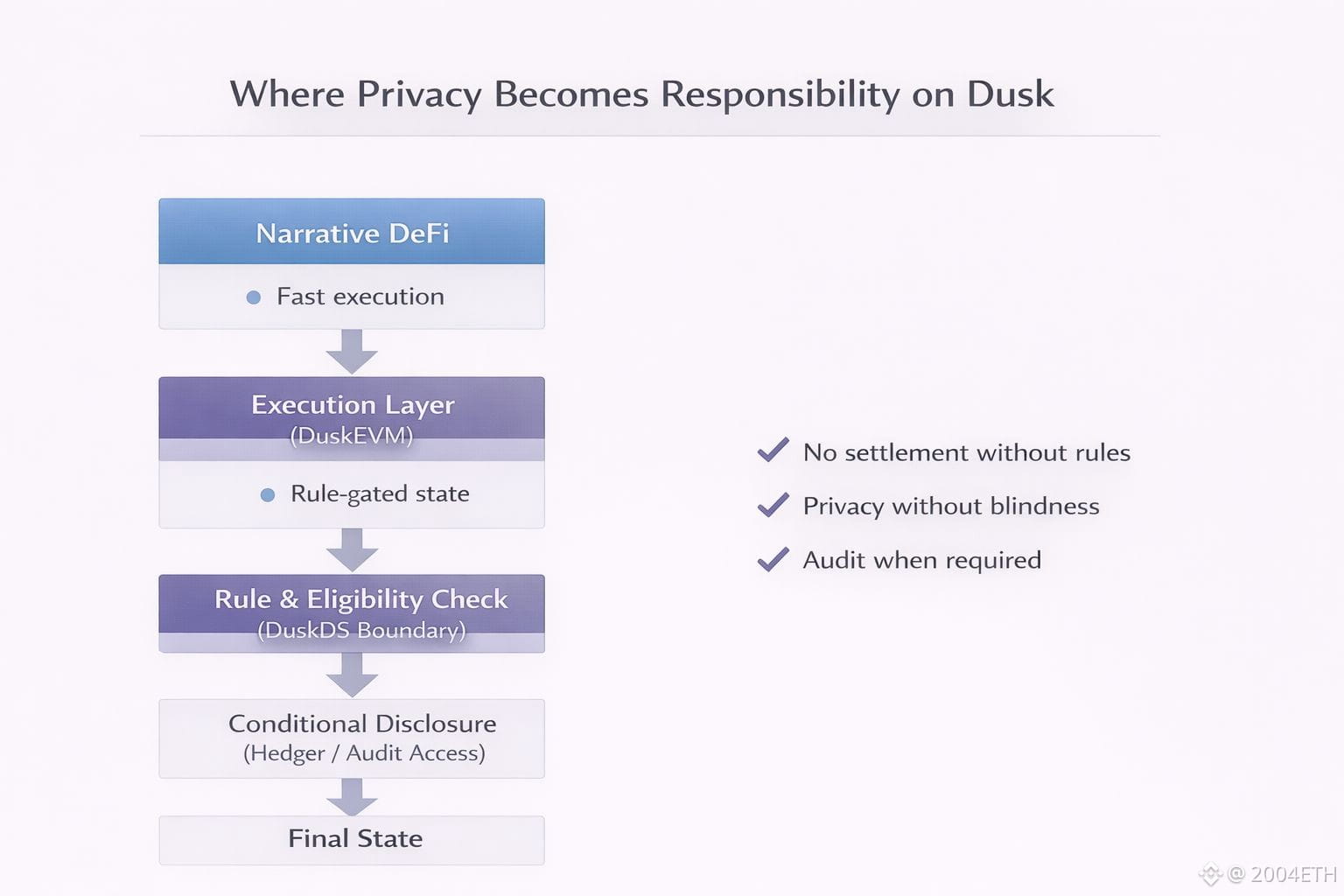
Execution on DuskEVM is expressive by design. Developers can deploy Solidity contracts. Applications can evolve. Logic can change. But execution does not automatically define reality. Outcomes produced by DuskEVM are candidates, not facts. They only become state after passing the constraints enforced at the DuskDS boundary.
That separation is not cosmetic. It is structural risk management.
I’ve watched enough systems where a single application bug cascaded into a ledger problem because execution and settlement were too tightly coupled. Dusk deliberately refuses to let complexity harden unchecked. Execution is allowed to move fast. Settlement is allowed to move once.
The same philosophy shows up again in how Dusk treats privacy.
Privacy in crypto is usually framed as all or nothing. Either everything is public, or everything is hidden. Both extremes break down in regulated environments. Total transparency leaks sensitive data. Total opacity collapses under audit.
Dusk treats privacy as conditional. Verification is separated from disclosure. The system can prove that rules were followed without exposing underlying details by default. When disclosure is required, it is explicit, authorized, and scoped.
That’s not a marketing slogan. It’s an operational stance.
Institutions don’t fear privacy. They fear privacy that cannot be explained. They fear systems where the only way to audit is to break confidentiality entirely. Dusk’s approach acknowledges that fear instead of dismissing it.
What ties all of this together for me is not any single feature, but the consistent direction of responsibility.
Execution responsibility lives with applications. Settlement responsibility lives with DuskDS. Privacy responsibility lives with controlled disclosure mechanisms. And human responsibility is acknowledged rather than abstracted away.
This is not the fastest way to build. It’s not the most flexible way to experiment. It’s not even the most exciting narrative to sell in a bull market. But it is a coherent answer to a question most projects avoid asking: what happens when this system has to explain itself years later, under pressure, to people who don’t care about crypto ideology?
That’s why Dusk often feels quiet.
Quiet systems don’t generate drama. They don’t produce constant exceptions. They don’t require public reconciliation. They don’t need to renegotiate reality every time something goes wrong. Silence, in this context, is not absence. It’s containment.
From a retail perspective, this can feel restrictive. From an institutional perspective, it’s the entire point.
Financial infrastructure doesn’t fail because execution was slow. It fails because settlement couldn’t be defended when the context changed. Dusk’s architecture is built around that uncomfortable reality.
I don’t know yet whether Dusk will succeed. Regulated finance is unforgiving. Trade-offs are real. Complexity doesn’t disappear just because you manage it better.
But I do know this: Dusk is one of the few projects I’ve seen that seems more concerned with being explainable than being impressive. More interested in surviving audits than surviving narratives.
And after enough cycles, that shift in priority starts to feel less conservative, and more honest.
