I have spent years watching crypto infrastructure evolve. Every cycle brings new promises, new L1s, new rollups, new data layers. But despite all this innovation, one problem has always stayed strangely unsolved: real applications still cannot store real data on-chain. Developers always had to cut corners. Games needed centralized servers for their assets. AI applications needed traditional cloud buckets. Even simple front-ends, the part users rely on the most, had to live on vulnerable hosting services that could be censored, corrupted, or taken down.
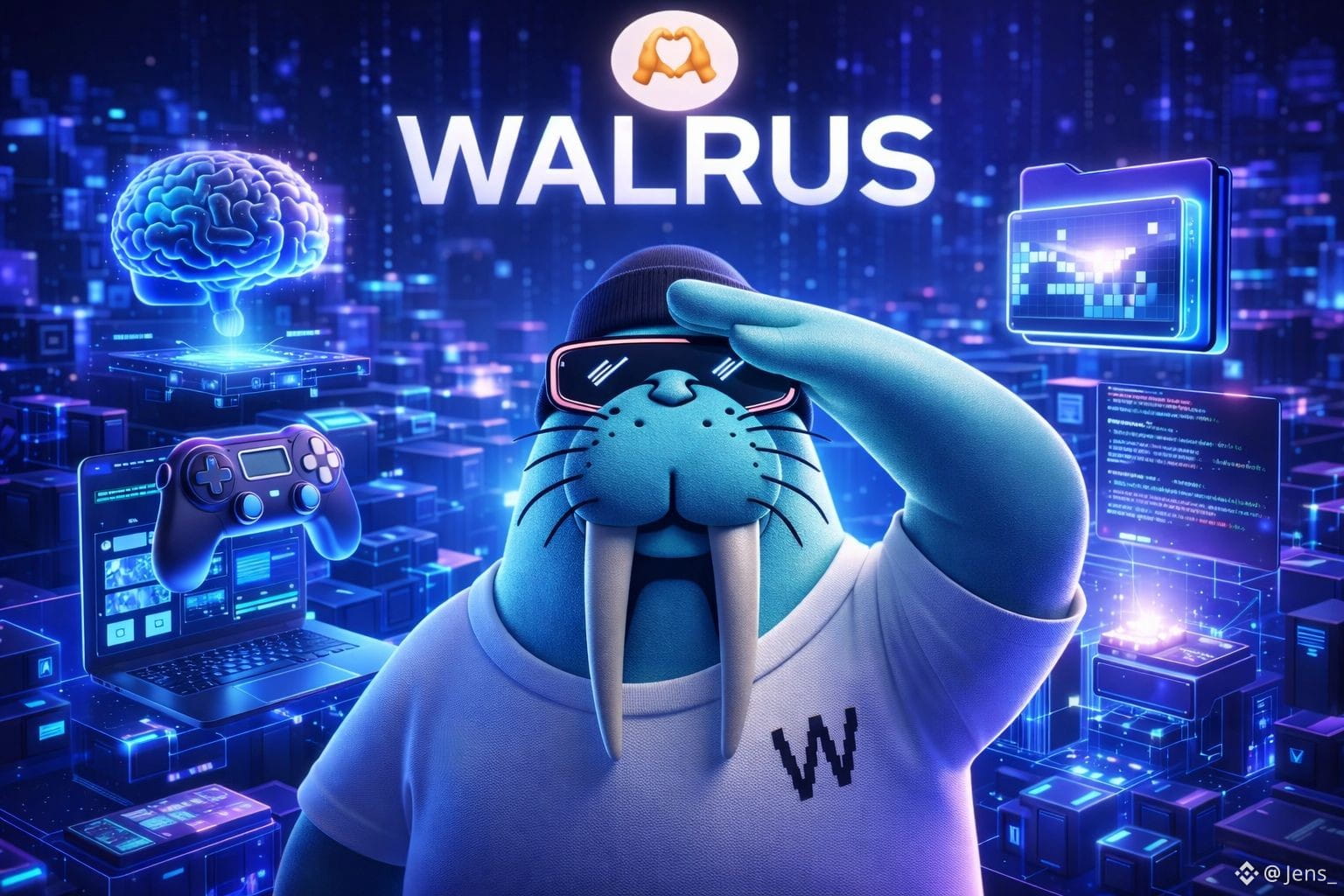
Then I discovered Walrus, and it felt different from everything I had seen. Not just a new chain, not just another storage experiment, but a complete rethinking of how data should live in a decentralized world. Walrus treats storage like a first-class citizen, not an afterthought. It turns data itself into programmable, verifiable objects. It anchors trust into the Sui blockchain, and suddenly the entire idea of Web3 becomes more coherent. The more I studied Walrus, the more I realized that this isn’t a niche tool. It’s more like the missing foundation piece we always needed.
Walrus calls itself a decentralized data network that lives alongside Sui. But the real story is much bigger. Walrus changes how developers think about what should be on-chain. In older systems, only the “logic” of an app was decentralized. Everything else, the content, assets, files, even the GUI users interact with, stayed centralized. Walrus challenges that idea by letting developers publish entire front-ends and heavy assets as durable, trust-minimized data objects. Once uploaded, they become part of the Walrus network’s distributed storage capacity. They gain integrity guarantees, verifiability, and programmability. And they survive in ways traditional hosting never could.
This changes the relationship between a user and an application. When you load a front-end served through Walrus, you’re not depending on a single point of failure. You’re interacting with infrastructure that is shared, replicated, cryptographically proven, and designed to survive the moments when users actually panic, rush, or try to transact during peak volatility. Walrus gives developers something rare in Web3: confidence that their application will stay reachable even when everything else is under stress.
What impressed me most is the architecture behind it. Walrus introduces new concepts like RedStuff, a mechanism that ensures data remains available across the network without relying on unrealistic assumptions. It takes proofs of storage seriously through Seal, a verification system that makes sure node operators are storing the data they claim. And it manages data as signed chunks with economic incentives and cryptographic checks, so there is no guessing or trusting. Every piece of the system is built with clarity and accountability.
But Walrus is not just a technical breakthrough. It is also an economic breakthrough. $WAL, the native token, becomes the foundation for how storage is paid for, governed, and maintained. Storage networks have historically struggled with token design. Either they made storage too cheap and unsustainable, or they made it too expensive for real adoption. Walrus finds a balance. Developers pay for the data they store, validators prove they are maintaining the network, and incentives align cleanly with usage. The more apps use Walrus, the stronger the ecosystem becomes.
And trust me, usage is coming. We are entering an era where apps will be far more data-heavy. Games want to store gigabytes of assets. AI models need reliable hosting with cryptographic integrity. NFT ecosystems are moving beyond static JPEGs and into dynamic, high-resolution, multimedia formats. Even social platforms want to anchor posts, profiles, and identity data in ways that cannot be manipulated.
Walrus positions itself exactly where the market is headed. And Sui, with its object-based programming model, makes the connection even stronger. When a Walrus data object becomes a Sui object, it turns into something powerful. Developers can reference it, manage it, govern it, and embed it directly into smart contract interactions. This is not just storage. It is programmable data availability. A concept the industry has been trying to solve for years.
Front-end distribution is another area where Walrus shines. This is something most people overlook, but it matters deeply in real-world Web3 usage. When a front-end breaks, users don’t just see an error screen. They lose trust. They feel like they’ve lost control. In a high-stakes moment, when prices move fast or a transaction needs to be signed quickly, a broken UI can feel catastrophic. Walrus protects that layer of user experience. It treats the front-end as a trust boundary that must be durable, decentralized, and resilient to real-life chaos.
And here’s why I believe Walrus is one of the most important infrastructure plays of this cycle: it blends high-performance storage with the programmability of a major L1. Other networks tried to solve storage by outsourcing it to miners with zero synchronization with application logic. Walrus solves it by merging data directly into the logic layer of Sui. This alignment creates something that feels natural and scalable. Something developers will actually use because it doesn’t force them to choose between decentralization and practicality.
The early ecosystem activity around Walrus is already impressive. Developers are experimenting with hosting dApps, AI workloads, multiplayer game assets, and even research datasets. Projects that depend on immutable front-ends are exploring Walrus because it gives them a deployment path that isn’t fragile. And more importantly, the Walrus team is shipping quickly. They have a clear roadmap, a strong technical vision, and a culture that focuses on solving real problems rather than chasing hype.
I genuinely believe that the market will soon understand the value of $WAL. It represents more than just a token. It represents a shift in how we treat data on the blockchain. It reflects the demand for honest, scalable infrastructure. And it aligns with the natural direction of Web3 as it matures. We’re moving away from gimmicks and into useful, durable systems. Walrus fits that category perfectly.
When you look around the crypto landscape in 2026, you can see what’s happening. AI is exploding. On-chain gaming is growing. Real-world applications want decentralized backends. Enterprises want verifiable data layers. They all need exactly what Walrus provides: reliable storage that feels native, not bolted on.
I’ve been saying this across multiple projects, but it matters even more here: cycles reward the infrastructure that solves real, painful problems. Walrus solves one of the most painful and long-ignored problems in Web3. And it does it with elegance, clarity, and strong engineering.
This is why I keep watching Walrus closely, and why I think many builders will migrate to it over time. When an ecosystem offers speed, safety, programmability, and reliable storage, developers don’t need to compromise anymore. They can finally build apps that feel complete. Apps that users trust. Apps that don’t break during volatility.
Walrus is not just another network. It is a foundation layer for the next wave of decentralized creativity. It gives power back to builders, stability back to users, and structure back to Web3’s chaotic infrastructure stack.
If you’re building, studying infra, or watching long-term trends, keep Walrus on your radar. The world is moving toward data-heavy decentralized apps, and Walrus is one of the few systems ready for that future.