Vanar Chain is in a stage where many networks discuss but few do so successfully is the transition of being a place where transactions occur to being a place where intelligent applications exist. That difference can be heard until one experiences it in actual application. The majority of chains continue to force individuals into a program that is mechanical attach a wallet do some transaction just hope that the result is the same as the intention. The direction given by Vanar implies more relaxed and natural applications that know intent make fewer steps and actions remain answerable onchain.
This can be best explained as Vanar approach viewing intelligence as an environment and not an attribute. In an AI heavy future it is not only the infrastructure that will execute smart contracts at a very high speed but it will also think in the manner in which modern applications execute. There is no thinking of magic or hype here. It involves working with context memory retrieval and decision paths. AI systems do not act like fixed software. They must have access to handy information they must compare what they need to know and they must be able to do what they need to do within safe parameters. A chain taking AI native building seriously must ensure that those patterns are natural to developers and predictable to users.
The significant purpose of this is that the wave of adoption next will not be motivated by individuals knowing complex interfaces. The experience is perceived as self-evident, which is the next wave. When one is able to articulate an objective and the application can lead in the implementation without misunderstanding. When repetition is automatic but control is not lost. When the chain ceases to be a destination and begins to be an invisible infrastructure beneath products that people actually desire to utilize.
The three concepts that continue to recur in the manner AI native systems are developed today include intent memory and verifiability, which is the future strength of Vanar. Intent refers to the fact that the user desires results and not menus. A user is not interested in tapping four buttons in the right sequence that one wants a result pay a bill set a recurring transfer move funds into a safer position settle a transaction with a specified limit. The purposeful application involves taking an objective and transforming it into a risk free strategy. The plan is important since it becomes auditable. It enables one to have a preview of what is about to occur. It can also enable the user to enter maximum amount maximum frequency maximum exposure and destinations that are permitted. It is through this that intelligence becomes credible not through being witty but through being limited.
The second pillar is memory which is not well understood. It does not require memory to mean surveillance or exposure of the self. The ability of an application to remember preferences and patterns with express permission is simply useful memory. Take into account the exhaustion when every new app is enforced to be set up in the same way. Pick the same settings affirm the same warnings re learn the same steps. Portable authorized memory modifications that. It enables a user to take comfort settings through experiences. It enables a business to encode its policies one time and re-use them many times. It also enables the experience to be less risky but smoother. The user remains in charge since it is a chosen setup, which is not a hidden profile.
The third pillar is verifiability and in this aspect a chain should remain serious. Intelligence that is not verifiable becomes a black box. Vanar has a chance of backing up applications that have the capacity to justify how and why. Not in an intricate technical manner but in a traceable manner. A user must be afforded a chance to know what rules were checked which limits were made and what was the evidence that prompted an action. This is particularly with the increase in the number of agent like applications. Automated execution will only remain acceptable to people when it remains accountable. The verifiability makes the automation a safe thing.
This is also where $VANRY comes out, rather than something that people observe on the chart. This is because when a network becomes associated to a repeated real use, the token of the network has a long term weight. In the event that Vanar manages to host applications that humans use on a daily basis then $VANRY would be the fuel of motion that is not motivated by mood but by utility. The difference between the demand and attention is that. Attention may be noisy and short lived. Demand is inquiring and insistent.
A single flagship application is not the most exciting thing Vanar should look forward to. It is an ecosystem pattern in which constructors make instruments that sense smart without relishing experimental. It starts with real-life applications. Autonomous settlement of payments within limits that are set by the users. Frictionless renewal subscriptions. Business transfers, which are not written off by a hand, are automatic. Simple commerce flows wherein the user experience remains smooth in cases where the settlement can be complex. When such experiences are taken effectively people cease to perceive the chain and begin to perceive the convenience.
The second one is operational automation. Majority of onchain intelligence debates are lost in speculation. Operations is the better way to move. Reconciliation. Scheduling. Policy enforcement. Logic of compliance that is explicit. Back and forth customer workflows are non existent. These are not glittering subjects but they make actual retention. They also bring about consistent transactions since they are related to routine. Whenever routine activity expands so does the network expand to the right cause.
The third group is the asset workflows which need integrity over time. Several tokenized ideas do not work out as they are concerned with the wrapping as opposed to the reality behind updates. The actual problem is maintaining the information as credible as things are shifting. Ownership changes. Status changes. Audits happen. Utilization changes. Revenue events occur. A chain is useful in that it is able to lock those updates in a manner that is difficult to tamper and simple to validate. AI will assist in identifying abnormalities and trends although the chain has to maintain the track. It is that mixture that makes smart infrastructure seem a reality.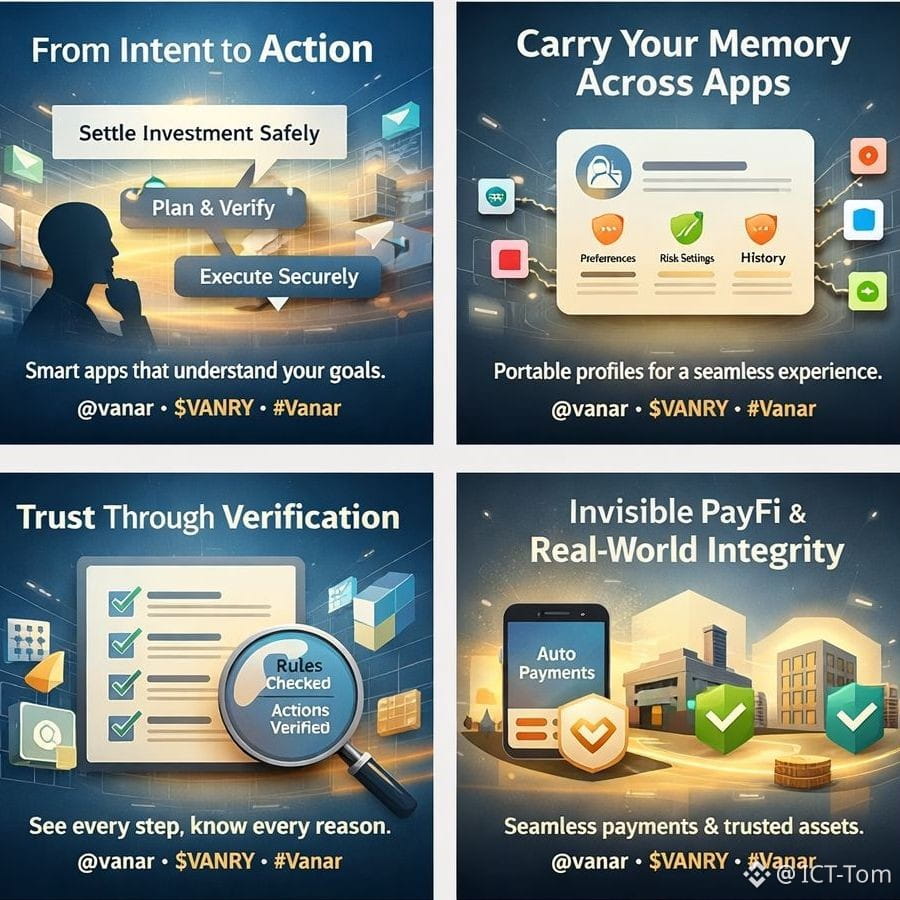
The most ideal ecosystems also favor by lessening the cognitive load. Creators emerge when construction becomes not so difficult. More teams are experimented with when deploying is familiar. Consistency in tools reduces the number of projects which break. Vanar can resort to leaning into this by ensuring that the builder journey is straight. Clear documentation. Stable endpoints. Predictable behavior. A quiet developer experience has a compounding effect since each successful deployment becomes a point of reference to its next one.
There is also a cultural factor that counts. The long lasting networks do not simply sell what they ship. They generate a beat, which individuals anticipate movement and are able to feel it. They form an identity in which builders have a direction other than noise. The first identity of the AI that Vanar possesses may be empowered when it remains grounded. Not chasing every trend. Not trying to be everything. However, always taking the lead in making smart applications a normal feeling.
To holders the best attitude is to monitor signals that can easily be forged. Increase in the number of applications that clients revisit. Even more developers coming and remaining. Activity onchain which is not of the form of a spike but appears part of normal usage. And a story about the ecosystem which gets more pragmatic as time goes by and not more abstract. Provided that the signs become stronger then the future of $VANRY will not be such a short term story but a long term utility curve.
The bigger industry is shifting towards the experience of an assistant over a dashboard. People desire systems that assist them in doing something rather than systems which demand that they master all things beforehand. The change in the development of products not within the chain space already is noticeable. The move to construct that shift directly is the advantage that Vanar has. Suffice to state that AI is important. The infrastructure should simplify the construction of AI oriented applications to be safer to perform and more relaxed to be confided in.
The second chapter Vanar has to do with demonstrating that smart blockspace can be serene. Peaceful does not imply lazy or monotonous. Sergeant will require fewer strides and less mystery. Calm implies that a user can define limits one time and count on them. Automation feels like control with less effort calm means automation does not feel like surrender. By continuing to drive towards that standard, then @Vanarchain can expand to be more than a story and be a working home where people can live because it helps them simplify their lives.