


The vast majority discuss tokenized RWAs as though the difficult job is to issue a token. That's the easy part. The difficult part is all that makes markets act like markets: published price information, publish actions of companies, regulated disclosure, and audit trail that is not used to spill strategy. Without solving those, you do not have a real on-chain market. You receive a token that has no use by institutions.
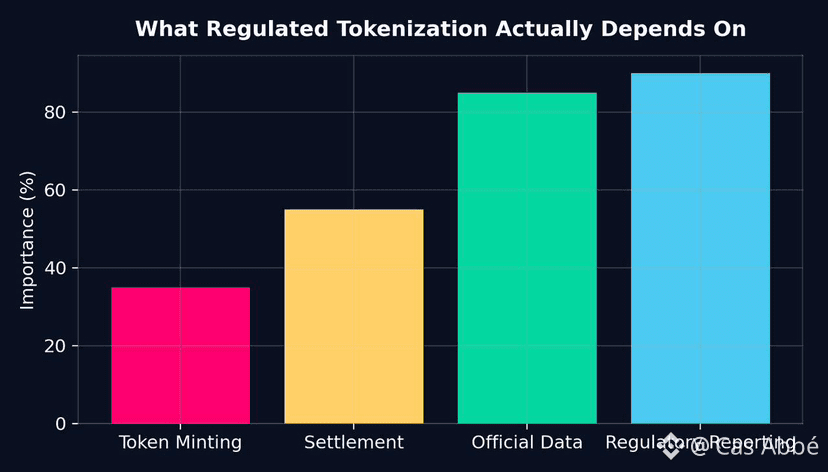
This is the place where the angle of Dusk is uncharacteristically clear. It does not even attempt to be a chain of all. It is attempting to become the location where controlled assets can exist on-chain without compelling institutions to publicize their actions to the world wide web. That no exposure one is part is not branding. It's a design constraint. Big money will just not be involved in case all the positions, trade size and pattern becomes transparent. The intent is money and the transparency of intent is a cost in real market.
Information is the difference between serious infrastructure and the conversation of RWA talk. Managed markets operate on official data dissemination. Unless you have a plausible mechanism of putting regulated market data on-chain, you cannot operate compliant venues, you cannot operate institutional grade settlement, and you cannot construct products based on official prices. A good indication of this is that Dusk also has NPEX and Chainlink as a partner, since it is not about retail hype, but about regulated data standards and interoperability. The framework is clear: regulated market data provided by NPEX is supposed to be delivered on-chain through Chainlink regulated data tooling and Dusk/NPEX are official data publishers and not just users.
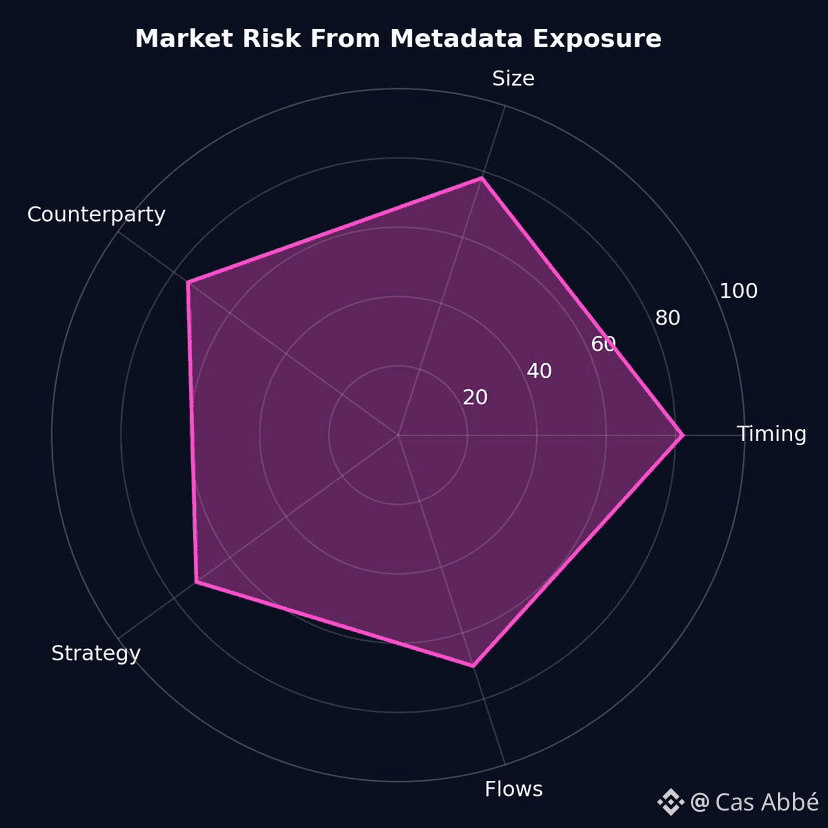
That is a significant difference. Any oracle feed does not mean the same as official exchange data as a standard. Institutions do not believe random sources when they are pricing instruments. They require transparent provenance, auditing and dependability capable of withstanding scrutiny. The fact that Push by Dusk is trying to ensure that regulatory-grade financial information can be accessible to smart contracts is simply saying: tokenized markets would need to be taken as seriously at their data layer as much of their settlement layer.
The second missing piece is then interoperability that does not make regulated assets unregulated wrappers. In case regulated securities are to be inter-environmentally migrated, the migration must maintain compliance assumptions and auditability. Chainlink CCIP has been identified as a canonical interoperability layer to link regulated assets in any blockchain environment, including assets issued on DuskEVM. That is a very hushpuppy move: fix the plumbing, since that is what makes the market real.
It is not the existence of partnerships with Dusk that is positive here. There are numerous projects that are announced. The good news is that Dusk is concentrating on those elements of tokenization that are typically overlooked since they are not entertaining to discuss: regulated data publishing, selective disclosure, and controlled interoperability. The ingredients that make tokenization a marketable commodity rather than a story are those.
The danger is also quite obvious: controlled infrastructure does not happen instantly. Standards of data publishing, integration in the market, and real issuance pipelines pass through pilots, compliance checks, and working tests. Unless these integrations become live volume and used on a regular basis, the story remains forever as promising. Almost infrastructure is not rewarded in the market. It encourages embedded infrastructure which is depended upon.
When you want to evaluate Dusk as an adult work, you do not begin with the question of whether it is technically impressive. You inquire whether it is getting into the regulated data and settlement stack. Will official feeds become live? Are controlled premises in fact utilizing them? Do controlled assets traverse cross-environmentally in a manner that maintains accountability? Those are boring questions. They are also the questions which determine the realness of tokenized finance.
