
When you first hear about Walrus, it sounds like a quirky name for a crypto token — maybe even something playful. But once you scratch beneath the surface, what you find isn’t whimsical at all. It’s bold. It’s almost audacious. Walrus stands at the crossroads of two fundamental forces reshaping the digital age: the explosion of data and the decentralized ethos of blockchain. In a world drowning in terabytes of videos, AI training data, game assets, and NFTs, the way we store and access that information is quietly becoming one of the biggest technological battlegrounds of our time. And Walrus wants to be at the heart of it all. �
Imagine a world where your digital memories — your creative work, your data streams, your AI training sets — weren’t buried in the monolithic servers of a few tech giants, but scattered across a global symphony of independent nodes, each holding a piece of the puzzle, each contributing to a decentralized tapestry that never sleeps. That’s the world Walrus is trying to build. It doesn’t just store data; it reimagines storage itself, turning it into a programmable, verifiable, and truly decentralized resource. �
Superex
From the moment the idea was first sketched out within the halls of Mysten Labs — the same minds that gave us the Sui blockchain — there was a sense that something transformative was in the works. Walrus wasn’t meant to be another storage network in the crowded landscape; it was conceived as a data sovereignty engine for the next generation of decentralized applications. Instead of treating storage as a passive service, Walrus treats it as an active, programmable asset — one you can build logic around, trade, stake, expand, or integrate directly into smart contracts. �
Superex
That spark of ambition ignited a journey that culminated in the Mainnet launch on March 27, 2025 — a day that will be looked back on by many in the blockchain space as one of those quiet but pivotal inflection points in decentralized storage history. On that day, Walrus didn’t simply flip a switch. It unleashed a fully functioning ecosystem with over 100 storage nodes ready to serve and verify data, governed not by a central authority but by a collective of independent operators and community participants. All of this was powered by the WAL token, the lifeblood of the network. �
Walrus Docs
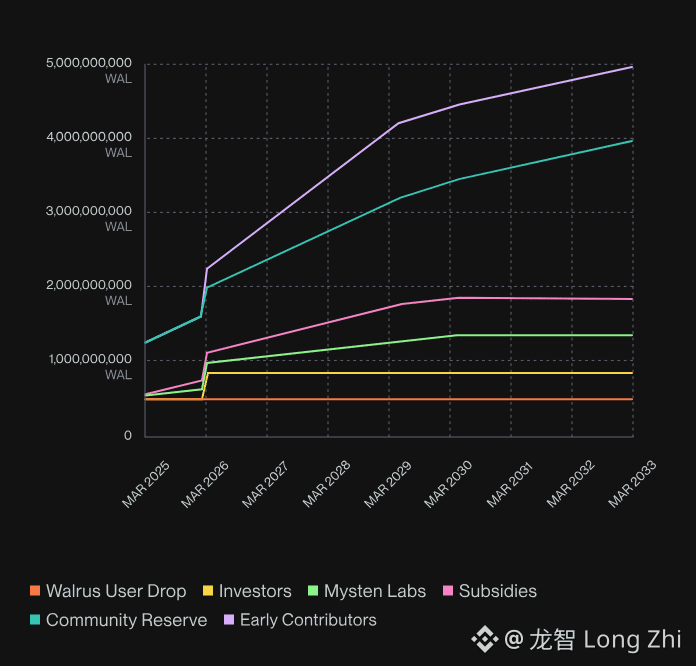
But let’s talk about WAL for a moment — because in Walrus, the token isn’t just a symbol on an exchange. It’s the economic gravitational field that keeps everything working in harmony. With a maximum supply capped at 5 billion tokens, WAL has been carefully designed to balance incentive and stability. It’s the currency you use to pay for storage, the asset you stake to secure the network, and the vote you cast when deciding the protocol’s future. Stakeholders, delegators, and participants all converge around this single point of economic coordination. �
CoinRank +1
Every upload, every proof of availability, every governance decision is expressed through WAL. If you pay to store a 10GB video, part of that WAL goes to the nodes that actually hold and serve the encoded shards of your file. If a node stays honest and available, it earns rewards. If it disappears or fails to serve, it risks penalties. It’s a system built not on trust in a corporation, but on incentives aligned with network health. �
Walrus Docs
What makes Walrus so electrifying isn’t just its economic model or its decentralized nature; it’s its technology. Traditional decentralized storage systems often rely on crude replication — copying data multiple times across many machines. Walrus, on the other hand, uses a sophisticated erasure‑coding algorithm known as RedStuff. This technique slices massive files into shards, adds intelligent redundancy, and scatters them across multiple nodes. Even if some nodes go offline, the original content can be reconstructed from the remaining pieces. It’s like turning a giant sculpture into thousands of tiny bricks that can be recombined no matter where they end up in the world. �
Walrus Docs
This is not just clever engineering for its own sake — it has real, visceral implications. For artists hosting NFT galleries, it means their creations will remain accessible even if parts of the network go silent. For AI developers training massive models, it means their datasets retain integrity and provenance. For enterprises, it means a future where data can’t be censored, hijacked, or locked behind paywalls controlled by centralized cloud providers. �
Walrus Docs
In many ways, Walrus’s evolution has mirrored the broader maturation of blockchain itself. In the early days, crypto was all about token speculation and decentralized money. Today, it’s evolving into decentralized truth and decentralized memory. Walrus sits squarely at that frontier — the layer where data becomes verifiable, programmable, and sovereign. �
CoinMarketCap
And yet, this story is still unfolding. The Walrus roadmap — while ambitious — reads like an odyssey of rediscovery. There are plans to extend programmability deeper into the Stack, so developers can build even richer experiences around stored data. There is talk of expanding cross‑chain compatibility, so even ecosystems outside Sui — like Ethereum or Solana — can tap into this storage backbone without friction. Imagine seamless AI datasets flowing between networks, all anchored by a single decentralized storage protocol. �
Superex
But it’s not all smooth sailing. Like any pioneering project, Walrus faces challenges. Decentralized storage is a complex beast. It forces developers and users alike to think differently — about on‑chain costs, about redundancy, about encoding, about economic incentives. And then there’s the market itself, always buffeted by sentiment, speculation, and the unpredictable dynamics of crypto markets. Yet through it all, the community’s energy has been one of the most striking aspects of Walrus’s rise. People aren’t just talking about the token price — they’re talking about building, integrating, and creating. That’s rare in this space. �
LedgerBeat
There have even been stories — whispered, celebrated, argued over — about early adopters, about community airdrops that changed lives for some, about people who saw the potential here and held on, believing this wasn’t just another investor play but a foundation for the decentralized future. �
So what does the future hold? For Walrus, it means growth borne of utility, not hype. It means a world where decentralized storage isn’t an afterthought but a fundamental layer of digital infrastructure. It means developers can build apps that rely on truthful, decentralized, programmable storage, and users can trust their data lives in a system as resilient as the blockchain itself. That’s the thrilling part of this story — that we might be witnessing the birth of something that doesn’t just disrupt an industry, but redefines how we think about data, ownership, and the very memory of the digital world.

