

Every few years, crypto seems to reinvent what it thinks matters most. At one point, decentralization was the headline. Then speed became the obsession. Later, liquidity, composability, and scaling took over the conversation. But underneath all these shifting themes, one issue keeps returning in different forms: can a network actually execute correctly and consistently when it matters? This is where Plasma, and the design of XPL, starts to stand apart in a quiet but important way.
In technical terms, deterministic execution means that the same transaction must always produce the same result, no matter which machine processes it or when it is processed. If a thousand validators run the same block, they must all reach exactly the same outcome. This sounds obvious, but at scale, with complex virtual machines and heavy traffic, it becomes surprisingly difficult to guarantee. Small differences in timing, ordering, or system behavior can slowly turn into real inconsistencies.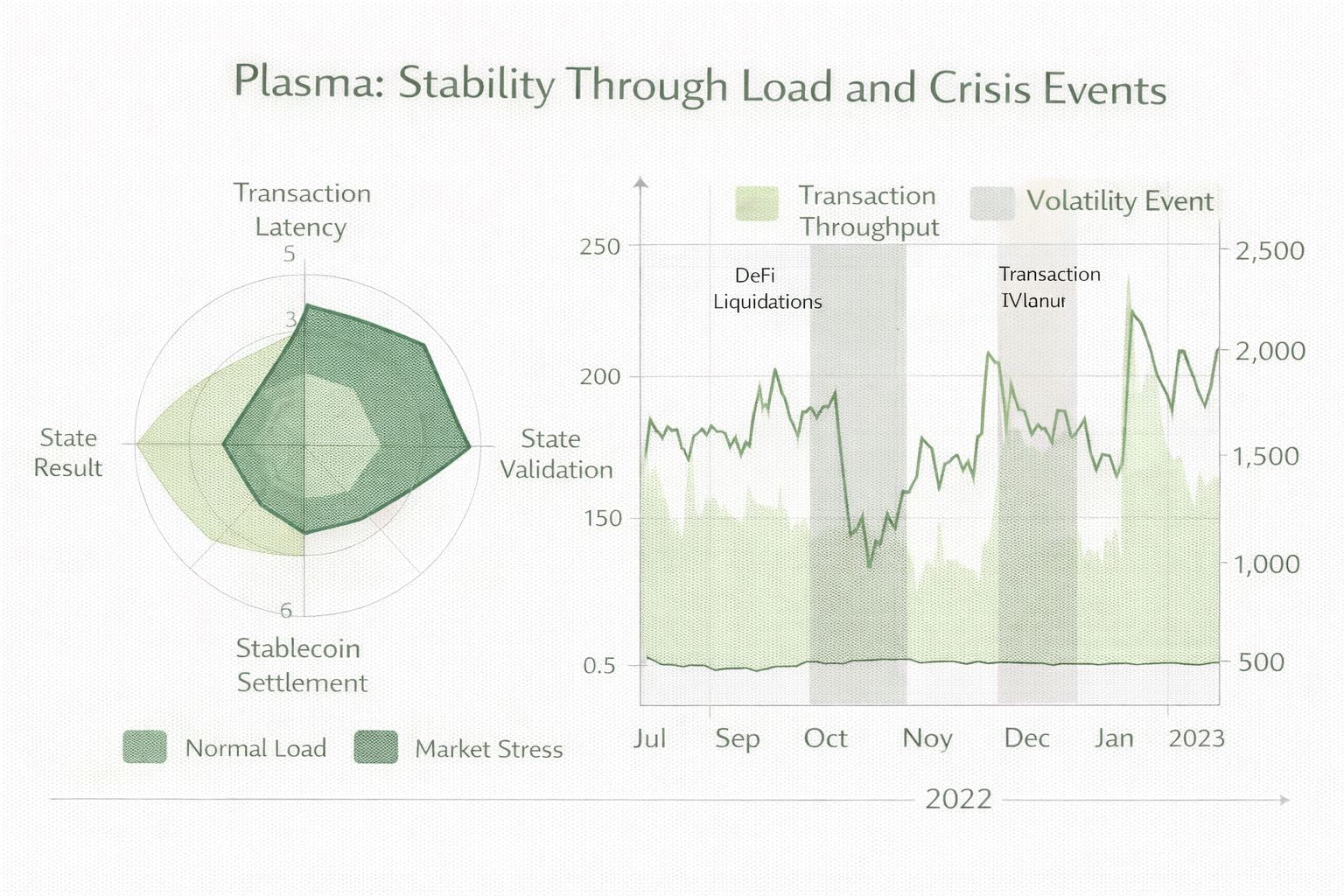
As blockchains grow, they usually try to do more things at the same time. They introduce parallel processing, more complex execution paths, and more advanced features. While this increases raw capacity, it also increases the number of edge cases. Most of the time, these issues stay hidden. But during market stress, heavy congestion, or sharp volatility, those small inconsistencies suddenly show up as delayed settlements, unexpected behavior, or broken assumptions.
Plasma is built around the idea that these stressful moments are the ones that matter most. Instead of optimizing only for peak throughput or the lowest possible cost, it focuses on making execution behavior repeatable and predictable. Validators operate under the same execution rules and constraints, and transactions are ordered and processed in a way that removes ambiguity. The system is designed to favor consistency first, even if that means being more careful about how performance is achieved.
This has important economic consequences. In any financial system, predictability is not a luxury. It is a requirement. Markets depend on being able to model outcomes, estimate risk, and understand how systems behave under pressure. When execution becomes unpredictable, confidence disappears quickly. Even if the system is fast, nobody wants to rely on something that behaves differently each time conditions change.
The industry has already seen what happens when execution assumptions break down. During past market crises, some decentralized systems did not fail because of bad intentions, but because their internal mechanics behaved in unexpected ways. Liquidations cascaded, oracles lagged behind reality, and settlement processes became unstable. The root problem was not the idea of decentralization, but the complexity of execution under stress.
A deterministic approach reduces this kind of uncertainty. When transaction ordering and execution follow strict and repeatable rules, participants can model outcomes more accurately. Risk management improves. Liquidation thresholds become more reliable. Arbitrage becomes more efficient. Over time, this leads to healthier and more stable market behavior, even when conditions are not ideal.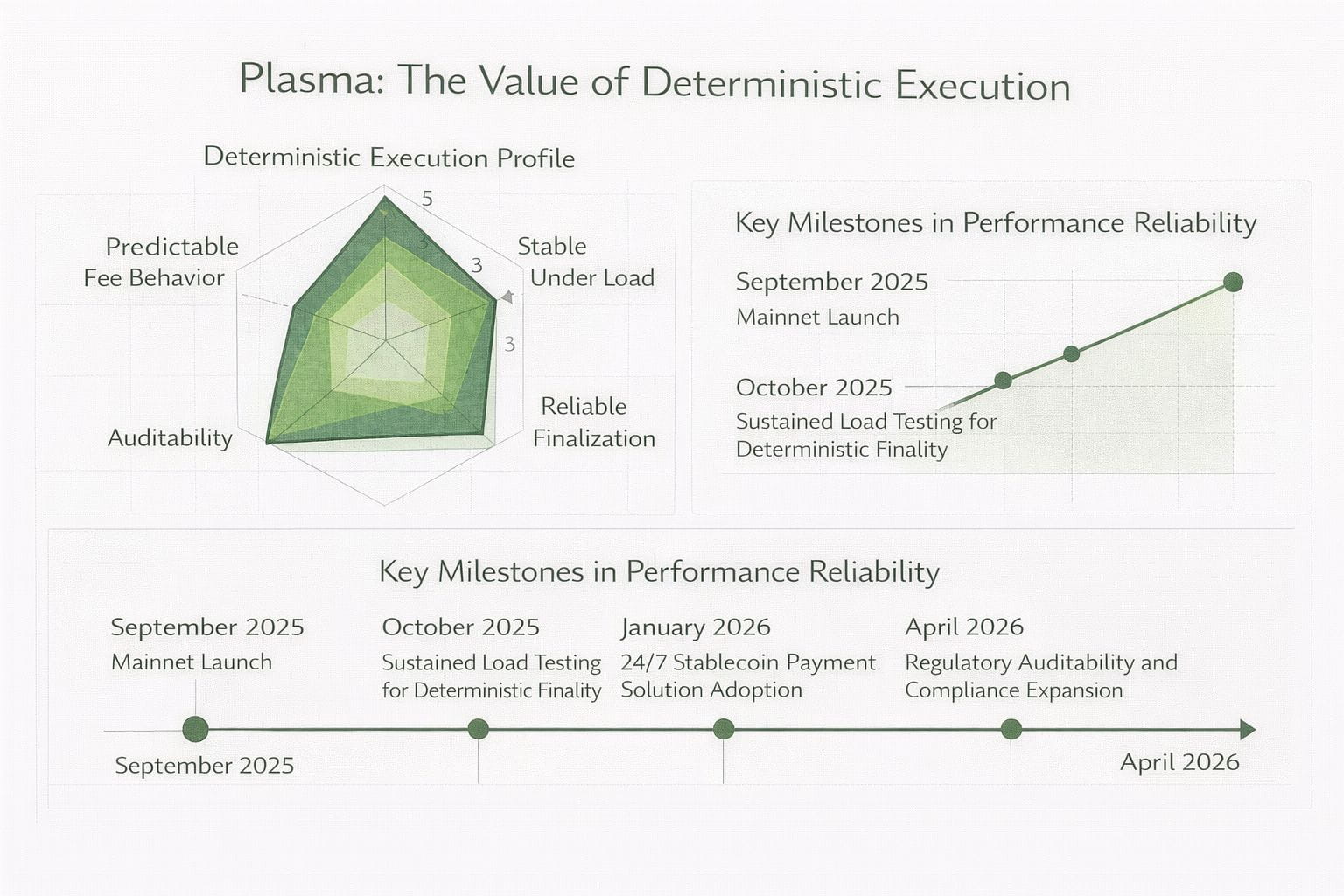
The design philosophy behind Plasma becomes clearer when looking at how the system behaves under sustained load. Even when transaction rates fluctuate significantly, the network aims to keep finality times and execution behavior stable. This kind of consistency is often more valuable to real users than occasional bursts of extreme performance. For payment and settlement systems, stability is more important than headline numbers.
There is also a broader shift happening in how blockchain systems are evaluated. In earlier cycles, performance benchmarks were the main story. Today, more attention is being paid to questions like: how does the system behave during congestion? Does it degrade gracefully? Does it remain predictable when usage spikes? These questions are not secondary for Plasma. They are part of the core design.
Validators in the network are not only rewarded for producing blocks, but for producing correct and consistent execution. Deviations from expected behavior are penalized. This aligns economic incentives with the technical integrity of the system. In other words, the network is not just encouraging activity, it is encouraging correctness.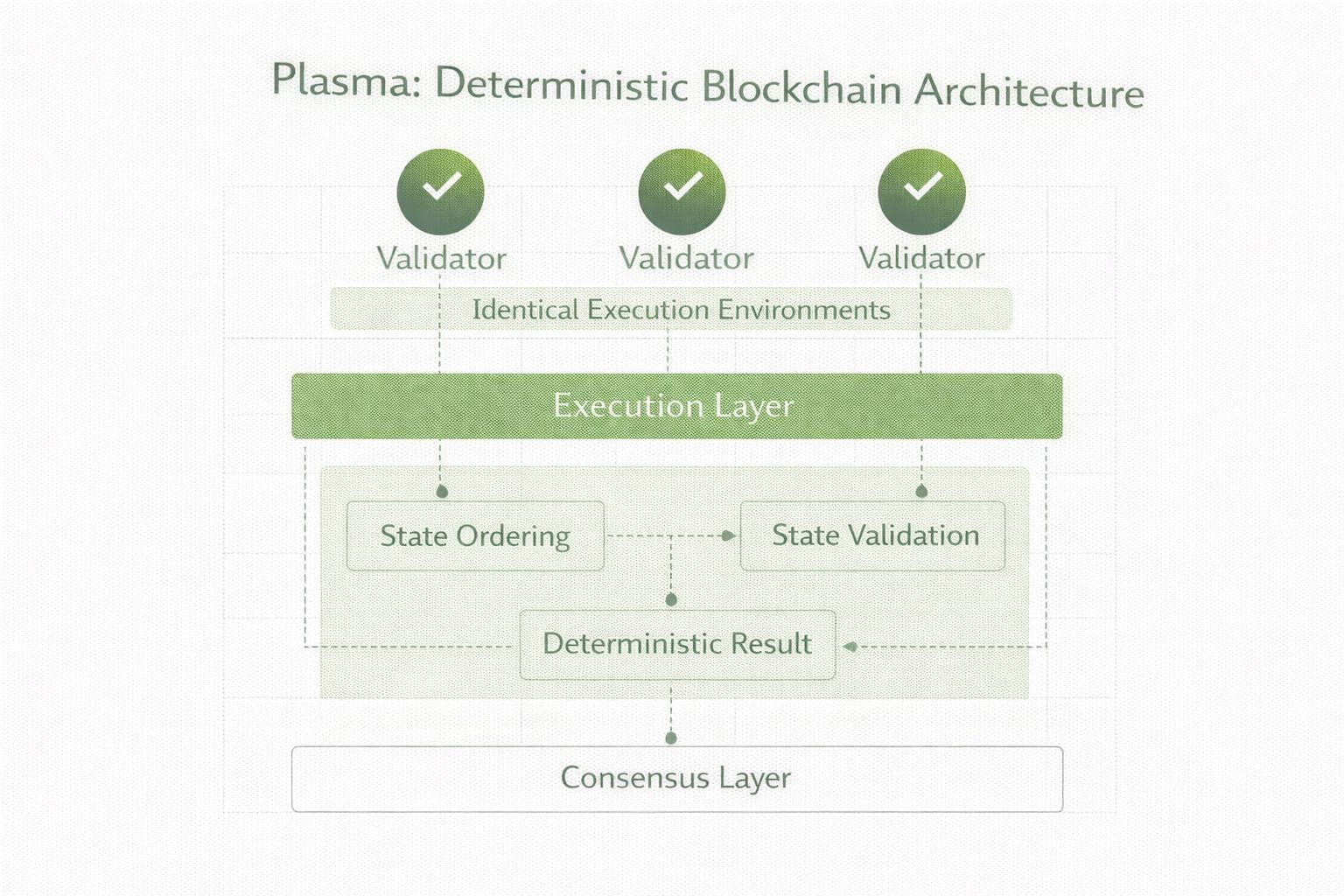
This approach also influences fee behavior. On many networks, congestion leads to chaotic fee markets where users compete blindly for inclusion. This introduces randomness and uncertainty into something that should be simple: sending a transaction. Plasma’s more controlled execution environment aims to keep throughput and costs more stable, even when usage increases.
From a system-wide perspective, predictable costs and predictable settlement reduce friction. Lower friction encourages steady, real usage rather than short bursts of speculative activity. Over time, this is what turns infrastructure into something people rely on instead of something they only visit during hype cycles.
There is also a growing regulatory and institutional angle to this. As rules around digital assets become more structured, auditability and reproducibility are becoming essential. Deterministic systems make this easier because transactions can be replayed, verified, and checked without interpretation. This does not reduce decentralization, but it does make the system easier to reason about and easier to trust.
At a deeper level, there is something very fundamental about deterministic execution in decentralized systems. If thousands of independent machines can always reach the same result without negotiation or coordination, the system becomes more resilient by design. It does not rely on trust. It relies on rules that always lead to the same outcome.
In the long run, execution quality may become one of the main signs of maturity in blockchain infrastructure. Systems that are boring, stable, and predictable are the ones that end up carrying real economic weight. Plasma is not trying to change what blockchains are. It is trying to make them behave more like real financial infrastructure. Quietly, carefully, and with an emphasis on consistency.
In finance, trends come and go. Reliability tends to stay.

