
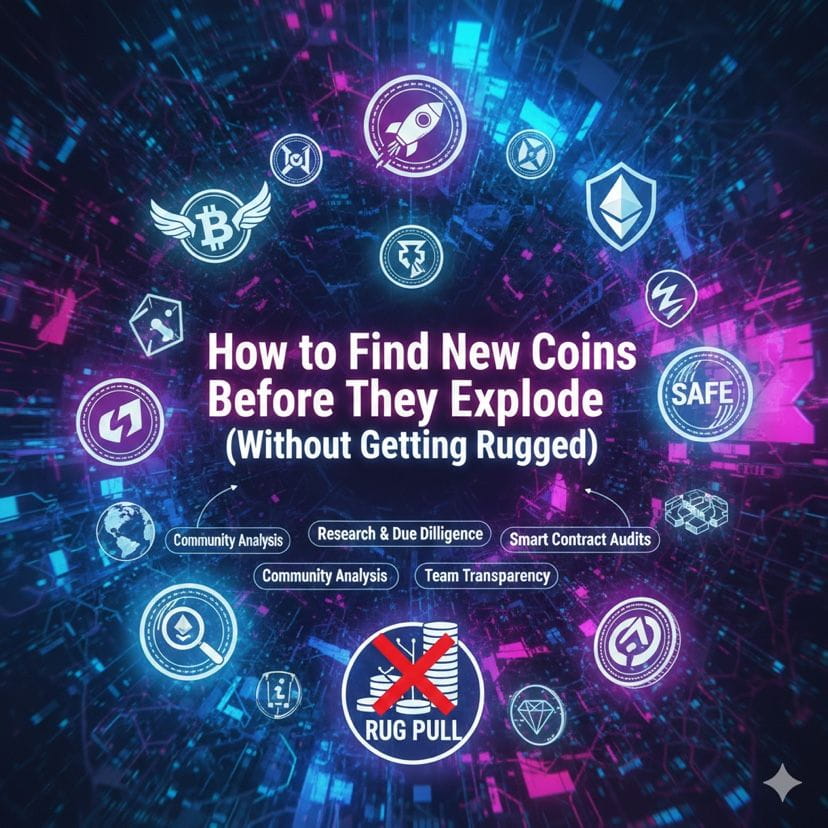
Everyone wants to find the next 100x coin. The one that goes from $0.001 to $1.
The reality? Most new coins go to zero. But some don't.
Here's how to find legitimate new projects without losing everything to scams.
Where to Actually Look
1. CoinGecko and CoinMarketCap "Recently Added" Sections
Both platforms have sections showing newly listed coins. These have already passed basic vetting - they're real projects with some legitimacy.
What to check:
Launch date (avoid anything less than 7 days old)
Market cap (under $10M is high risk, $10M-$50M is the sweet spot)
Trading volume (should be at least 10% of market cap daily)
Number of holders (more holders = more distributed)
Red flags:
Top 10 wallets hold 80%+ of supply
Zero trading volume
Launched yesterday with $50M market cap (suspicious)
No website or social media
2. DEXTools and DexScreener
These show real-time data on decentralized exchanges. Perfect for finding coins before they hit major exchanges.
How to use them:
Filter by "New Pairs" on your preferred chain (Ethereum, Solana, BSC)
Look for volume spikes
Check liquidity (minimum $50k locked)
Verify liquidity is locked (not removable by devs)
Warning signs:
Liquidity under $10k (easy to rug)
Less than 100 transactions
Wallet concentrations over 5% per holder
Contract not verified
3. Twitter/X Crypto Communities
Follow smart crypto researchers, not influencers selling dreams.
Accounts worth following:
Blockchain developers
On-chain analysts
Venture capital firms announcing investments
Early-stage project founders with track records
What to ignore:
Accounts promising guaranteed gains
"Next 1000x!!!" posts
Paid promotions
Anonymous accounts shilling random tokens
4. Crypto Launchpads
Platforms like Coinlist, DAO Maker, and Polkastarter vet projects before launching.
Advantages:
Basic due diligence already done
Real teams with doxxed identities
Actual products or roadmaps
Token unlock schedules (protects against dumps)
Disadvantages:
Harder to get allocation
Competition is fierce
Not all succeed despite vetting
The Due Diligence Checklist
Before investing a single dollar, check ALL of these:
The Team
Are team members publicly known (doxxed)?
Do they have LinkedIn profiles with real history?
Have they built anything before?
Are they anonymous? (Red flag for serious projects)
The Product
Does it actually exist or just a whitepaper?
Is there a working demo or testnet?
Does it solve a real problem?
Is the problem worth solving?
The Tokenomics
Total supply clearly stated?
Vesting schedules for team and investors?
How much is allocated to community vs team?
Are there lockup periods?
Recommended distribution:
Community/Public: 40-60%
Team: 15-20% (with 2-4 year vesting)
Advisors: 5-10%
Treasury/Development: 15-25%
The Smart Contract
Is it verified on blockchain explorer?
Has it been audited by reputable firms (CertiK, Trail of Bits)?
Can you read the code or find the audit report?
Are there mint functions that allow unlimited supply?
The Community
Active Telegram or Discord?
Real discussions or just moon talk?
Team responds to questions?
GitHub activity (for tech projects)?
The Risk Levels
Ultra High Risk (90% fail rate)
Launched within 7 days
Anonymous team
No audit
Meme coin with no utility
High Risk (70% fail rate)
Launched 1-4 weeks ago
Small community under 1,000 members
Unaudited but verified contract
Market cap under $1M
Medium Risk (50% fail rate)
Launched 1-3 months ago
Known team members
Audited contract
Working product in beta
Market cap $1M-$10M
Lower Risk (30% fail rate)
Established 3+ months
Doxxed team with track record
Multiple audits
Live product with users
Market cap $10M-$50M
Listed on tier 2 exchanges
Red Flags That Should Stop You Immediately
Contract Red Flags:
Honeypot code (you can buy but can't sell)
Hidden mint functions
Ownership not renounced when claimed
Tax over 10% on buys/sells
Team Red Flags:
Copied whitepaper from another project
Stock photos for team members
Fake LinkedIn profiles (created recently, no connections)
Previous projects that failed or rugged
Community Red Flags:
Deleting negative comments
Banning people who ask questions
Only price talk, no product discussion
Paid shillers flooding channels
Smart Strategies for New Coins
1. The Pilot Position
Put in 1-2% of your portfolio as a test. If it goes well, add more. If it dumps, small loss.
2. The DCA Approach
Don't buy everything at once. Split your investment across 3-4 entries over 2-4 weeks. Reduces timing risk.
3. The Wait-and-See
Watch the project for 30 days before investing. See if promises are kept. Most scams show signs within a month.
4. The Exit Strategy
Decide your exit before buying:
Sell 50% at 2x (get initial investment back)
Sell 25% at 5x
Let 25% ride for potential moonshot
This way you lock profits and still have upside exposure.
Tools to Use
Free Tools:
Token Sniffer (scam detection)
RugDoc (contract analysis)
BSCCheck or similar (for BSC tokens)
Etherscan/Solscan (verify everything)
Paid Tools (Optional):
Nansen (whale tracking)
Dune Analytics (on-chain data)
Messari (research reports)
The Uncomfortable Truth
Most new coins will fail. Even good projects with real teams fail because:
Market timing is wrong
Competition is fierce
Technology doesn't work as planned
They run out of money
Your goal isn't to find every winner. It's to avoid the scams and occasionally catch a real project early.
Realistic Expectations
Out of 10 new coins you research:
6-7 will lose you money
2-3 will break even or small gain
0-1 might actually moon
That one winner needs to cover your losses on the others. That's why position sizing matters.
Never put more than 5% of your portfolio into any new, unproven project.
Final Recommendations
Start small. Learn the process. Get comfortable with due diligence.
Most importantly: It's okay to miss out. FOMO kills more accounts than bear markets.
There's always another new coin. There's always another opportunity.
But there's only one of your portfolio. Protect

$DUSK go for Long on this
