
When you look closely at Dusk Foundation, it feels less like a typical crypto project and more like a reaction to a mistake the industry made early on. We convinced ourselves that full transparency was always a virtue. It worked when blockchains were experimental toys moving small amounts of value. It stopped making sense the moment real capital, real strategies, and real institutions showed up. Dusk exists because that realization finally caught up with the tech.
At its core, Dusk is built around a simple truth: finance needs discretion. Traders don’t want their positions broadcast. Companies don’t want their balance sheets visible in real time. Regulators, on the other hand, still need oversight and proof. Most blockchains force you to pick one side. Dusk refuses that choice. Instead of treating privacy and compliance as enemies, it treats them as two requirements that must coexist at the base layer.
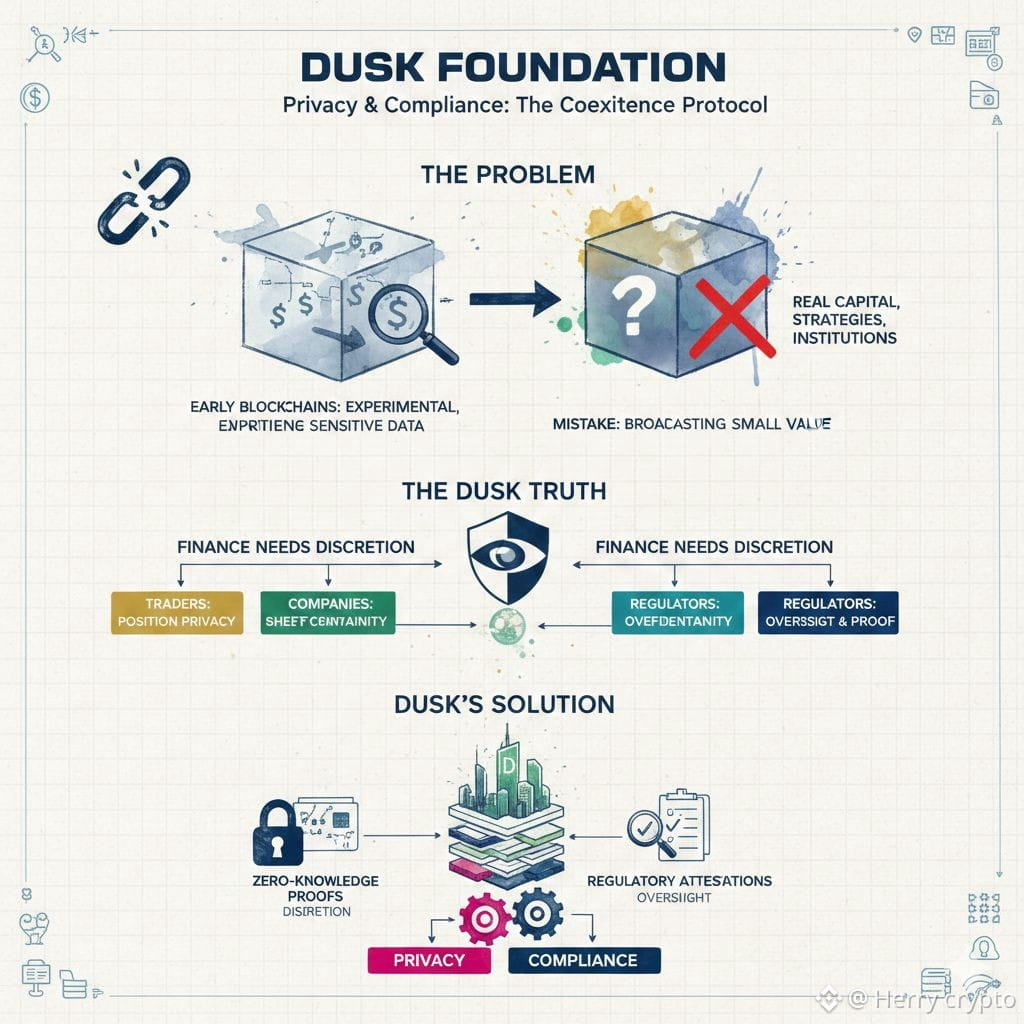
That mindset shows in how the network is designed. Dusk isn’t chasing flashy throughput numbers or buzzword-heavy architectures. It’s modular, practical, and intentionally conservative. Settlement and consensus are kept predictable and stable. Execution is made EVM-compatible so developers don’t have to relearn everything from scratch. Privacy lives deeper in the system, using zero-knowledge proofs and shielded transaction models that allow smart contracts and transfers to run without exposing sensitive details to the entire network. Validators don’t see the data — they see proof that the data is valid. That distinction is the entire point.
What’s important is why this matters. Dusk is not trying to be anonymous money for everyday payments. It’s trying to be invisible plumbing for regulated financial activity. Tokenized securities, private lending markets, institutional DeFi, and real-world asset settlement all break down on fully transparent ledgers. You simply cannot run serious financial infrastructure when every move is permanently public. Dusk is built for that uncomfortable middle ground where privacy is necessary, but accountability is unavoidable.
The DUSK token fits naturally into this picture. It’s not designed to be flashy or over-engineered. It secures the network through staking, compensates validators, pays for transactions, and aligns long-term participants with the health of the chain. Emissions and incentives lean toward sustainability rather than aggressive short-term rewards. That’s not exciting in the way yield farming is exciting, but it’s exactly what regulated systems demand. Stability matters more than spectacle.
Recent progress suggests the project is slowly moving from theory into reality. Mainnet development and the introduction of an EVM-compatible environment lowered the barrier for developers who want to experiment with privacy-aware applications. Market interest has also returned in waves, especially as narratives around privacy and tokenized real-world assets resurface. None of this guarantees success, but it does show that Dusk is no longer just an idea — it’s a functioning network being tested by real users and capital.
The role Dusk seems to be carving out is subtle but important. It doesn’t need millions of retail users to succeed. It needs a smaller number of serious applications that cannot exist on transparent chains. If regulated assets continue moving on-chain, someone has to provide the rails that respect confidentiality without sacrificing trust. That’s where Dusk wants to sit.
Of course, the path forward isn’t easy. Privacy still makes regulators nervous. Zero-knowledge systems add complexity for developers. Performance will always be more constrained than chains that ignore confidentiality altogether. But Dusk doesn’t feel like it’s racing anyone. It feels like it’s waiting for the rest of the industry to admit that transparency alone was never enough.
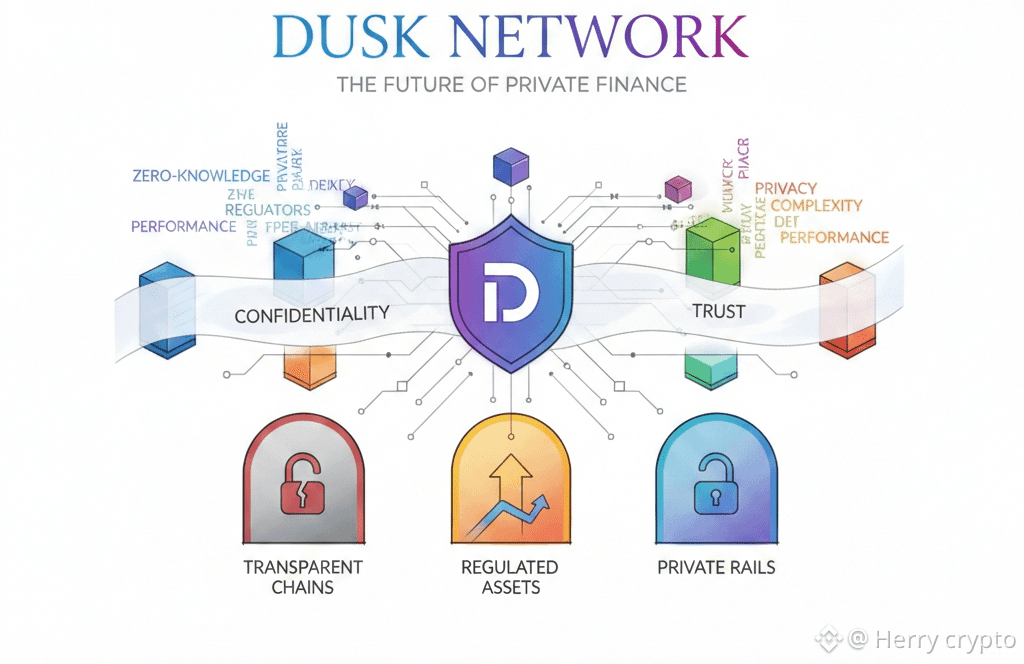
If on-chain finance is going to mature, it will need infrastructure that understands restraint as well as openness. Dusk isn’t trying to shout its way into relevance. It’s building quietly, on the assumption that the future of finance won’t belong to the loudest chain, but to the one that knows what not to reveal.
