
Stablecoin flows are often treated like a forecast.
Capital moves into stables, so something must be about to happen.
That framing used to feel reasonable. Lately, it explains very little.
What stablecoins really capture is not anticipation, but reaction. They become useful once volatility has already done its damage, when positions have closed, risk has been reduced, and capital has stepped aside to reassess.
Before volatility, markets are still unresolved.
Leverage remains open. Conviction hasn’t been tested. Capital is still committed, even if it’s uncomfortable. Stablecoin inflows at this stage can mean almost anything: hedging, venue rotation, collateral management, or simple operational movement.
Nothing has forced a decision yet.
So nothing has revealed intent.
This is why stablecoin inflows ahead of major moves so often disappoint. The capital hasn’t chosen safety or risk yet. It’s still inside the trade.
Volatility changes that.
Once price moves hard enough, positions close whether participants want them to or not. Losses are realized. Exposure is reduced. Screens get quieter. This is the moment when stablecoin flows start to carry meaning, not because they predict what comes next, but because they show what capital does once it’s free again.
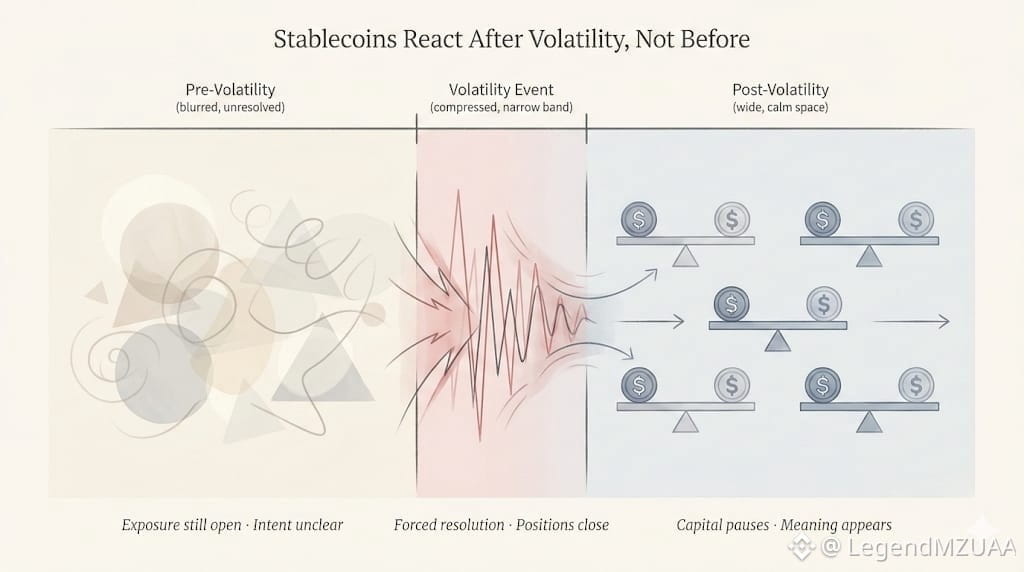
After volatility, stablecoins represent pause, not promise.
They mark the space between surviving a move and trusting the next one.
There’s a phase most charts don’t label.
After volatility settles, activity doesn’t immediately return. Stablecoin balances rise, but trading volumes don’t. Narratives fade. Participation thins. The market isn’t accumulating or distributing, it’s waiting.
That waiting is information.
When stablecoins remain idle after volatility, capital is signaling hesitation. Not fear exactly, and not confidence either. Just uncertainty that hasn’t resolved yet.
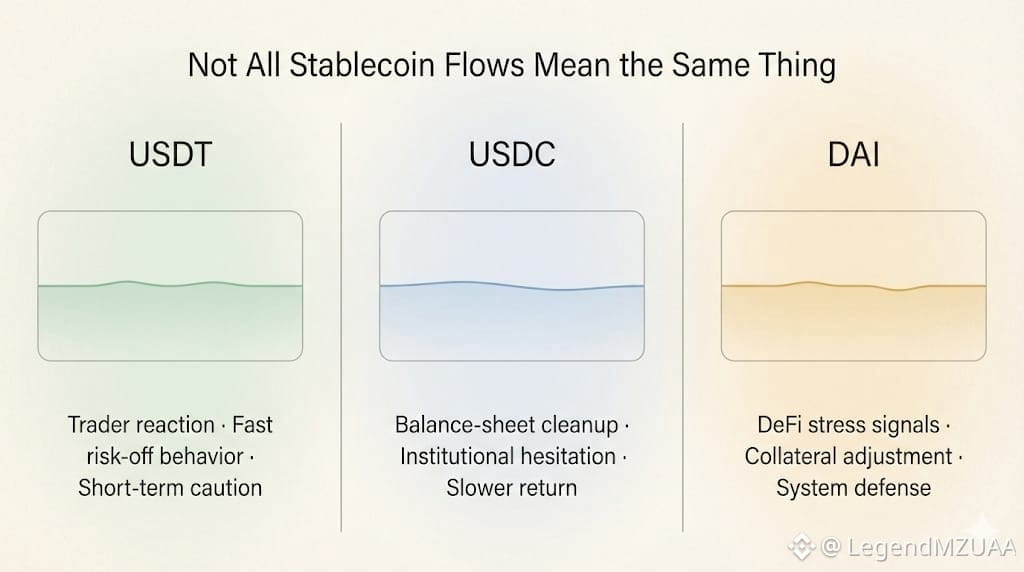
Not all stablecoins reflect that hesitation in the same way.
USDT tends to move first. It’s the preferred medium for traders and market makers, especially in derivatives-heavy environments. After volatility, USDT inflows usually indicate capital stepping out of risk quickly. If those balances rotate back into markets fast, confidence is returning. If they don’t, it’s a sign that short-term participants are staying cautious.
USDC behaves more slowly. Its post-volatility flows often reflect balance-sheet decisions rather than trading reactions. Funds reducing exposure, desks cleaning up positions, or capital moving back onto regulated rails. When USDC sits idle after a volatile move, it usually points to deeper uncertainty, the kind that takes time to resolve.
DAI tells a different story altogether. Its activity after volatility is less about sentiment and more about system stress. Collateral adjustments, deleveraging, and defensive behavior inside DeFi protocols tend to show up here. DAI doesn’t say much about direction. It says a lot about stability.
Some newer, exchange-backed stablecoins also move after volatility, but their signals are narrower. These flows are often tied to internal settlement or venue-specific mechanics. Useful if you’re looking closely at microstructure, but easy to misread at the market level.
What matters most isn’t the inflow itself.
It’s what happens next.
Do stablecoin balances stay parked, or do they rotate back into risk? Does volume recover while stablecoin supply remains elevated? Does participation return gradually, or not at all?
Those answers say more about market confidence than any single spike in inflows ever could.
Stablecoins don’t predict volatility.
They explain how capital behaves once volatility has passed.
Read them too early and they confuse the picture.
Read them at the right moment and they quietly describe the market’s state of mind.
That’s when they’re worth paying attention to.
