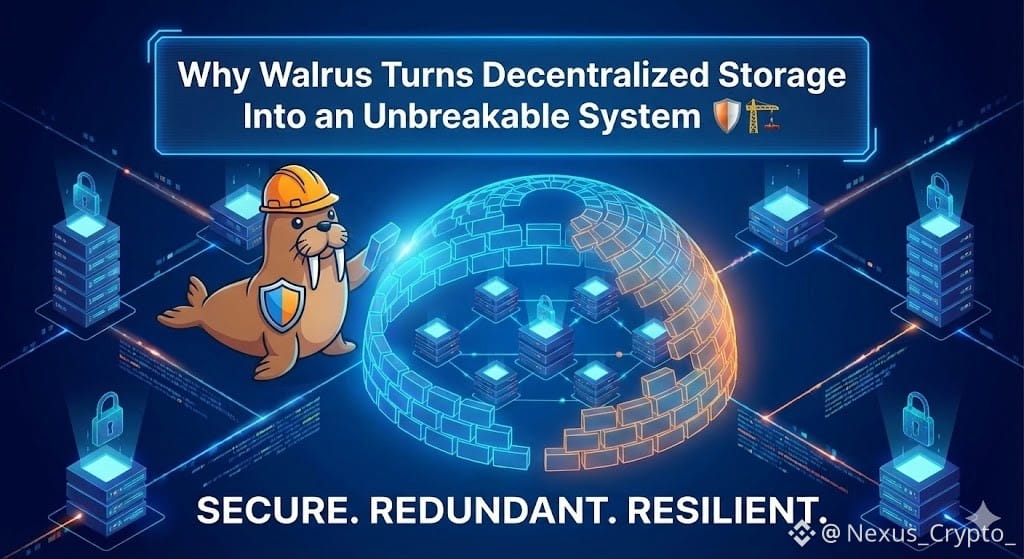
Why Walrus Turns Decentralized Storage Into an Unbreakable System 🛡️🏗️
Security in Web3 is often treated like a feature.
In reality, it should be a property of the architecture itself.
Most decentralized systems still rely on fragile assumptions: trusted operators, readable data at rest, or security layers bolted on after deployment. As value and data density increase, these assumptions become attack surfaces.
This is where @walrusprotocol fundamentally separates itself — and why $WAL deserves attention as real infrastructure, not hype. 💎 #Walrus
The Core Principle: Break the Data, Break the Attack 🧠
Traditional storage security assumes:
Data is whole
Data is readable
Data must be protected from access
Walrus flips this model completely.
Through erasure coding, data is mathematically split into encrypted fragments and distributed across many independent nodes. No single node — or small subset — holds anything meaningful.
Compromise one node?
You get zero usable information.
There is no file to steal.
No database to dump.
No centralized breach vector.
Security is achieved not by guarding data, but by making it incomprehensible in isolation.
Economically Irrational Attacks ⚡
Modern security is not just about cryptography — it is about economics.
To reconstruct data stored on Walrus, an attacker must:
Compromise a threshold number of nodes
Do so simultaneously
Across geographically distributed locations
This is not a technical challenge alone — it is an economic impossibility.
The cost of coordination, capital, and timing far outweighs the potential benefit. Walrus doesn’t rely on trust or hope; it relies on attack cost asymmetry.
If attacking the system costs more than it can ever return, the system wins.
Zero Knowledge for Storage Providers 🧠📉
One of the most overlooked risks in decentralized storage is operator visibility.
In many systems, storage providers can still:
Read data at rest
Analyze metadata
Become insider threats
Walrus eliminates this entire class of risk.
Storage providers host only encrypted fragments. They cannot read, reconstruct, or infer the content they are serving. Even honest-but-curious behavior yields nothing.
This creates:
Strong privacy guarantees
Regulatory insulation
Reduced insider threat exposure
Security does not depend on who runs the node.
It depends on math.
Sui Finality: Verifiable, Immutable Commitments 💧
Security is meaningless without verifiability.
Walrus leverages the Sui blockchain to anchor storage commitments with fast, deterministic finality. Once data availability commitments are recorded on Sui, they become:
Immutable
Publicly verifiable
Resistant to rollback or manipulation
This means users and applications can cryptographically prove:
Data was stored
Data remains available
Commitments cannot be altered
There is no need to trust an off-chain service or centralized auditor.
The chain itself becomes the security witness.
Smart Contracts Without Trusted Middlemen 🧠⚡
For developers, this changes everything.
With Walrus, smart contracts can:
Verify data availability on-chain
Enforce rules based on cryptographic proofs
Eliminate reliance on centralized storage APIs
This removes entire categories of vulnerabilities:
API outages
Malicious data substitution
Silent data deletion
Applications become fully trustless, end to end.
Execution is decentralized.
Data is decentralized.
Security is complete.
Security Is Not a Feature — It’s the Foundation 🏗️
Many protocols treat security as something to “add later.”
Walrus does the opposite.
Every design choice — erasure coding, encrypted fragments, asynchronous retrieval, Sui-based coordination — is driven by a single question:
How do we make attacks structurally unviable?
This is not defensive coding.
This is offensive architecture.
Instead of reacting to threats, Walrus removes them from the possibility space entirely.
Why This Matters Now ⚡
As Web3 moves into:
AI agents with persistent memory
DePIN networks producing real-world data
Governance systems managing real capital
The cost of data compromise explodes.
Security failures will not be theoretical.
They will be existential.
Protocols that treat security as a checkbox will fail under real pressure. Protocols that embed security at the protocol level will survive.
Walrus is building for adversarial reality, not ideal conditions.
Final Thought
The strongest systems are not the ones with the most guards.
They are the ones with nothing worth stealing.
By fragmenting, encrypting, and distributing data at the architectural level, Walrus makes compromise pointless and attacks irrational.
That is what real decentralized security looks like.
CTA — critical discussion:
Do you believe decentralized storage today is actually secure, or mostly “security theater”? What attack vector worries you most? Share your thoughts below 👇
If you’re tracking serious infrastructure and security-first protocols, drop a 🛡️🏗️ and follow — more deep dives coming.
⚠️ DISCLAIMER: This content is for educational purposes only and does not constitute financial advice. Cryptocurrency investment involves high risk. Always do your own research (DYOR) before investing. The views expressed are my own.