

Hello family, I have been reading and researching @Plasma for a while, and I want to share what stood out to me in simple words. This project caught my attention not because of hype or price talk, but because of how quietly serious it is about real usage. Plasma is built around one clear idea: making stablecoins and Bitcoin work like everyday money, fast, cheap, and simple. From what I have seen, they are not trying to impress traders first, they are trying to build rails that money can actually move on.
When I looked deeper into the ecosystem, I noticed something interesting. They did not start with random apps. They focused on protocols where real capital usually goes. Big lending activity, stablecoin liquidity, yield strategies, and structured products are already there. In my view, this tells us the team is targeting users who care about efficiency and reliability, not just short term speculation. We usually see chains chasing users, but here it feels like Plasma is letting capital come on its own terms.
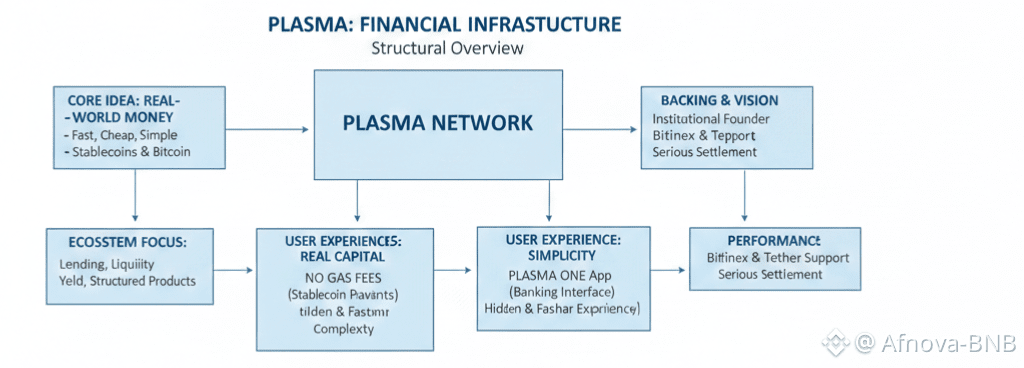
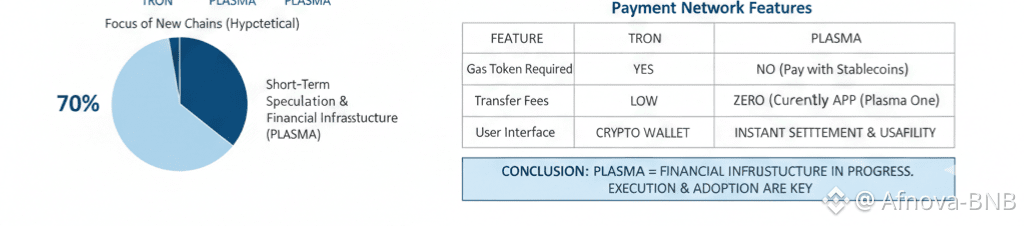
One thing I found important is how they handle fees. On Plasma, users do not need a separate gas token. You can pay fees directly using stablecoins, and basic transfers are currently free. From my research, this removes one of the biggest headaches for normal users. No one wants to think about gas when sending money. I think this design choice alone makes Plasma feel closer to a payment network than a typical crypto chain.
Another part that stood out to me is Plasma One. They are building a consumer app that looks like a normal banking app, not a crypto wallet. In my knowledge, this is where most crypto projects fail because they expect users to learn too much. Plasma One hides all the blockchain complexity. Users just see dollars, cards, and cashback. I tell you honestly, this approach makes sense if they really want adoption in emerging markets where people care more about stability and usability than technology.
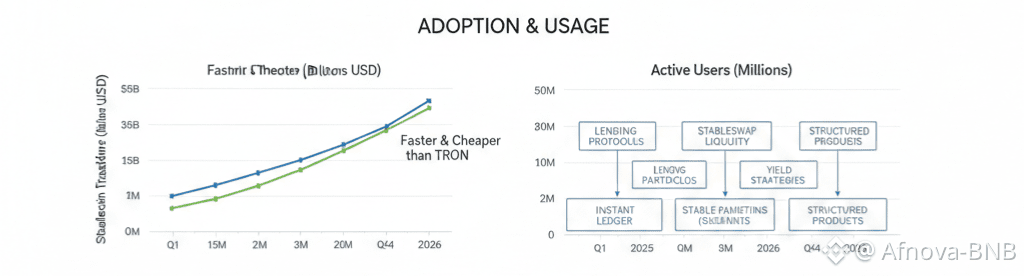
When we compare Plasma to other networks, the difference becomes clearer. Tron dominates stablecoin transfers today, mostly because it is cheap and widely integrated. Plasma, from what I can see, is trying to offer a cleaner and faster experience, especially with instant finality. The challenge is not technology, it is convincing exchanges and merchants to switch rails. That takes time, and we should be realistic about that.
I also read about the team and backing, and this part matters. Plasma is not coming from anonymous builders. The founder has an institutional background, and the project is backed by Bitfinex and Tether. In my view, this explains why Plasma feels designed for serious settlement rather than experiments. It also suggests that Tether may want more control and diversification instead of relying too heavily on a single network.
Of course, we should not ignore the risks. Right now, zero fees are subsidized, and that cannot last forever. Plasma will need enough real economic activity to support validators in the long run. I also noticed concerns around centralization in the early phase and questions about inflated trading volume in some apps. These are not small issues, and anyone watching the project should keep them in mind.
Token unlocks in the future are another thing I paid attention to. Large unlocks can create selling pressure, and that can affect market confidence. We have seen this story before in many projects. Plasma will need strong organic demand by then to absorb that supply.
Overall, from what I have researched and read, Plasma feels less like a hype driven blockchain and more like financial infrastructure in progress. They are not promising the moon. They are trying to make stablecoins and Bitcoin act like real money you can send, spend, and settle instantly. Whether they succeed or not will depend on execution and adoption, but the direction they are taking is serious. In my opinion, Plasma is a project worth watching closely, not because of noise, but because of what it is quietly trying to build.

