

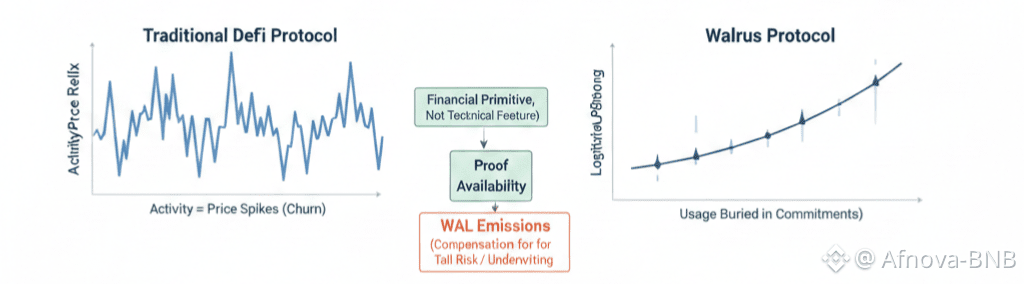
I keep trying to evaluate @Walrus 🦭/acc Protocol using the same instincts I rely on for DeFi, and it never quite fits. There is no clean relationship between activity and price. No visible surge when sentiment flips. Usage does not show up as excitement. That absence is the first clue. Walrus does not express demand through churn. It embeds demand inside long running commitments. If activity suddenly became loud, it would probably signal failure rather than success. When everything works, it looks dull. That is unsettling if you are conditioned to look for volatility as proof of life.
What I notice next is how deliberately Walrus treats Sui as a coordination layer rather than a data pipe. At first that sounds like a technical nuance. It is not. Sui is not there to make storage faster. It is there to make obligations explicit. A write certificate does not tell you where data lives. It tells you that a group of economically bonded actors is accountable for keeping it alive. Markets are good at pricing speed and throughput. Walrus is pricing responsibility. Once that clicks, bandwidth metrics stop feeling important and the real variable becomes how expensive it is to break a promise.
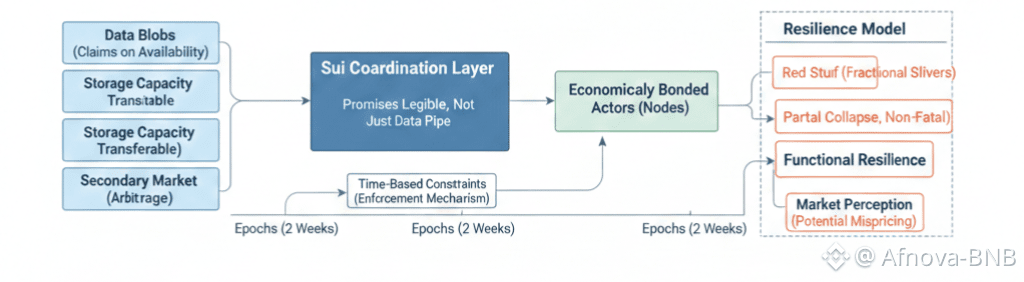
Availability starts to look less like a feature and more like a position you carry. Keeping data accessible costs something every epoch. That obligation rolls forward whether anyone is paying attention or not. Storage begins to resemble a rolling short against failure. Nodes are structurally short downtime and long continuity. WAL emissions are not rewards in the casual sense. They are payment for absorbing tail risk. Framed that way, inflation stops looking like noise. It looks like underwriting.
Red Stuff quietly changes how I think about failure. When only a subset of fragments is needed to recover data, collapse stops being binary. A large chunk of the network can disappear and the system still functions. That creates a strange disconnect. Headlines might suggest stress while the protocol barely registers it. That gap between perceived fragility and actual resilience is where markets tend to get things wrong.
I keep coming back to the epoch structure. Two weeks is short enough to adjust behavior, but long enough to prevent opportunism. A node cannot show up briefly, collect fees, and vanish without consequence. It has to survive an entire accountability window. Time becomes an enforcement mechanism. Traders usually discount time based constraints because they do not appear cleanly in charts. But here, duration is the pressure. The longer data exists, the more expensive failure becomes.
Deletion is where the philosophy really shows itself. History cannot be erased. Only its economic backing can be withdrawn. That is not just a technical choice. It is a market rule. Once storage capacity becomes transferable, blobs stop being passive files. They turn into claims on future availability. That opens the door to secondary behavior that does not resemble speculation. Arbitrage across time reliability and geography does not spike. It grinds. Slowly.
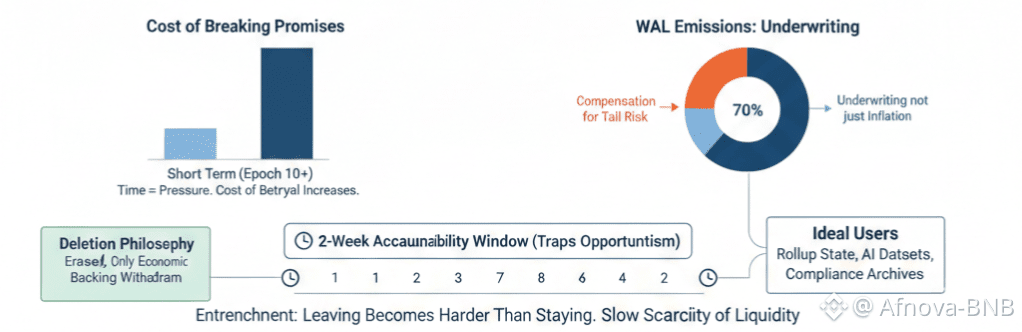
I also find myself asking who should not be using Walrus. Anything that needs constant mutation probably does not belong here. But anything that values persistence over speed fits almost too well. Rollup state. AI datasets. Compliance records. These users do not rotate capital. They lock it. Locked capital does not chase narratives. It just sits there, tightening supply in ways that only become obvious much later.
So I stop asking whether Walrus is adopted and start asking whether it is entrenched. Entrenchment does not trend on dashboards. You notice it when leaving becomes harder than staying. If Walrus works the way it is designed to, price will not lead usage. Usage will lead to a slow almost irritating scarcity of liquidity. That is not exciting in real time. In hindsight, it usually looks inevitable.

