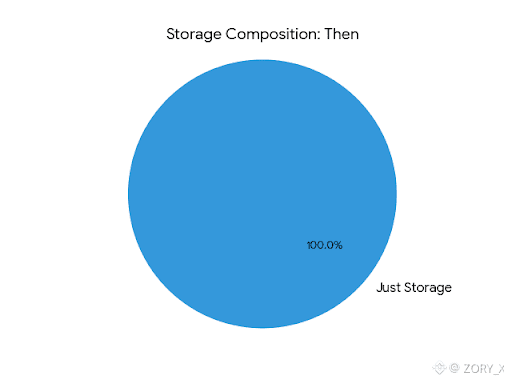
I’ve been around long enough to remember when storage was just storage and nobody pretended it was a moral movement.
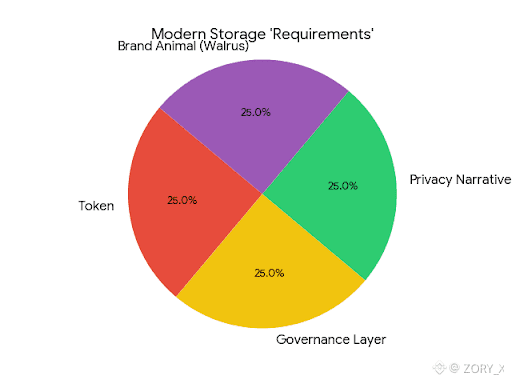
Today, we’re told it needs a token, a governance layer, a privacy narrative, and a brand animal with tusks.
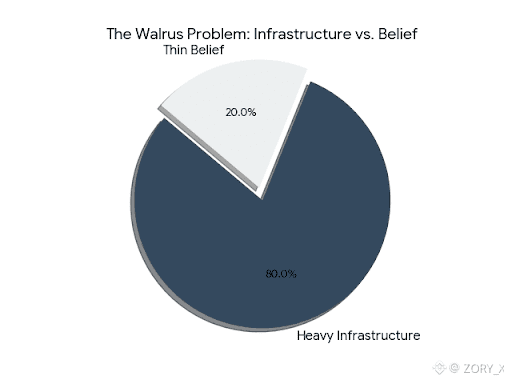
Walrus, and its WAL token, sits squarely in that tradition, promising decentralized, privacy-preserving data storage on top of the , wrapped in language that suggests resilience, censorship resistance, and a cleaner break from cloud monopolies, even though the underlying economic reality still depends on hardware costs, bandwidth bills, and human operators who do not accept ideology as payment.
Strip away the prose.
You are left with storage that must be paid for every single day.
I’ve seen this movie before—Filecoin, Arweave, Storj, each arriving with a slightly different accent but the same structural gamble that token incentives can smooth over the fact that decentralized storage is slower, more redundant, and operationally fragile compared to centralized providers that already run on razor-thin margins and decades of brutal optimization.
The math does not blink.
Walrus leans heavily on erasure coding and blob storage, which sounds clever because it is clever, but clever does not mean cheap when fragments still need to be stored, indexed, monitored, and reassembled under real-world conditions where nodes go offline, networks stall, and incentives wobble every time the token chart takes a dive.
Costs compound quietly.
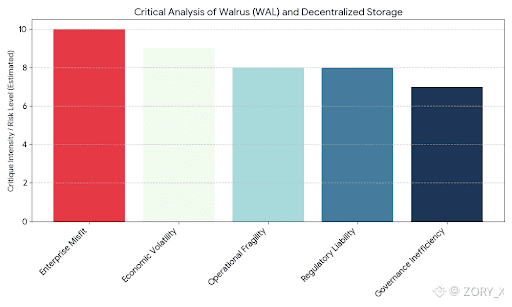
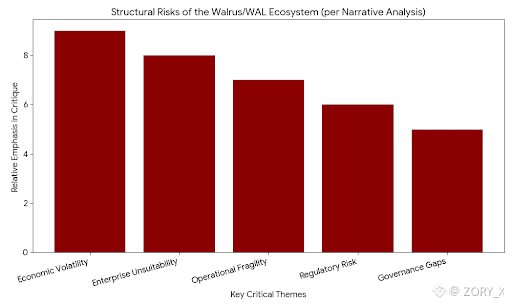
WAL is supposed to be the glue—paying node operators, enabling staking, powering governance, and acting as the unit of account inside the system—but I get nervous whenever a single asset is asked to be income, security deposit, voting right, and speculative chip all at once, because I’ve watched that setup collapse under its own contradictions more times than I can count.
It stretches.
Then it snaps.
Why does this even matter?
Because infrastructure hates volatility, and WAL is volatile by design.
Node operators are paid in a token whose price is driven less by storage demand and more by market mood, which means their real income can halve in a week while their electricity bills remain stubbornly fixed, forcing either higher rewards, degraded service, or quiet exits that only show up later as missing data and broken promises.
That is not a bug.
Privacy, meanwhile, is sold as a virtue, but from where I sit it reads more like a balance-sheet liability waiting for a headline, because systems that advertise private transactions and opaque storage flows eventually collide with regulators who do not enjoy being excluded and have a long track record of turning “censorship resistance” into fines, freezes, and forced shutdowns.
Ask any bank.
Governance is the usual theater—on-chain votes, proposals, forums buzzing with technical jargon—yet participation tends to be thin and outcomes predictable, dominated by early holders and insiders who have every incentive to protect token value rather than user experience, uptime, or legal survivability.
Democracy in name only.
The enterprise pitch makes me laugh quietly every time I hear it, because enterprises do not want tokens, forums, or probabilistic guarantees about data availability; they want contracts, liability, and someone they can call at 3 a.m. when systems fail, none of which fit comfortably inside a decentralized network of pseudonymous operators paid in an asset that can drop thirty percent before lunch.
Who are we kidding?
I’ve watched markets reward WAL-like tokens handsomely during optimistic cycles, when liquidity is abundant and belief substitutes for revenue, but those phases end, and when they do the question becomes brutally simple: who is paying real money, in stable currency, for long-term storage that must be maintained year after year regardless of token price.
Silence is an answer.
Walrus exists because frustration with centralized cloud giants is real, and the desire for alternatives is understandable, but desire does not cancel gravity, and gravity in finance looks like costs, margins, enforcement, and time—lots of time—during which systems must keep working even after the hype drains out.
That is the part nobody wants to model.
I’ve learned to trust one signal above all others.
When the story is louder than the cash flow, the floor is thinner than it looks.