As Web3 continues to evolve, one critical challenge remains at the center of innovation: data storage. From NFTs and gaming assets to DeFi records and AI-generated content, decentralized applications demand storage solutions that are not only secure, but also fast, scalable, and cost-efficient. This is where Walrus steps in—and why it’s gaining serious attention across the blockchain ecosystem.
Rethinking Decentralized Storage
Traditional decentralized storage systems often struggle with performance bottlenecks. While they prioritize decentralization and security, speed and efficiency are frequently sacrificed. Slow retrieval times, high redundancy costs, and complex data verification processes limit real-world usability—especially for applications that require near-instant access.
Walrus takes a different approach. Designed as a high-performance, programmable storage layer, Walrus focuses on delivering enterprise-grade speed without compromising decentralization. Instead of treating storage as a passive archive, Walrus positions data as an active, usable asset within Web3.
Built for Speed and Scale
One of Walrus’s strongest advantages is its ability to handle large-scale data efficiently. Through advanced data encoding, intelligent sharding, and parallel retrieval mechanisms, Walrus dramatically reduces latency compared to legacy decentralized storage solutions.
This makes Walrus ideal for:
On-chain gaming assets requiring real-time access
NFT metadata that must load instantly
DeFi and analytics platforms handling massive datasets
AI and machine learning models operating on decentralized infrastructure
High throughput and rapid data availability give developers the confidence to build performance-intensive dApps without falling back on centralized servers.
Cost Efficiency Without Compromise
Storage costs are a major pain point in Web3. Walrus addresses this by optimizing redundancy and minimizing unnecessary data replication. Instead of brute-force duplication, Walrus uses smart redundancy models that preserve data integrity while keeping costs predictable and affordable.
For developers and enterprises, this means:
Lower long-term storage expenses
Transparent pricing models
Sustainable scaling as user demand grows
Cost efficiency combined with performance makes Walrus a practical choice—not just an experimental one.
Security and Reliability at the Core
Speed means nothing without security. Walrus integrates cryptographic verification, fault tolerance, and decentralized node participation to ensure that stored data remains tamper-resistant and always accessible.
Even in the presence of node failures or network disruptions, Walrus maintains data availability. This resilience is critical for applications operating at scale, where downtime can result in real financial and reputational loss.
Developer-Friendly by Design
Adoption starts with developers—and Walrus understands that. With flexible APIs, programmable storage logic, and seamless integration into modern blockchain ecosystems, Walrus lowers the barrier to entry for teams building next-generation applications.
Rather than forcing developers to redesign their architecture, Walrus fits naturally into existing workflows—accelerating development cycles and reducing operational complexity.
The Bigger Picture
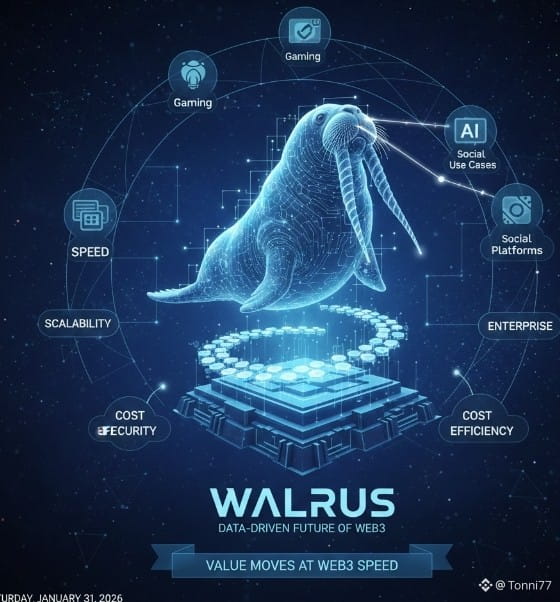
Walrus isn’t just another storage solution—it’s a foundational layer for the data-driven future of Web3. As blockchains move beyond simple transactions into gaming, AI, social platforms, and enterprise use cases, high-performance storage will be a defining factor of success.
By combining speed, scalability, security, and cost efficiency, Walrus sets a new benchmark for decentralized storage. In a world where data is value, Walrus ensures that value moves at Web3 speed.
High-performance storage isn’t optional anymore. With Walrus, it’s finally achievable.