
In payment systems, fees are more than a pricing mechanism. They define how responsibility is distributed once transactions stop being theoretical and start carrying real consequences. Who pays, when they pay, and under which conditions quietly determines where operational risk ends up when something goes wrong.
Users compete for block space. Fees fluctuate with demand. Cost becomes part of the game. That logic works when transactions are optional, reversible in practice, or offset by opportunity elsewhere. It breaks down when transactions become part of routine financial operations.
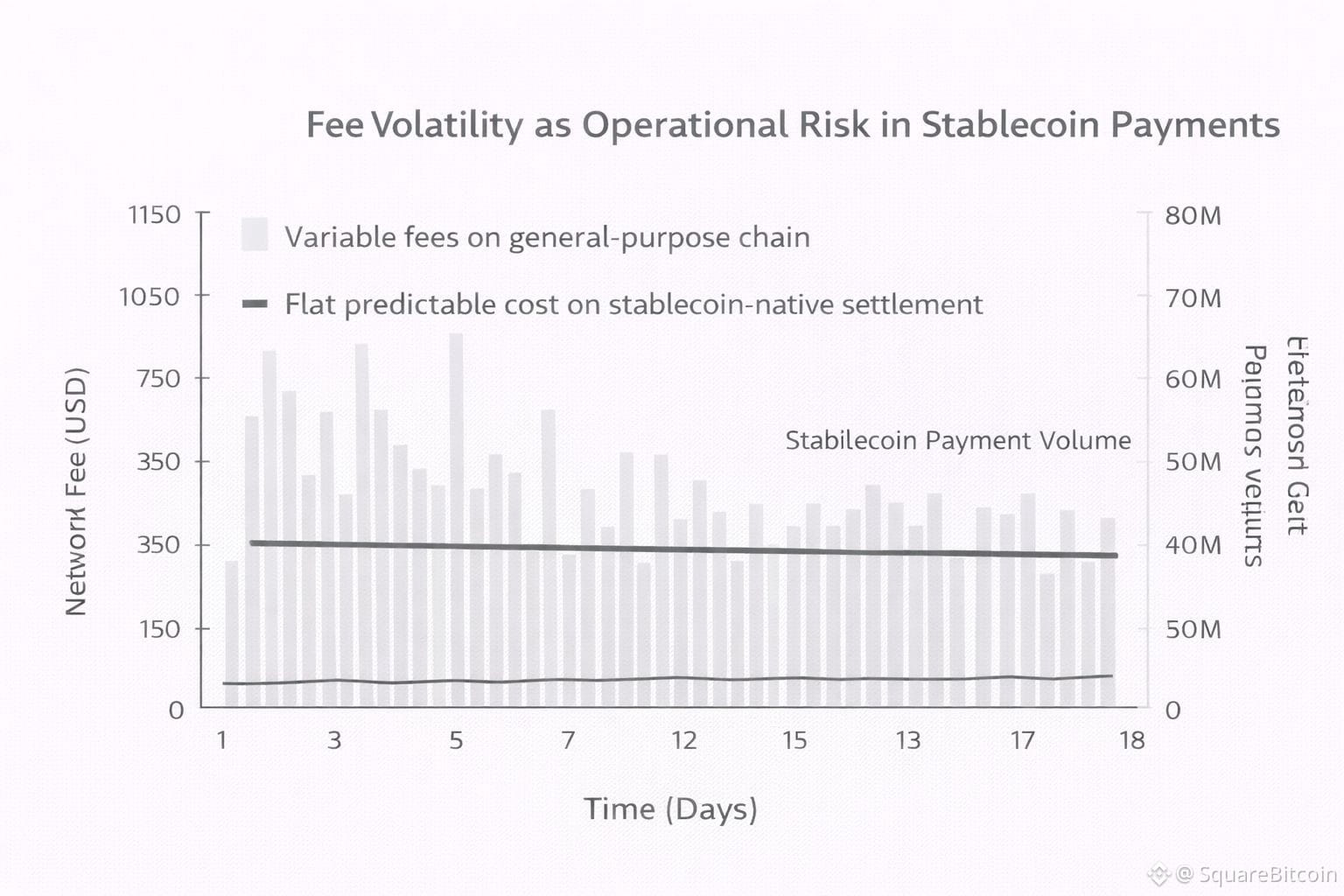
Stablecoin usage exposes that break very clearly. Payroll runs on schedules. Treasury movement depends on accounting certainty. Merchant settlement requires cost predictability. In those contexts, fee volatility is not an inconvenience. It is a source of operational friction that compounds over time.
Plasma responds to this reality by making a clean separation. Fees are removed from the user layer, but they are not removed from the system. The cost still exists. The question Plasma answers is where that cost should live.
Instead of asking users to manage gas exposure, Plasma treats fees as a settlement concern. Stablecoin transfers can be gasless at the interaction layer because the system assumes payment users should not need to reason about network conditions at all. Execution still consumes resources. Settlement still carries risk. Those factors are simply handled where they can be controlled more rigorously.
This distinction matters because many systems that advertise gasless payments rely on temporary measures. Relayers cover fees. Treasuries subsidize activity. At low volume, the illusion holds. At scale, it collapses. Either costs resurface at the user layer, or the system tightens access in ways that undermine the original promise.
Plasma avoids that trap by treating fee abstraction as structural, not promotional.
By relocating fees into the settlement layer, Plasma enforces discipline without exposing users to variability. Validators stake XPL, and that stake binds correct finality to economic consequences. If settlement rules are violated, validator capital absorbs the impact. Stablecoin balances and application state remain insulated.
This changes what fees represent. They no longer serve to prioritize users against each other. They act as a control surface for settlement correctness. The system remains constrained by real costs, but those costs are applied where enforcement is explicit rather than implicit.
This approach closely resembles how mature payment infrastructure operates outside crypto. End users are not asked to guarantee correctness. Merchants do not insure clearing failures personally. Risk is isolated within capitalized layers that exist precisely to absorb it. Plasma applies that logic on chain instead of spreading risk thinly across participants who are not equipped to manage it.
Once fees are removed from the interaction layer, other design choices follow naturally. Stablecoin first gas logic allows applications to present consistent pricing models. Customizable fee handling keeps payment flows stable under load. Predictability becomes something the system guarantees, not something developers hope for.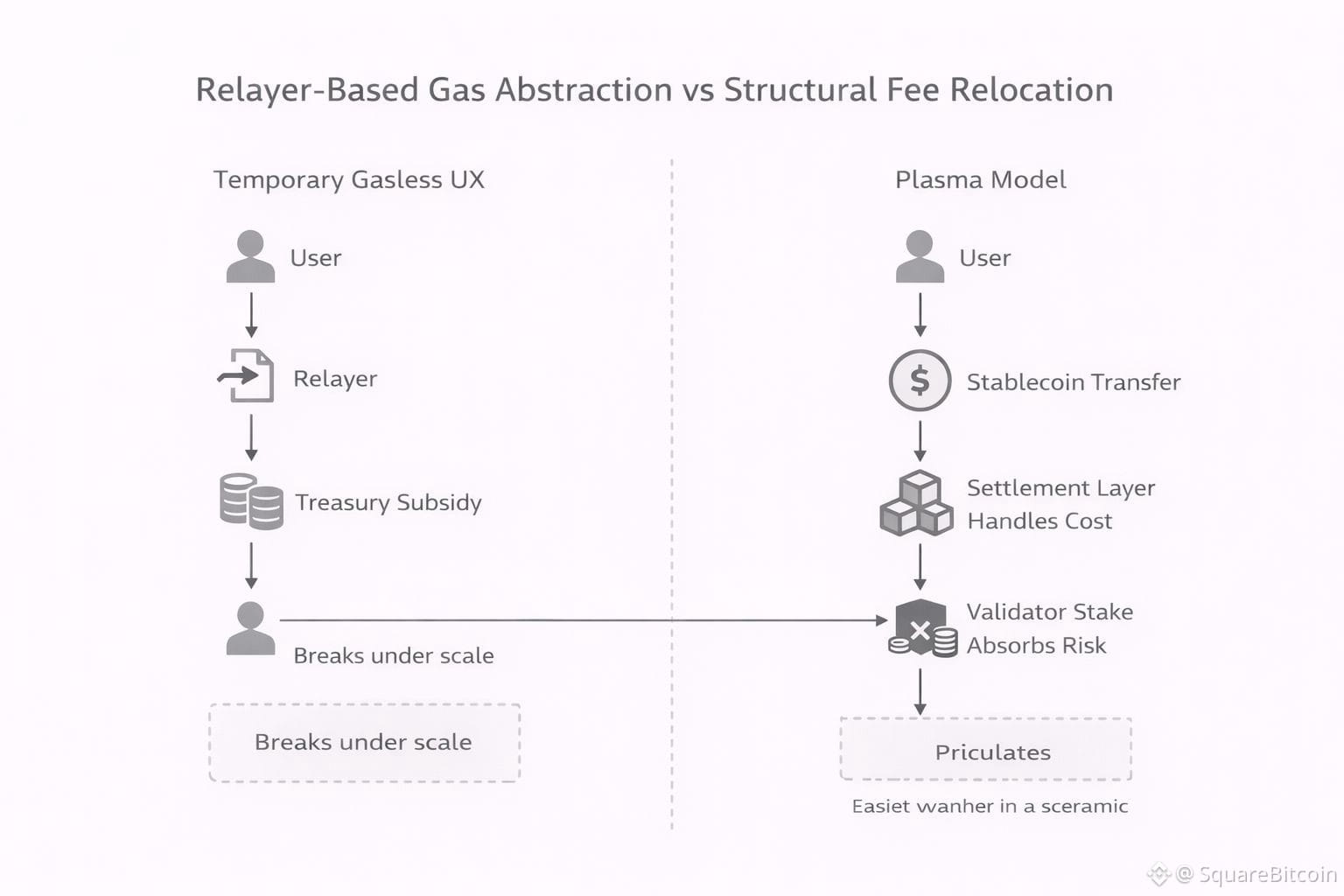
Full EVM compatibility fits into this picture as well. It is often framed as convenience, but its more important function is risk containment. Familiar execution environments reduce the chance of subtle errors. Mature tooling lowers the probability of unexpected behavior under stress. For systems that move large volumes of stable value, reliability matters more than novelty.
The same reasoning extends to Plasma’s approach to security anchoring. Anchoring settlement guarantees to Bitcoin is not presented as ideological alignment. It connects short term liquidity movement to long horizon security assumptions that are already widely understood. That separation strengthens settlement credibility without introducing new dependencies.
XPL’s role becomes clearer when viewed through this lens. It is not consumed by activity and does not scale with transaction count. Its function is to concentrate accountability. As stablecoin throughput increases, the cost of incorrect settlement rises, and the relevance of the asset securing finality increases with it. This is characteristic of risk capital rather than transactional currency.
Plasma does not attempt to eliminate fees. It places them deliberately. The system remains constrained by real economic limits, but those limits are enforced in a way that preserves clarity for payment flows.
This design does not assume adoption or guarantee outcomes. It reflects a system built around observed constraints in how stablecoins are actually used. Removing fees from the user layer without removing them from the system is not a shortcut. It is a signal that Plasma is being designed as settlement infrastructure, not as a surface optimized for appearances.

