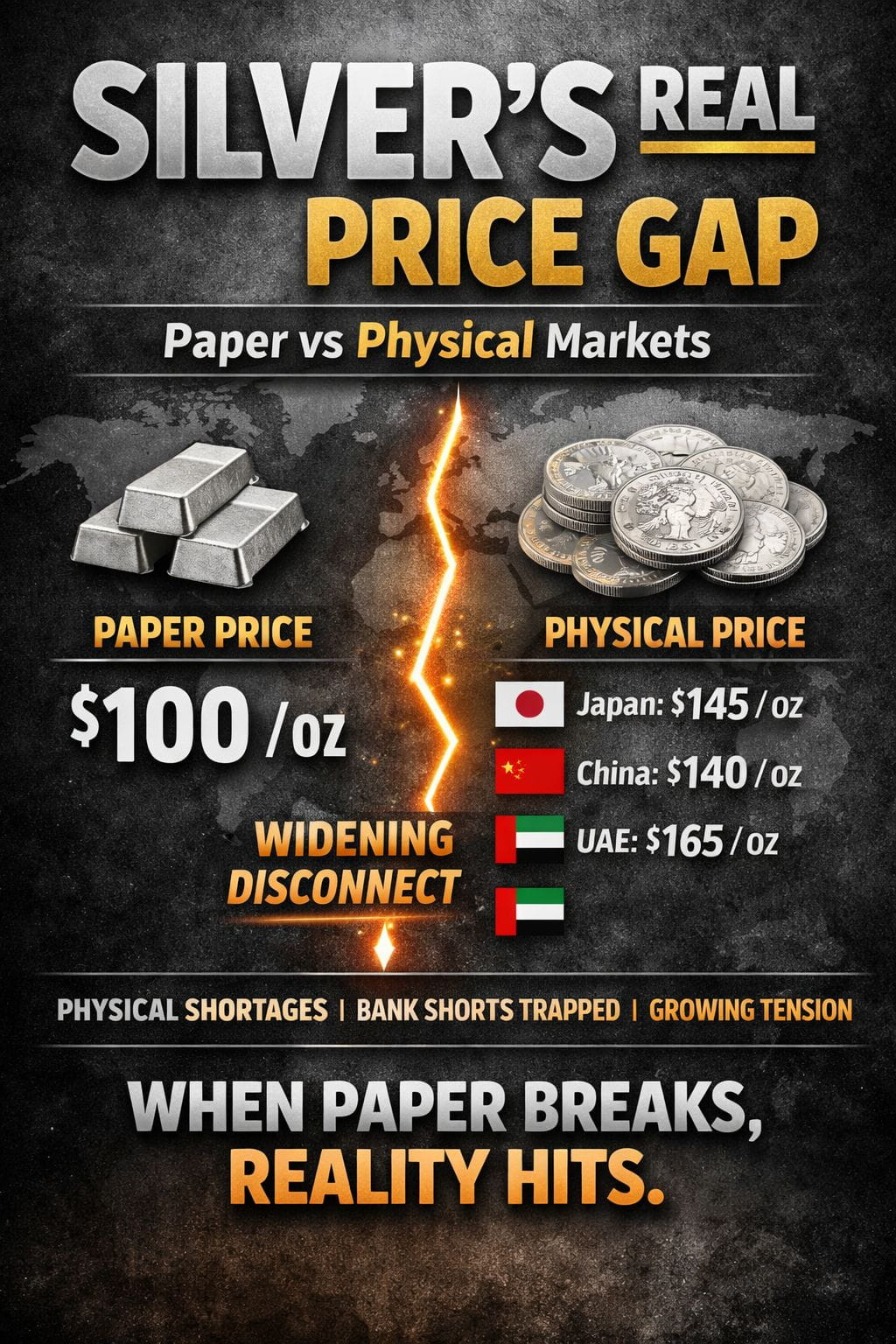
If you believe silver is trading at ~$100/oz, you’re not observing the full market.
You’re looking at a paper price, not where real supply and demand meet.
Step outside the screen, and a very different picture emerges:
🇺🇸 COMEX (paper): ~$100
🇯🇵 Japan (physical): ~$145
🇨🇳 China (physical): ~$140
🇦🇪 UAE (physical): ~$165
This isn’t a minor discrepancy.
It’s a structural disconnect — and it shouldn’t exist in a healthy market.
Under normal conditions, arbitrage would close spreads like this quickly.
The fact that it hasn’t tells us something important: the paper market is under constraint.
Why?
Because large financial institutions are heavily short silver through derivatives.
If prices converge toward where physical metal actually clears — say $130–$150 — those losses stop being theoretical. They become balance-sheet events.
At that stage, it’s no longer about positioning or speculation.
It’s about risk containment and survival.
What we’re seeing now resembles a quiet divergence:
Physical silver is steadily moving out of vaults
Paper contracts continue to expand
Real value is being absorbed
Claims on that value are multiplying
That dynamic can persist — until inventories tighten enough to stress delivery.
When that happens, paper pricing loses authority.
This isn’t a call for immediate fireworks.
It’s an observation of building pressure.
Silver isn’t stable.
It’s compressed.
And when compression releases, it rarely does so in an orderly way.
Most participants won’t notice — because they’re focused on the quoted price, not the clearing price.