

Hello Square Family #MavisEvan here
I’ve spent a lot of time reading and thinking about Walrus Protocol, and the more I look at it, the more it feels different from most projects in this space. It doesn’t try to impress you immediately. There’s no loud narrative or aggressive marketing. Instead, it reveals itself slowly, through design choices that make sense once you understand what problem it’s actually trying to solve.
The timing of Walrus matters. We are entering a period where data, AI, and digital ownership are becoming inseparable. At the same time, trust in centralized infrastructure keeps eroding. Data leaks, sudden policy changes, censorship, and platform shutdowns are no longer rare events. Centralized cloud storage was never built for this level of responsibility. Walrus feels like a response to that reality, not a rebellion, but a rebuild.
What stood out to me early on is that Walrus treats storage as a first-class layer, not an add-on. Data isn’t just dumped somewhere and forgotten. It’s verifiable, programmable, and designed to exist independently of any single application or company. That alone puts it in a different category from many “decentralized storage” projects that still rely heavily on assumptions inherited from Web2.
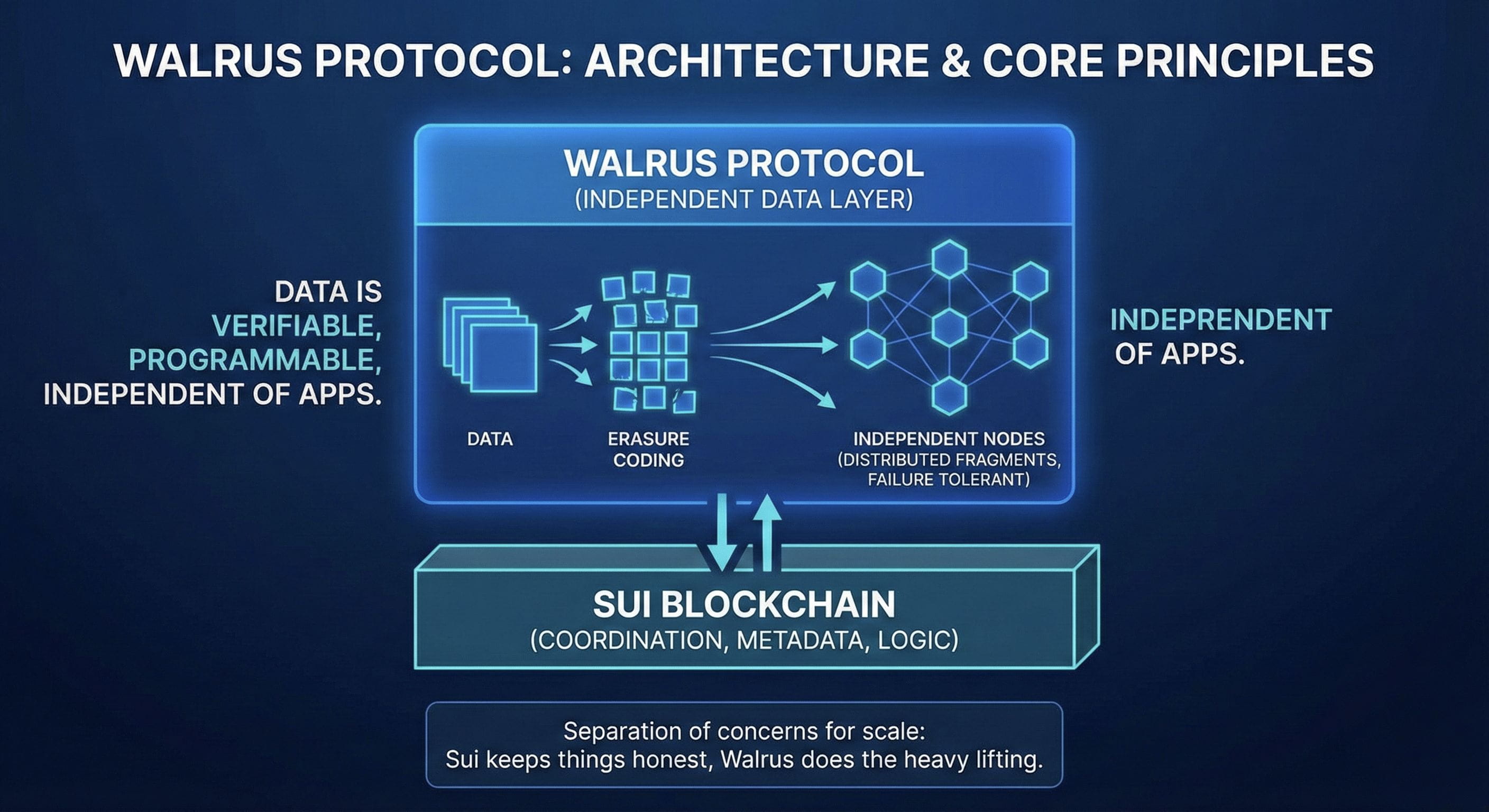
On a technical level, Walrus takes a very deliberate approach to reliability. Instead of endlessly replicating full files, it breaks data into fragments using erasure coding and distributes them across many independent nodes. This means the system can tolerate failures without losing data, while staying efficient on cost and bandwidth. To me, this feels like real engineering, not a shortcut.
Its relationship with Sui is another important piece. Sui handles coordination, metadata, and logic, while Walrus handles the actual data. The blockchain keeps things honest and synchronized, and the storage network does the heavy lifting. That separation of concerns feels intentional and modern. It’s how systems designed for scale usually look.
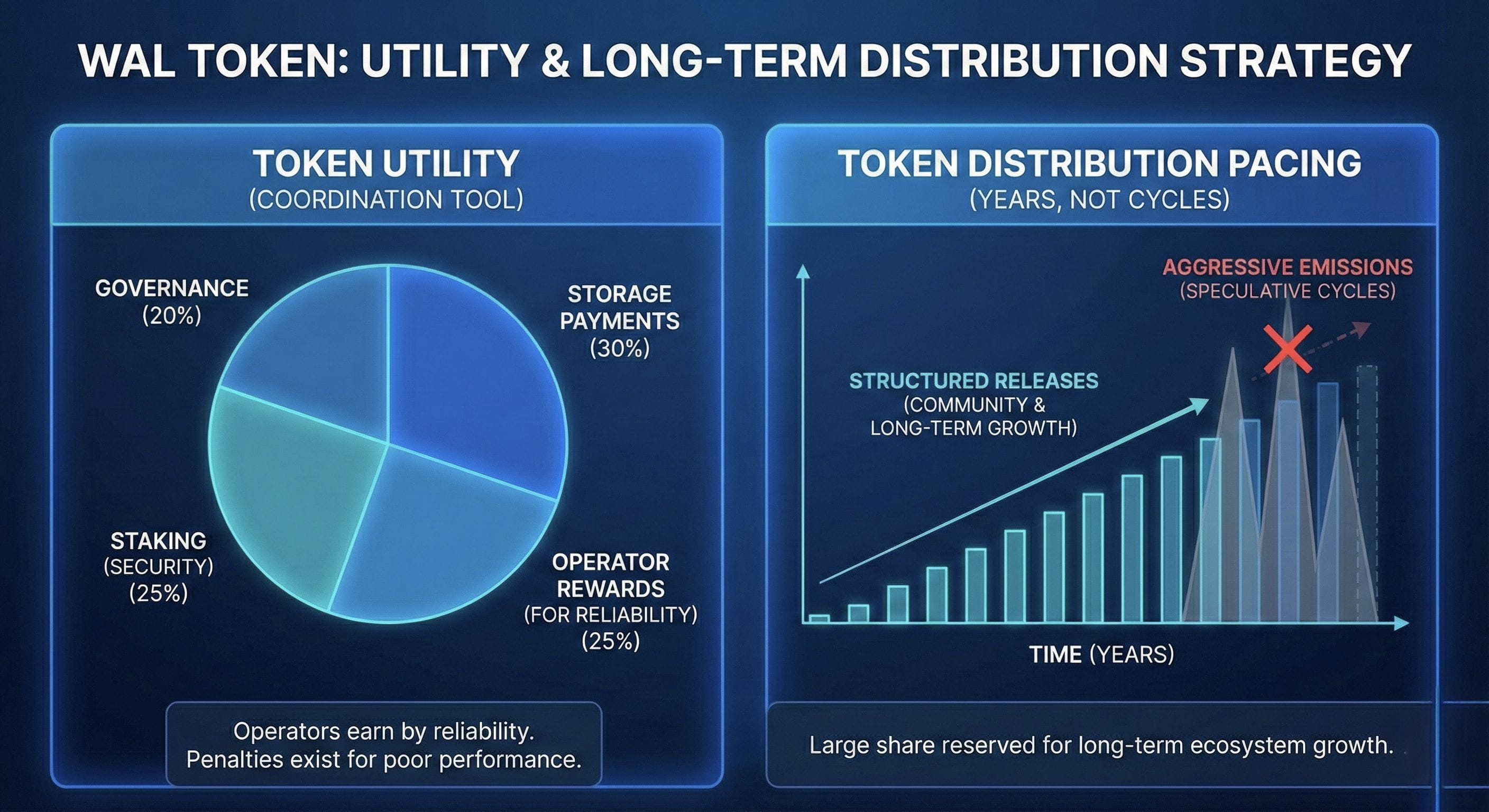
The WAL token also makes more sense the deeper you go. It’s not positioned as a speculative instrument first. It’s a coordination tool. WAL is used to pay for storage, reward operators, secure the network through staking, and participate in governance. Operators earn by being reliable, not by chasing short-term rewards, and penalties exist for poor performance. Everyone involved carries responsibility, not just upside.
Token distribution reinforces that mindset. A large share is reserved for the community and long-term ecosystem growth, with structured releases rather than aggressive emissions. That kind of pacing suggests a project thinking in years, not cycles.
What really changed my perception was seeing real usage. Walrus isn’t stuck in theory. It’s already being used by infrastructure providers, identity systems, and data-heavy applications. That’s usually where the difference between ideas and systems becomes obvious. Real data on a live network has a way of exposing weak designs quickly.
The team background also matters. Walrus was developed by Mysten Labs, the same group behind Sui, and later transitioned to the Walrus Foundation. Teams with deep experience in distributed systems tend to prioritize reliability and correctness over hype, and that influence shows throughout the project.
None of this means Walrus is guaranteed to succeed. Competition is strong, adoption takes time, and execution always matters. But the challenges ahead look like execution problems, not foundational ones.
In the end, Walrus doesn’t feel like a project trying to win attention. It feels like infrastructure being quietly put in place for a future where data matters more, not less. As AI grows, as applications become more autonomous, and as users demand real ownership, programmable and decentralized storage stops being optional.
From everything I’ve read and researched, Walrus is building for that future in a calm, disciplined way. And in this space, that kind of approach is often underestimated until it’s already essential.

