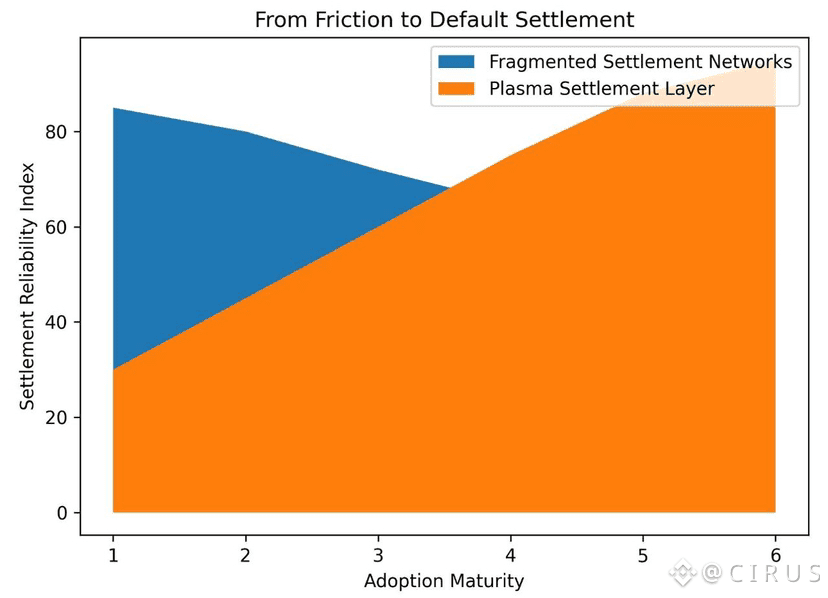
There is a point in every financial transition where the question quietly changes. It is no longer “does this work?” or “is this allowed?” The question becomes “where does this naturally belong?” Stablecoins have crossed that threshold. They are no longer testing whether they fit into global finance. They are actively reshaping it. And once money reaches that stage, it stops adapting to infrastructure. Infrastructure has to adapt to money.
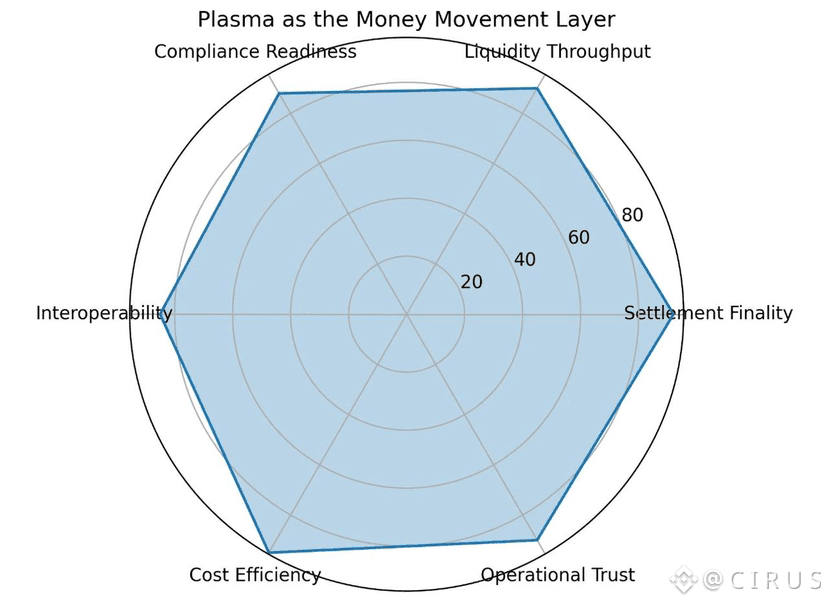
This is the moment Plasma is stepping into.
For years, stablecoins were treated as instruments. Useful, efficient, but still contained within crypto-native loops. They moved between exchanges, settled trades faster, reduced volatility exposure, and made arbitrage easier. But scale changes meaning. When stablecoin volumes begin to rival national payment systems, when wallets holding dollar-pegged assets number in the hundreds of millions, and when transaction counts pass the billion mark in a single month, the system is no longer experimental. It is operational.
Money at that scale does not tolerate friction.
It does not tolerate delays that introduce uncertainty. It does not tolerate fees that distort behavior. And it does not tolerate infrastructure that treats compliance and settlement as afterthoughts. Money flows toward environments where movement feels natural, predictable, and final. That is not ideology. It is behavior.
Plasma is not trying to convince stablecoins to move there. It is building the conditions under which stablecoins have nowhere else to go.
What makes this shift easy to miss is that it does not look like growth in the usual crypto sense. Plasma is not competing for attention by adding novelty or complexity. It is aligning itself with how money actually behaves once it becomes systemic. Systemic money does not want to be routed, bridged, wrapped, or interpreted. It wants to settle.
Settlement is not just the act of moving funds. It is the removal of doubt. When value settles instantly, without cost, and with cryptographic finality, the space where risk lives collapses. That collapse is transformative. It changes how businesses operate, how liquidity is managed, and how trust is constructed.
On Plasma, stablecoin transfers do not feel like events. They feel like state. When USDT moves with sub-second finality and no transfer fee, the significance is not speed. It is the disappearance of friction as a concept. There is no waiting period to manage. No cost to optimize around. No intermediary to reconcile. The transaction does not ask permission to exist. It simply becomes true.
This matters because global finance is not built on single transactions. It is built on chains of responsibility. A payment processor connects to an issuer. An issuer connects to a bank. A bank connects to regulators. A settlement network must support all of these relationships simultaneously, without breaking continuity. Traditional finance solved this through institutions layered on institutions. Digital finance solves it through infrastructure.
Plasma is deliberately positioning itself at that convergence point.
The regulatory steps Plasma is taking are not cosmetic. Acquiring a VASP-licensed entity, expanding in the Netherlands, building compliance leadership, preparing for MiCA authorization, and integrating EMI capabilities are not signs of a chain trying to appear legitimate. They are signs of a network preparing to host real financial flows without abstraction. When fiat on-ramps and off-ramps become native rather than external, the chain stops being a destination and becomes a corridor.
This is where Plasma diverges from most blockchains.
Many chains optimize for activity and hope institutions will adapt later. Plasma optimizes for settlement correctness and lets activity follow naturally. That is why payments companies, custody providers, and liquidity operators are paying attention. These actors do not care about narratives. They care about whether a system reduces operational complexity. Every extra hop in a payment flow is risk. Every reconciliation step is cost. Every compliance gap is liability.
Plasma removes those gaps by design.
What is emerging is not a new payments network in the traditional sense. It is a settlement substrate where stablecoins function as operating capital rather than financial products. When Visa expands stablecoin rails across multiple chains, when Mastercard moves deeper into crypto infrastructure through acquisitions, when banks issue domestic stablecoins backed by sovereign instruments, the question is no longer whether stablecoins will be used. The question is where they will settle reliably at scale.
Money reorganizes around certainty.
That certainty is not just technical. It is legal, operational, and psychological. Businesses need to know that funds can move without interruption. Users need to know that value will arrive when expected. Regulators need to know that flows are traceable and compliant without being obstructive. Plasma is building an environment where these requirements are not in conflict.
This is why Plasma feels less like a competitor to other chains and more like an underlying layer. It is not trying to host every application. It is trying to ensure that whatever application moves money can do so without friction. The difference is subtle but decisive. Core infrastructure does not advertise itself. It becomes unavoidable.
There is also a deeper shift happening beneath the surface. For decades, financial systems relied on trust in institutions because settlement was slow and opaque. Digital settlement changes that balance. When finality is instant and verifiable, trust migrates from institutions to systems. But for that migration to complete, the system must be stable enough to carry responsibility. Plasma is designing for responsibility, not experimentation.
I think this is why Plasma’s rise does not feel dramatic. It feels inevitable. Infrastructure that aligns with money’s natural behavior does not need hype. It becomes the path of least resistance. And money always follows the path of least resistance.
Stablecoins have already won the legitimacy debate. The volumes, the adoption, and the institutional involvement have settled that question. What remains undecided is which network becomes the settlement layer for this migration. Not the loudest network. Not the most complex. The one that disappears into normalcy.
Plasma is not trying to be noticed. It is trying to be necessary.
And in financial systems, necessity is the highest form of success.