

@Walrus 🦭/acc There’s a point in every infrastructure system’s life where attention stops being helpful. Early on, visibility brings contributors, incentives, and rapid iteration. Later, it becomes noise. What matters then is whether the system can keep doing its job without applause. That’s the phase where Walrus is starting to feel unusually relevant not because it announced something dramatic, but because it continues to function in a way that suggests it was never built to rely on excitement in the first place.

Decentralized storage has historically struggled with this transition. In the beginning, participation is high and redundancy feels abundant. Data is written aggressively, often with little thought about how long it needs to remain available. Over time, that imbalance becomes visible. Old data doesn’t disappear, but the motivation to maintain it weakens. Operators leave quietly. Incentives flatten. The system doesn’t break outright; it becomes fragile in ways that are hard to measure until something goes wrong. Most protocols discover this too late, because they designed for visibility rather than longevity.
Walrus approaches storage from a calmer, more deliberate angle. It doesn’t assume persistence is automatic just because data is decentralized. Instead, it treats availability as something that must be continuously supported. Data is stored as blobs, fragmented through erasure coding, and distributed across a decentralized network so no single participant carries full responsibility. Only a subset of fragments is required for reconstruction, which allows the system to tolerate ordinary churn without collapsing. This isn’t about eliminating failure. It’s about designing so failure doesn’t cascade.
What’s subtle is how this architecture shapes behavior over time. When storage is framed as cheap and abundant, users behave optimistically and operators behave opportunistically. Walrus introduces friction in the right places. Writing data is not just an action; it’s a decision with ongoing consequences. Keeping data available is not assumed; it’s paid for. Storage and write payments are aligned with duration rather than novelty, rewarding operators who remain reliable long after the initial excitement fades. That economic gravity discourages the “show up early, leave later” pattern that quietly undermines many decentralized systems.
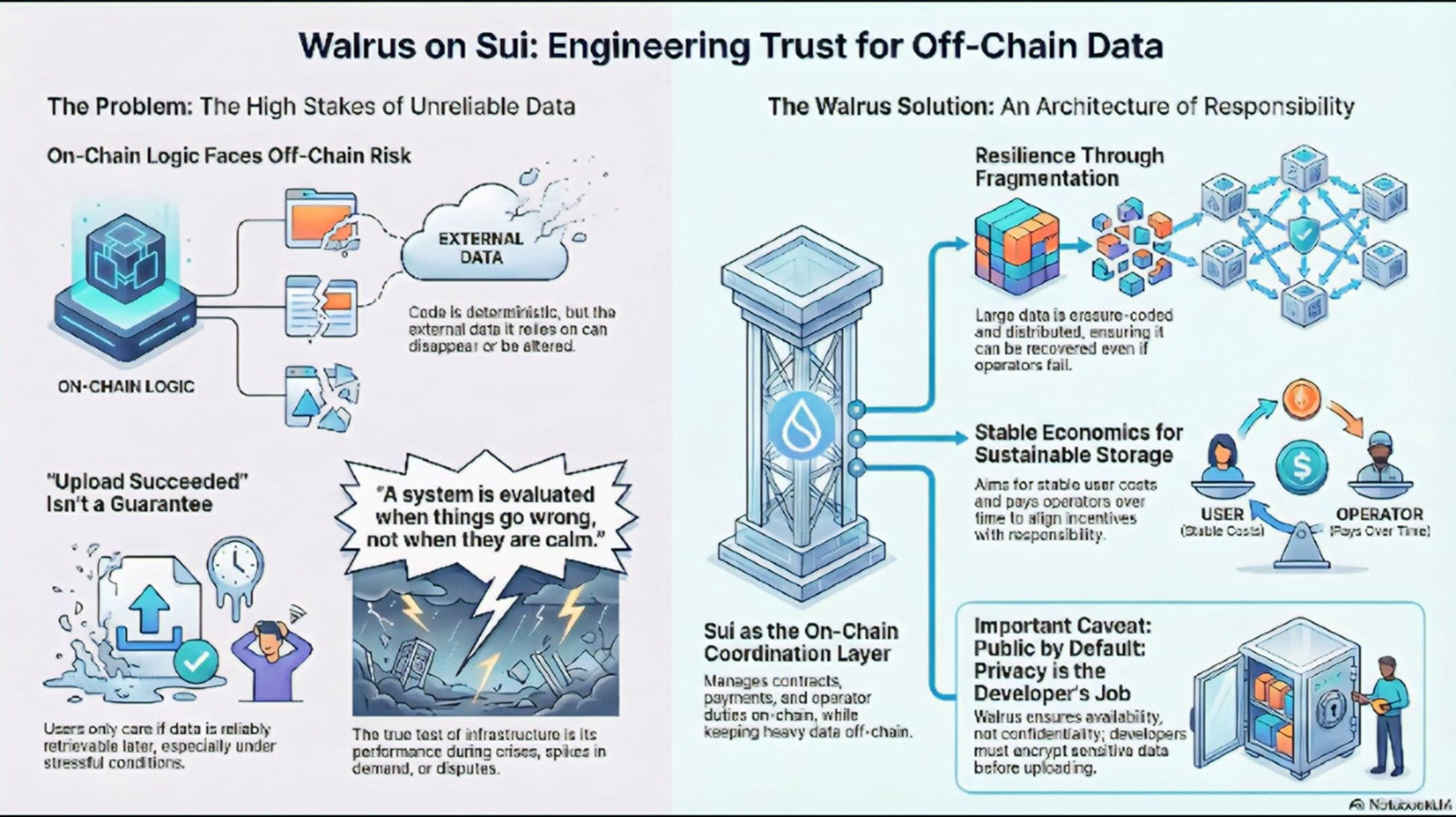
The $WAL token supports this long view without becoming the center of attention. It coordinates staking, governance, and alignment, but it doesn’t turn storage into a speculative event. Governance here is less about sweeping change and more about maintenance adjusting parameters, preserving balance, and making sure incentives continue to reflect reality. This kind of governance rarely attracts attention, but it’s exactly what infrastructure needs once it becomes operational rather than experimental.
From experience, this phase is where many Web3 projects struggle most. Growth slows. Dashboards flatten. The question shifts from “what’s next?” to “does this still make sense?” Walrus feels built for that question. It doesn’t rely on constant narrative renewal to justify its existence. Its value is quiet and cumulative, expressed through consistency rather than milestones.
There are still risks. Long-term participation must hold through market cycles. Governance must remain active without drifting toward concentration or apathy. Storage costs must remain understandable as usage grows and data ages. Designing for maturity doesn’t remove uncertainty; it simply acknowledges that uncertainty is permanent. Walrus doesn’t promise perfection. It promises structure.
What makes Walrus feel different isn’t that it claims to have solved decentralized storage forever. It’s that it seems comfortable operating in the unremarkable middle after hype, before legacy. That’s where infrastructure either becomes dependable or disappears. In an ecosystem still learning how to build things that last longer than attention spans, Walrus feels like a study in quiet competence.
If Walrus succeeds, it won’t be because it dominated a cycle or captured a moment. It will be because it stayed coherent when moments stopped arriving. And in decentralized systems, that kind of endurance is often the most meaningful signal of all.

