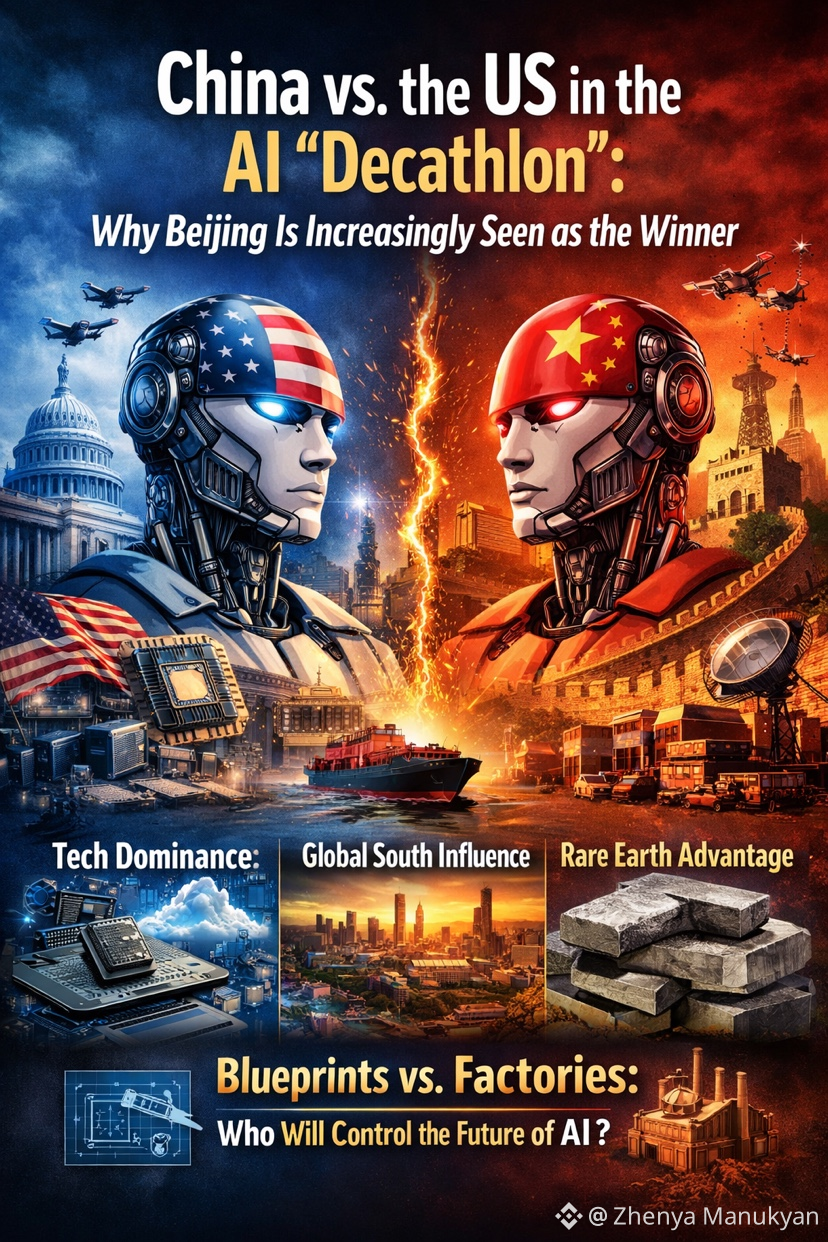
The global AI rivalry between the United States and China is often framed as a race. But that metaphor may be misleading. According to analysts, what’s unfolding looks less like a sprint—and more like a decathlon.
This week, Microsoft president Brad Smith joined Nvidia CEO Jensen Huang and Elon Musk in publicly warning that the US may be losing ground to China in the AI race. Not in cutting-edge models, but where it increasingly matters: real-world adoption beyond the West.
Not One Race, but Many
American companies still dominate advanced semiconductors, cloud infrastructure, AI platforms, and talent attraction. China, however, is pulling ahead in areas that translate faster into economic and geopolitical influence—industrial robotics, deployment of AI hardware, quantum communications, and battery technologies.
Crucially, China is winning hearts and servers across the Global South.
The Power of Cheap, Open AI
Chinese firms, backed by state subsidies, are exporting low-cost open-source AI models that are highly attractive to developing economies. Models like DeepSeek R1 may not be the most advanced—but they are accessible, affordable, and deployable at scale.
For over 140 countries, China is already a larger trading partner than the US. Through infrastructure, trade, and investment, Beijing is nudging these countries toward Chinese tech standards—AI included.
Hardware: America’s Edge—and China’s Leverage
The US still holds a major advantage in computing power. Nearly half of the world’s data center capacity is American, compared to roughly a quarter in China. Nvidia’s most advanced chips remain unmatched, and Chinese alternatives like Huawei’s Ascend still lag in performance and production scale.
But there’s a catch: rare earths.
China dominates the supply chain—controlling the vast majority of rare-earth mining, processing, and magnet production. The AI hardware of the future depends on materials Beijing already owns.
Trump’s Gamble
In December, the Trump administration reversed course and lifted some restrictions on exporting Nvidia’s H200 chips to China. The logic: better to keep China dependent on American hardware than to push it into full technological self-sufficiency.
Chinese tech giants like Alibaba and ByteDance are reportedly lining up massive orders—millions of chips worth tens of billions of dollars.
Supporters say this preserves US leadership. Critics warn it may accelerate China’s ability to close the compute gap.
The Real Risk
The core question isn’t who has the best models today—but who controls the ecosystem tomorrow.
As one analyst put it:
The US may own the blueprints and the code, while China owns the factories, the hardware, and the physical infrastructure.
If that happens, the balance of economic and geopolitical power could shift far beyond artificial intelligence.
The AI race isn’t being won in a lab.It’s being won in supply chains, emerging markets, and the real world.
#AI #ArtificialInteligence #ChinaVsUS #Ai_sector #OpenAI