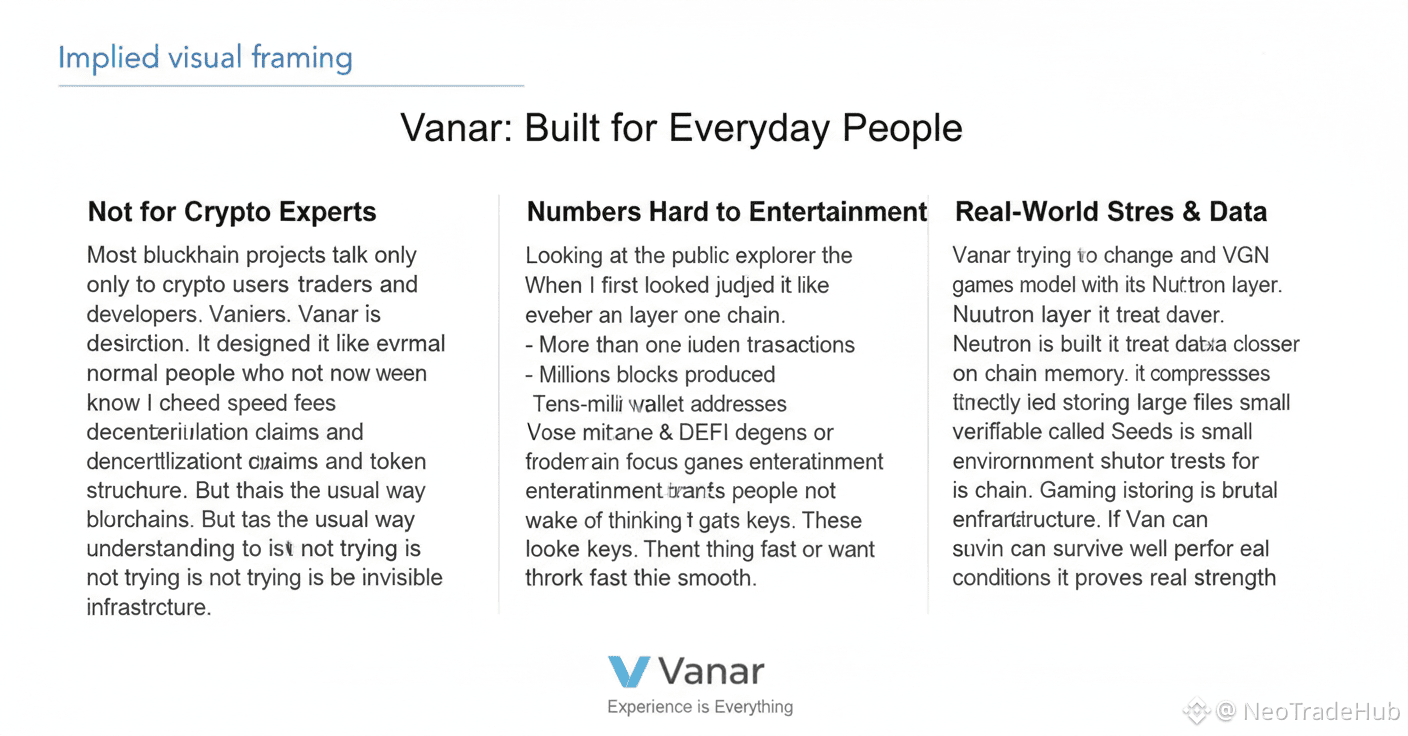
Vanar: Built for Everyday People, Not Crypto Experts
Most blockchains are built for traders, developers, and crypto natives.
Vanar is taking a different path.
It’s designed for normal users — people who don’t know what Web3 is and don’t care to learn. They just want apps that work.
At first glance, Vanar looks like any other Layer-1. You check speed, fees, decentralization, tokenomics — the usual checklist. But spend time with it and you realize Vanar isn’t trying to win the “fastest chain” race.
It’s aiming to be invisible infrastructure.
The on-chain data is hard to ignore:
100M+ transactions processed
Millions of blocks produced
Tens of millions of wallets created
Numbers alone don’t prove everything — wallets can be auto-generated, transactions can be small. But patterns matter. This network looks like it’s handling massive volumes of small, everyday actions, not just whales moving capital around.
That aligns perfectly with Vanar’s real audience:
games, entertainment, brands, and mainstream users.
These users don’t think about gas fees, private keys, or consensus models. If an app feels slow or confusing, they don’t research — they leave. For them, user experience is everything.
Mass adoption starts by removing friction.
Technology and ideology come second.
Where Vanar gets truly interesting is data.
Most blockchains are just record keepers — balances, ownership, transaction history. Anything heavy like images or files is pushed off-chain. Vanar challenges this with its Neutron layer.
Neutron treats data more like on-chain memory. Instead of storing large files directly, it compresses them into small, verifiable units called Seeds. This isn’t just a technical trick — it shows a clear product mindset.
Real consumer apps need more than token balances.
They need memory, context, and continuity.
In games and digital worlds, an item isn’t just an object — it carries history, status, achievements, and identity. In Web2, that data lives inside company databases. In most Web3 systems, it gets fragmented when users move between apps.
Vanar is betting on connected digital experiences — where data is portable, provable, and reusable across platforms. If this works, digital life becomes continuous instead of broken into silos.
That’s why Virtua Metaverse and the VGN games network matter so much. These aren’t cosmetic partnerships — they’re real stress tests.
Gaming is brutal infrastructure-wise:
Sudden traffic spikes
Bots from day one
Unpredictable user behavior
If fees rise or transactions slow, users disappear instantly. Gamers don’t care about excuses. If Vanar can perform here, it proves real strength — far beyond simple financial transfers.
The VANRY token follows the same practical philosophy.
It’s used for transactions, staking, validator rewards, and governance — nothing flashy or over-engineered.
Interoperability is handled realistically too. VANRY exists as an ERC-20 on Ethereum, allowing easy movement between Ethereum liquidity and the Vanar ecosystem. Users aren’t forced to choose — Vanar meets them where they already are.
Even staking reflects this consumer-first mindset:
simple delegation, predictable rewards, no slashing.
To crypto veterans it may look basic. To newcomers, it removes fear — and mainstream adoption only happens when people feel safe, not impressed.
This doesn’t mean Vanar should be trusted blindly. Big visions need long-term proof. The Neutron layer must scale in real conditions, and large wallet counts must turn into active communities. Consumer chains live or die by retention and reliability, not marketing.
Still, the direction is clear.
Vanar understands a hard truth:
most people will never want to use a blockchain directly.
They just want to play games, watch content, collect items, and enjoy digital experiences. For blockchain to reach billions, it must fade into the background — just like the internet today.
That’s the path Vanar is on.
Not a chain for crypto insiders.
Infrastructure for everyday digital life.
If Vanar succeeds, users won’t talk about the chain or the token. They’ll just enjoy their apps — never realizing a blockchain is quietly doing the work behind the scenes.
And that invisible success is the real goal.